The Technology Most People Use Without Understanding
Millions of people have heard the word “blockchain.”
They see it mentioned in Bitcoin discussions, cryptocurrency headlines, investment articles, and technology conferences.
Yet if you ask most people what blockchain actually is, the answer often becomes surprisingly vague.
Some think blockchain and Bitcoin are the same thing.
Others assume it’s just another complicated technology trend that only programmers understand.
The reality is very different.
Blockchain is one of the most important digital innovations of the past two decades. Its influence extends far beyond cryptocurrency and could affect how money moves, how ownership is verified, how contracts are enforced, and how information is stored across the internet.
Understanding blockchain doesn’t require a computer science degree.
Once you grasp the core idea, everything starts making sense.
And that idea is surprisingly simple.
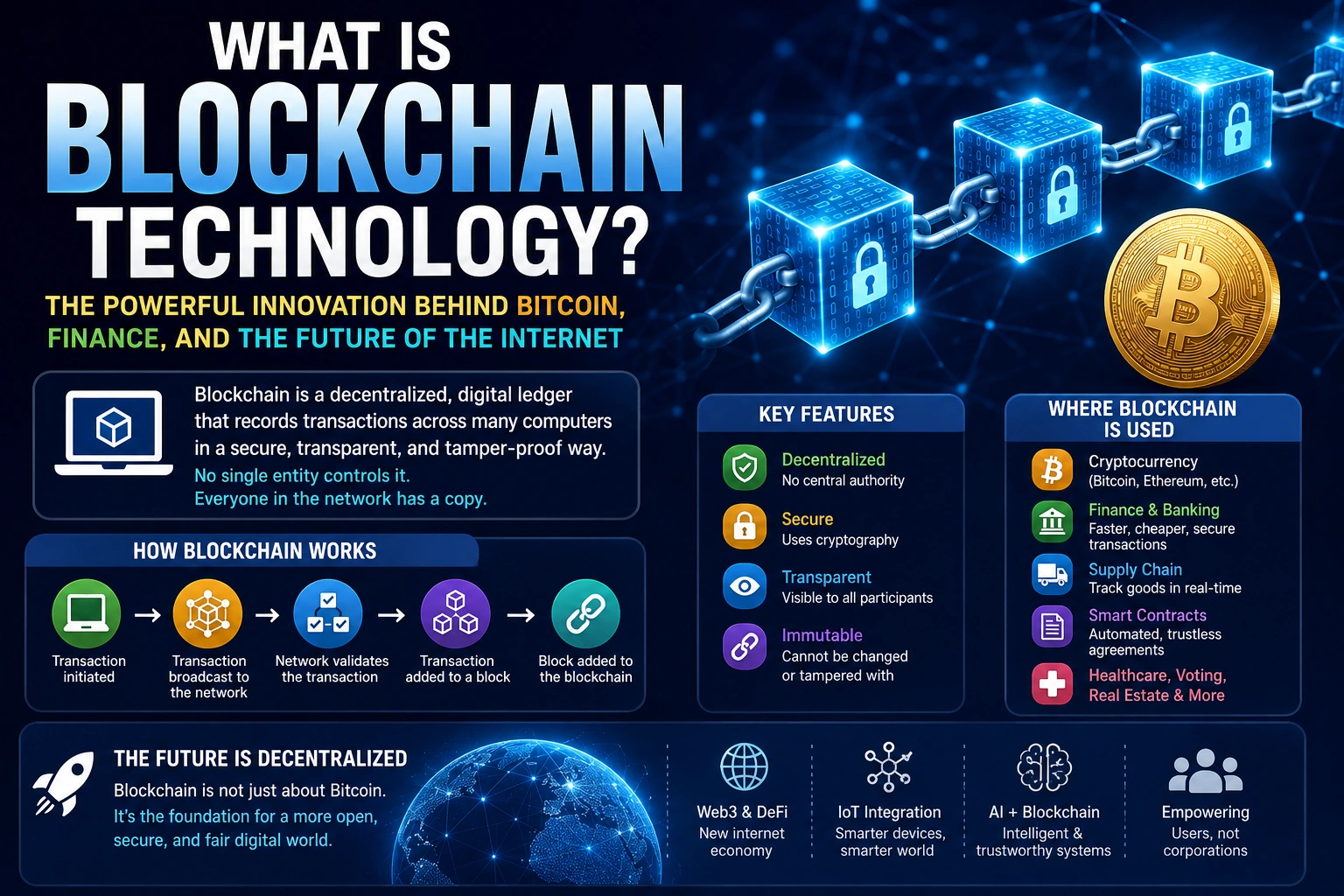
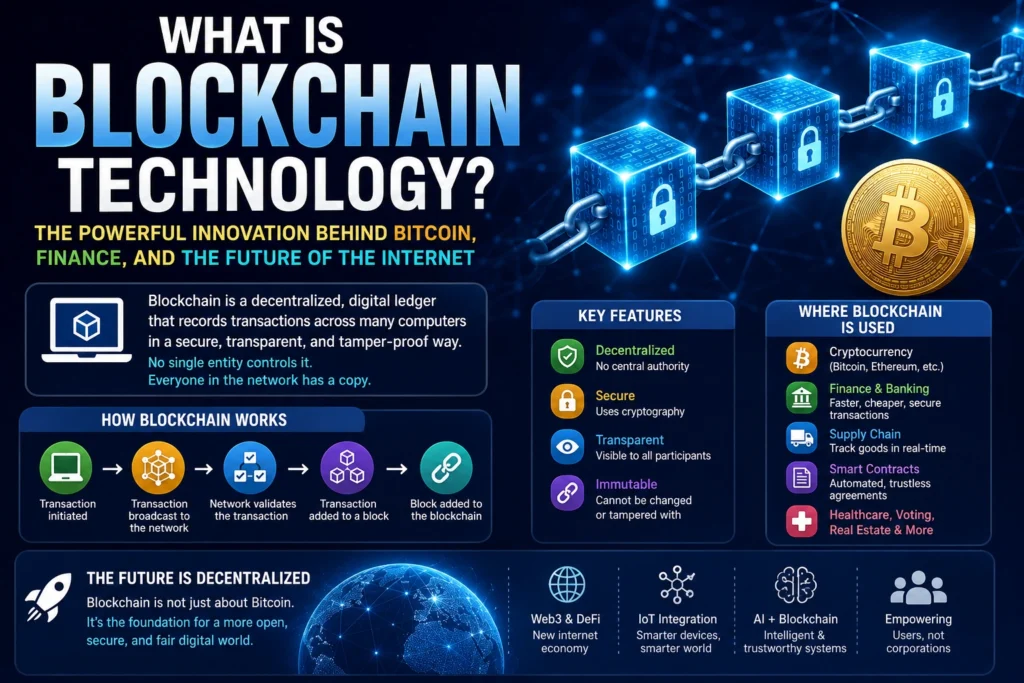
What Is Blockchain Technology?
Blockchain technology is a decentralized digital ledger that records transactions and information across a network of computers.
Instead of storing data in one central location controlled by a single organization, blockchain distributes copies of the same record across many computers worldwide.
Every new transaction becomes part of a permanent digital record.
Once recorded and verified, that information becomes extremely difficult to alter or delete.
Simple Definition
Blockchain is a secure digital record-keeping system that stores information in connected blocks of data across a decentralized network.
Because multiple participants maintain the records, no single person, company, or government controls the entire system.
This is why blockchain is often described as a trust machine.
It allows people who do not know each other to exchange value and information without relying entirely on a central authority.
Blockchain Explained Simply
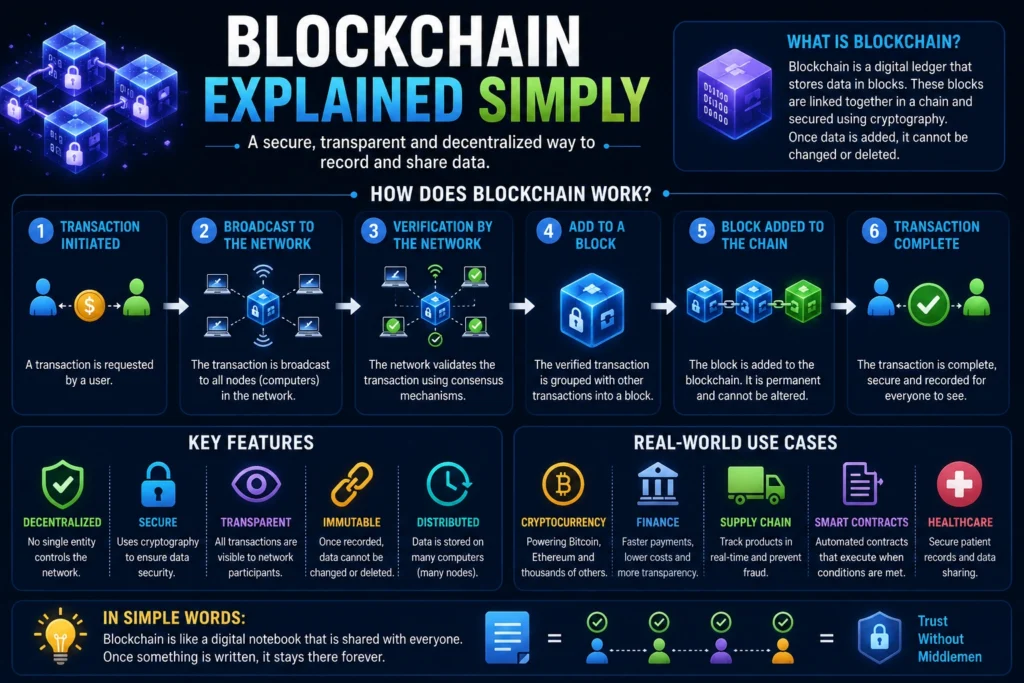
Blockchain Explained Simply
Imagine a shared Google Sheet that thousands of people can see.
Every time someone adds a new entry:
- Everyone sees the update
- The change is recorded permanently
- Previous entries remain visible
- No single user can secretly manipulate the records
Now imagine that sheet is protected by advanced cryptography and distributed across thousands of computers worldwide.
That simplified example captures the basic concept behind blockchain.
Instead of trusting one organization to maintain records, trust is distributed across the entire network.
This creates transparency, accountability, and security on a scale that traditional systems often struggle to achieve.
Why Blockchain Was Created
To understand blockchain’s importance, it helps to look at the problem it was designed to solve.
For decades, digital transactions relied on intermediaries.
Banks verify payments.
Governments maintain property records.
Companies store customer information.
Payment processors handle online transactions.
These systems generally work well, but they create several challenges:
- Central points of failure
- High operational costs
- Slow international transactions
- Data manipulation risks
- Dependence on trusted third parties
The global financial crisis of 2008 intensified concerns about centralized systems.
Trust in major institutions declined dramatically.
Around that same period, a mysterious creator known as Satoshi Nakamoto introduced Bitcoin, the world’s first successful blockchain-based cryptocurrency.
The underlying technology that powered Bitcoin was blockchain.
While Bitcoin gained most of the attention, blockchain itself became the bigger innovation.
How Blockchain Works
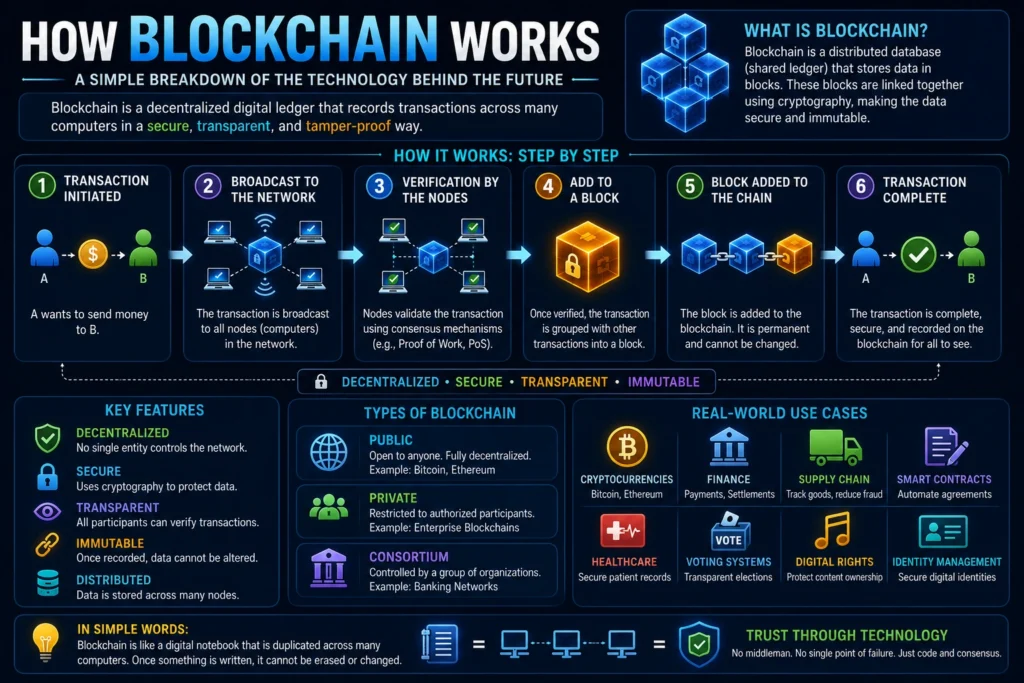
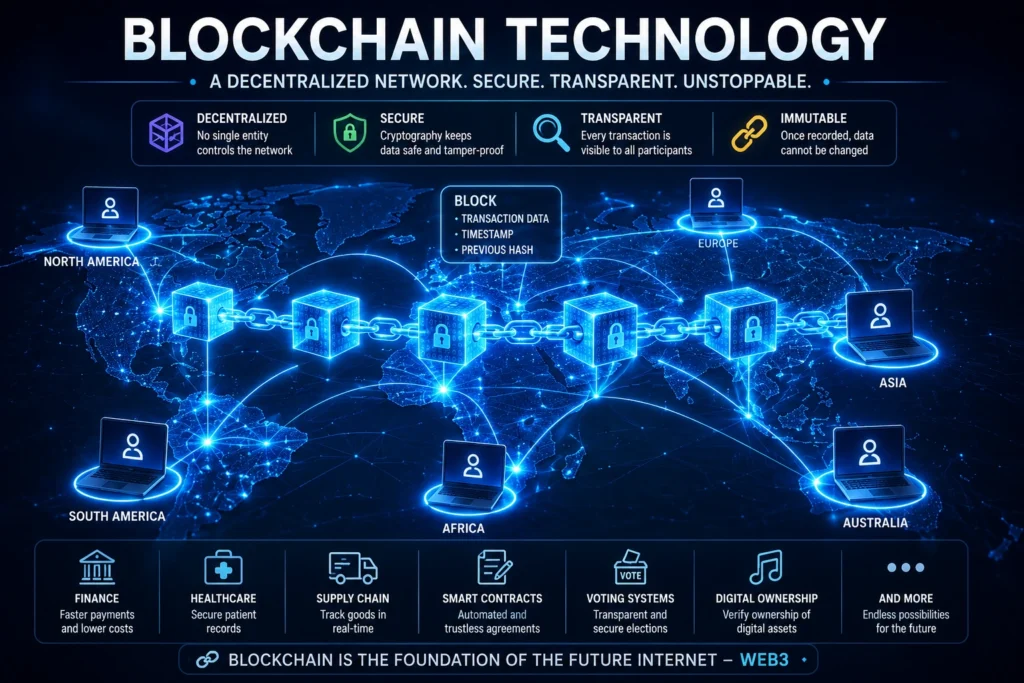
how blockchain works
At first glance, blockchain sounds complicated.
In reality, the process follows a straightforward sequence.
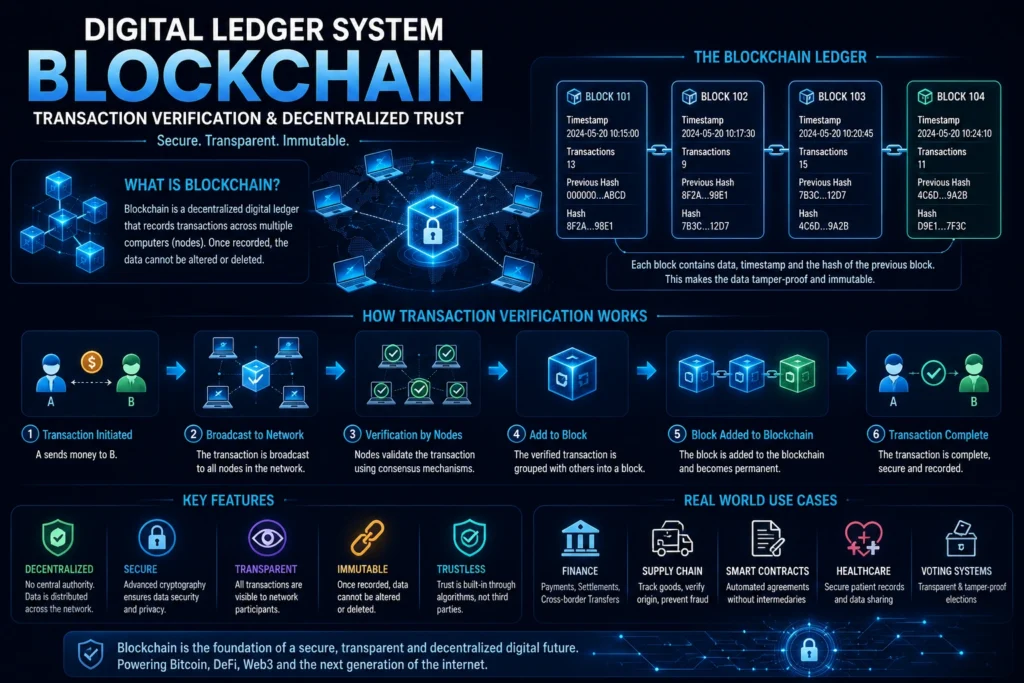
Step 1: A Transaction Occurs
Someone sends cryptocurrency, transfers digital assets, signs a digital contract, or records information.
Step 2: The Network Receives the Request
The transaction is broadcast to participating computers known as nodes.
These computers independently verify the information.
Step 3: Verification Happens
The network checks whether the transaction follows the rules.
For example:
- Does the sender actually own the asset?
- Is there sufficient balance?
- Has the transaction already been processed?
Step 4: The Transaction Joins Other Transactions
Verified transactions are grouped together into a block.
Think of a block as a digital container holding a collection of records.
Step 5: The Block Is Added to the Chain
Once approved, the block becomes linked to previous blocks.
This creates a continuous chain of historical records.
That connection between blocks gives blockchain its name.
Understanding Blocks and Chains
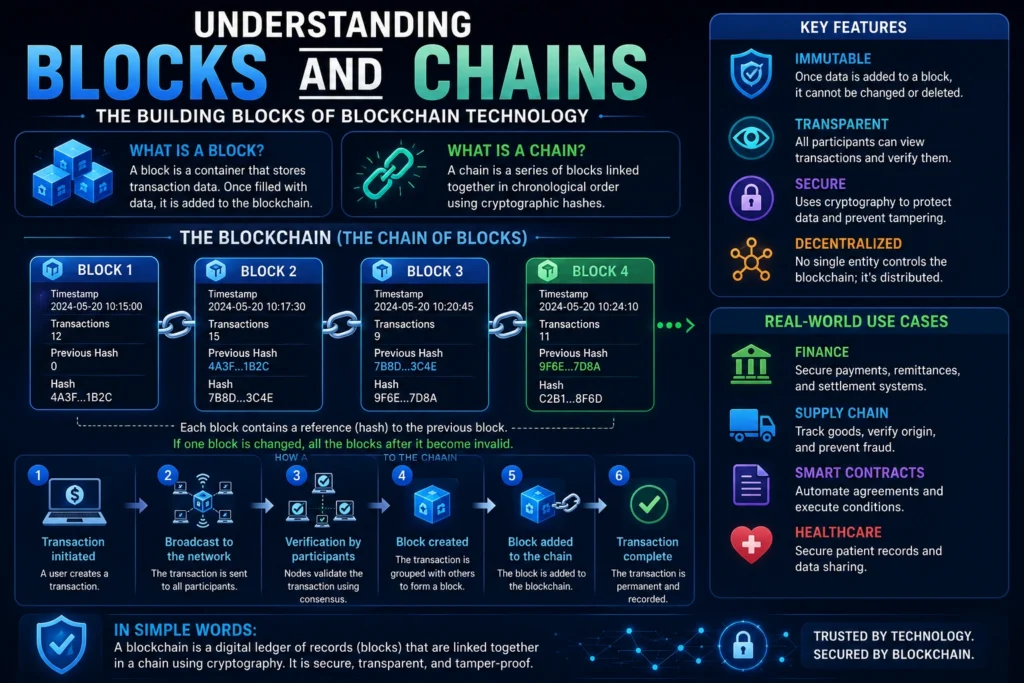
The easiest way to visualize blockchain is as a digital timeline.
Each block contains:
- Transaction data
- A timestamp
- A unique cryptographic signature
- A reference to the previous block
Because each block references the one before it, changing old records becomes extremely difficult.
If someone attempted to alter information from years ago, they would need to modify every subsequent block while simultaneously convincing the entire network to accept those changes.
For large blockchains, this becomes practically impossible.
This structure is one of the reasons blockchain is considered highly secure.
What Makes Blockchain Different?
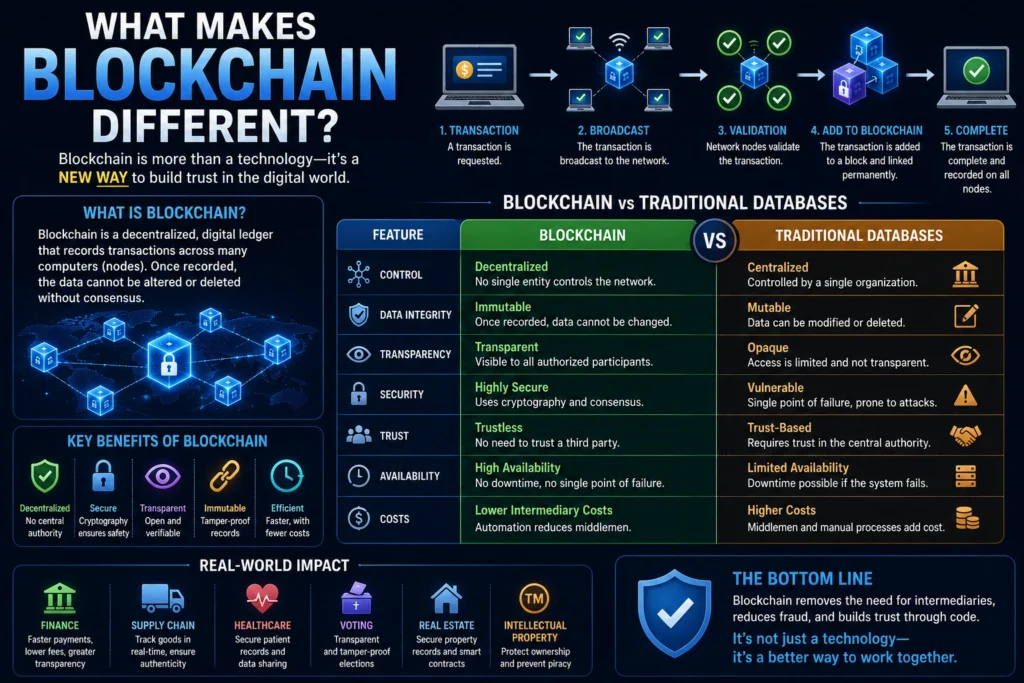
Traditional databases and blockchain databases may appear similar on the surface.
Both store information.
Both organize records.
Both support digital applications.
The difference lies in how trust is established.
Traditional systems depend heavily on centralized control.
Blockchain distributes trust across an entire network.
This seemingly small distinction creates massive implications.
With blockchain:
- Records become more transparent
- Data becomes harder to manipulate
- Single points of failure are reduced
- Verification becomes decentralized
For many industries, these benefits represent a fundamental shift in how information can be managed.
Blockchain vs Traditional Databases
| Feature | Traditional Database | Blockchain |
|---|---|---|
| Control | Centralized | Decentralized |
| Transparency | Limited | High |
| Data Modification | Allowed | Extremely Difficult |
| Single Point of Failure | Yes | No |
| Verification | Central Authority | Network Consensus |
| Trust Model | Institution-Based | Technology-Based |
This comparison explains why blockchain attracts interest from industries far beyond cryptocurrency.
The technology offers an alternative way of organizing trust in digital environments.
The Role of Decentralization
Decentralization is one of blockchain’s most important concepts.
In traditional systems:
- Banks control financial records
- Governments maintain official databases
- Companies own customer information
Blockchain distributes responsibility across many participants.
No single organization has complete authority.
Supporters argue this creates stronger security, greater resilience, and increased transparency.
Critics point out that decentralization can sometimes reduce efficiency and make governance more complicated.
Both perspectives contain elements of truth.
The effectiveness of decentralization often depends on the specific use case.
How Blockchain Secures Information
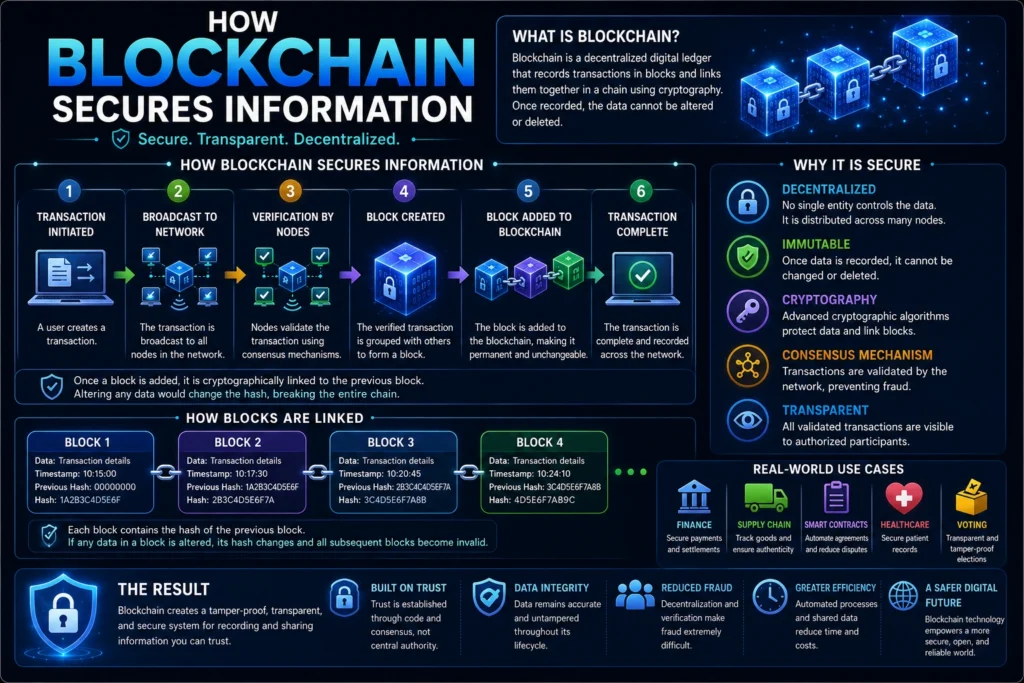
Security is one of the biggest reasons blockchain gained global attention.
Blockchain combines several technologies:
- Cryptography
- Distributed networks
- Consensus mechanisms
- Immutable record structures
Together, these systems make unauthorized changes extremely difficult.
Every transaction leaves a permanent digital footprint.
Every participant helps verify the integrity of the network.
This creates a level of transparency that many traditional systems struggle to match.
And that security model is precisely why blockchain became the foundation of Bitcoin, Ethereum, and thousands of other digital assets.
Blockchain and Bitcoin: What’s the Difference?
One of the biggest misconceptions online is that blockchain and Bitcoin are the same thing.
They’re not.
Bitcoin is a cryptocurrency.
Blockchain is the technology that makes Bitcoin possible.
A simple comparison helps:
- Bitcoin is like an email message.
- Blockchain is like the internet infrastructure that allows the message to travel.
Without blockchain, Bitcoin would not exist.
But blockchain can exist without Bitcoin.
Today, thousands of projects use blockchain technology for purposes completely unrelated to cryptocurrency.
That distinction is important because blockchain’s long-term impact may ultimately be much larger than Bitcoin itself.
Real-World Uses of Blockchain Technology
When blockchain first appeared, many people viewed it as a niche financial experiment.
Today, governments, multinational corporations, banks, healthcare providers, and technology companies are exploring practical applications.
Financial Services
Banks and payment providers are using blockchain to improve:
- International transfers
- Payment settlement
- Asset tracking
- Fraud prevention
Traditional cross-border transactions can take days.
Blockchain-based systems can often complete them much faster.
Supply Chain Management
how blockchain works
Consumers increasingly want transparency.
They want to know:
- Where products come from
- How goods are transported
- Whether products are authentic
Blockchain can create permanent records that help track products from origin to destination.
This improves accountability and reduces fraud.
Healthcare
Medical records are among the most sensitive forms of information.
Blockchain may help create secure systems where authorized providers can access accurate patient data while maintaining privacy protections.
Digital Identity
Identity theft remains a growing global problem.
Blockchain-based identity systems could give individuals greater control over personal information while reducing reliance on centralized databases.
Smart Contracts
One of blockchain’s most fascinating innovations is the smart contract.
A smart contract is a self-executing agreement whose rules are written directly into code.
When predefined conditions are met, actions occur automatically.
For example:
- Insurance payouts
- Property transfers
- Business agreements
- Royalty payments
This can reduce administrative costs and improve efficiency.
Digital Ownership
The rise of NFTs introduced millions of people to blockchain-based ownership systems.
While NFTs generated controversy, they demonstrated blockchain’s ability to verify ownership of digital assets.
That concept may influence future systems for:
- Intellectual property
- Gaming assets
- Digital collectibles
- Online credentials
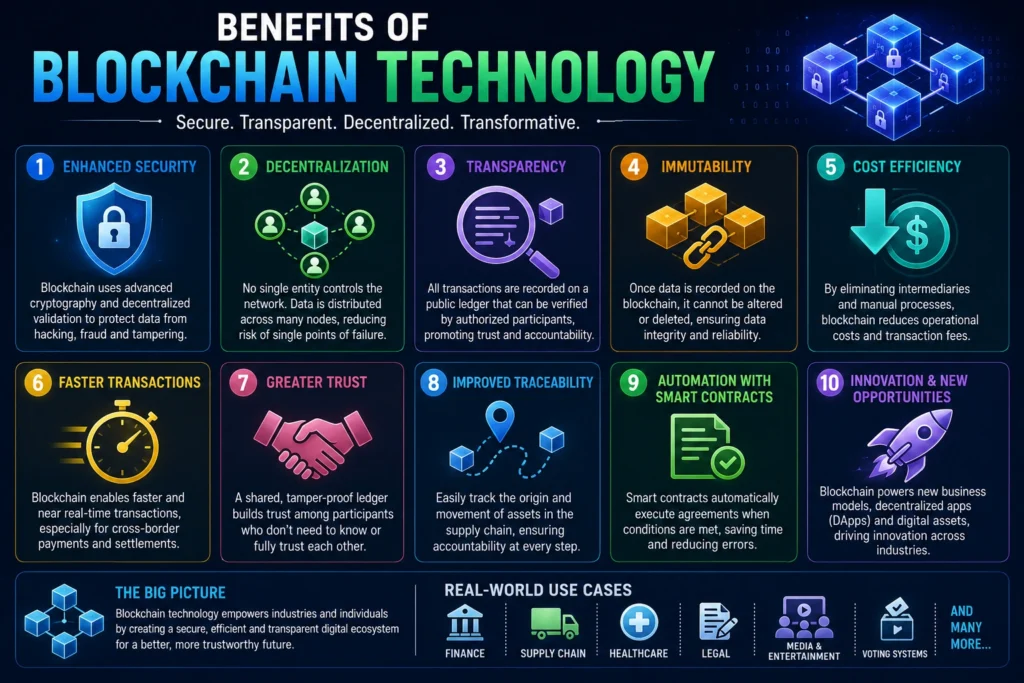
Benefits of Blockchain Technology
What Is Blockchain Technology
Supporters believe blockchain offers several meaningful advantages.
Greater Transparency
Public blockchains allow participants to verify records independently.
This can improve trust and accountability.
Enhanced Security
Cryptographic protection and distributed verification make unauthorized alterations extremely difficult.
Reduced Dependence on Intermediaries
Blockchain enables direct peer-to-peer interactions.
In some cases, this reduces the need for middlemen.
Improved Efficiency
Certain processes that traditionally require multiple approvals can be automated and streamlined.
Better Traceability
Blockchain creates permanent records that help organizations track products, transactions, and activities more accurately.
Challenges and Limitations
Blockchain is powerful, but it’s not a perfect solution.
This is where many overly optimistic articles become misleading.
Scalability Issues
Large blockchain networks can process transactions more slowly than traditional centralized systems.
Developers continue working on solutions.
Energy Consumption
Some blockchain networks require substantial computing power.
Bitcoin’s energy usage remains one of the most debated topics in the industry.
Newer blockchain systems often use more energy-efficient approaches.
Regulatory Uncertainty
Governments worldwide are still determining how blockchain-based systems should be regulated.
Policies continue evolving.
Complexity
For many users, blockchain still feels intimidating.
Mass adoption depends partly on making the technology easier to understand and use.
Security Risks Outside the Blockchain
Ironically, blockchain itself is often highly secure.
Many security failures occur through:
- Weak passwords
- Fraudulent websites
- Exchange hacks
- Social engineering attacks
Human error frequently creates greater risks than the technology itself.
Why Governments and Major Companies Care About Blockchain
Blockchain has moved far beyond startup experiments.
Some of the world’s largest organizations are actively researching or implementing blockchain solutions.
Interest continues growing because blockchain addresses several challenges simultaneously:
- Security
- Transparency
- Verification
- Data integrity
- Digital ownership
Financial institutions explore digital assets.
Technology companies explore decentralized systems.
Governments investigate digital identity programs and central bank digital currencies.
Not every blockchain project succeeds.
However, the level of global investment suggests the technology is being taken seriously by influential decision-makers.
The Future of Blockchain Technology
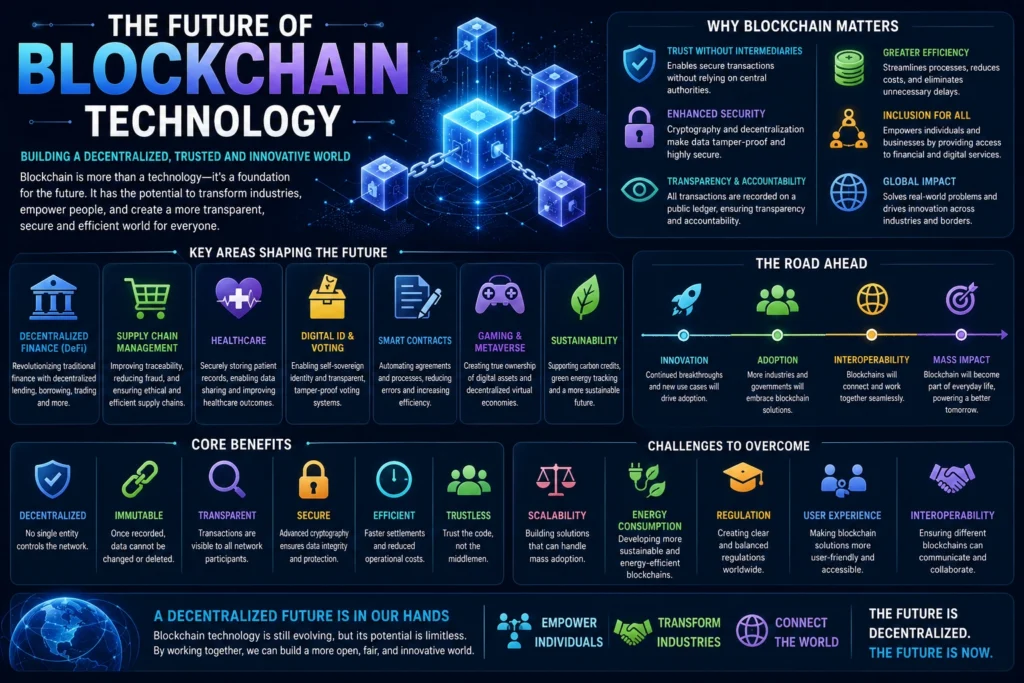
Predicting technology is always risky.
Few people accurately predicted the internet’s impact in the 1990s.
Blockchain may follow a similar path.
Many experts believe the technology will gradually move into the background.
Users may eventually benefit from blockchain systems without realizing blockchain is involved.
Several trends are worth watching:
Institutional Adoption
Large financial institutions continue expanding blockchain initiatives.
Tokenized Assets
Real-world assets may increasingly move onto blockchain networks.
Digital Identity Solutions
Identity verification could become faster, safer, and more user-controlled.
Decentralized Finance
Financial services may continue evolving beyond traditional banking models.
Web3 Development
Many developers view blockchain as an important component of the next generation of internet applications.
While no one knows exactly how the future will unfold, blockchain has already proven that decentralized digital systems can operate at a global scale.
That achievement alone has permanently changed conversations about technology, trust, and ownership.
Final Thoughts
Blockchain technology began as an innovative solution to a difficult problem: how can people exchange value and information online without relying entirely on centralized authorities?
The answer created something far bigger than a cryptocurrency.
Today, blockchain sits at the intersection of finance, technology, security, identity, and digital ownership.
Some predictions surrounding blockchain will inevitably prove wrong.
Some projects will fail.
Some innovations will exceed expectations.
But one fact is already clear:
Blockchain has introduced a new way of thinking about trust in the digital age.
Whether you’re interested in Bitcoin, investing, technology, or simply understanding the forces shaping the future, blockchain is no longer a topic that can be ignored.
The question is no longer whether blockchain matters.
The real question is how deeply it will influence the next chapter of the internet.
FINAL GUIDE:
how blockchain works
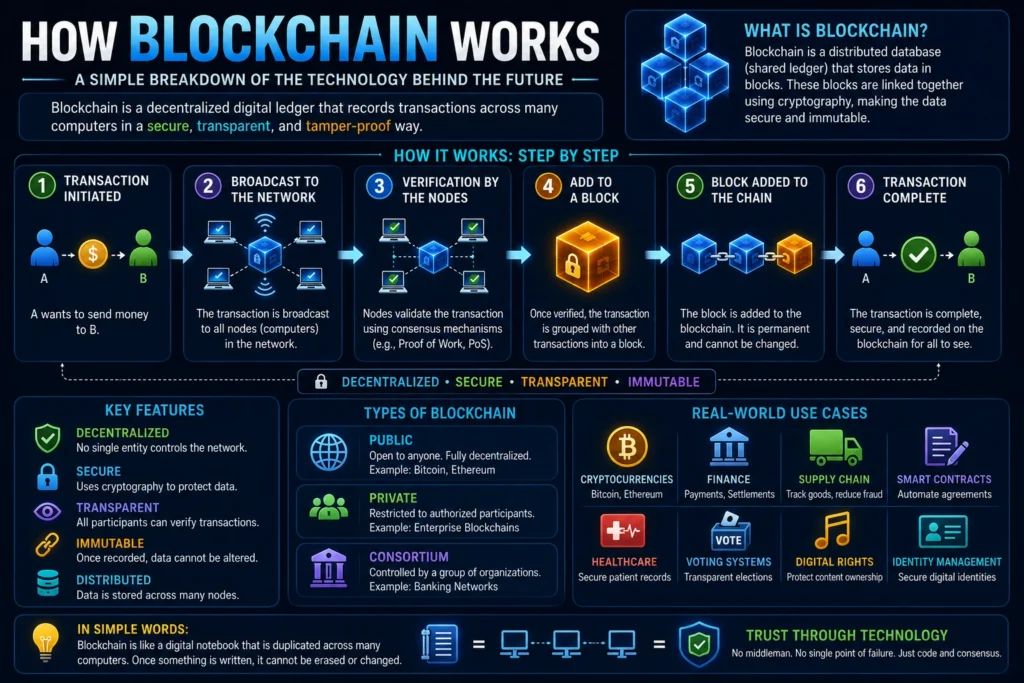
Blockchain Explained Simply
FAQs
What is blockchain technology in simple words?
Blockchain technology is a decentralized digital ledger that records transactions across multiple computers, making records transparent, secure, and difficult to alter.
Is blockchain the same as Bitcoin?
No. Bitcoin is a cryptocurrency, while blockchain is the underlying technology that enables Bitcoin and many other digital systems to function.
Why is blockchain considered secure?
Blockchain uses cryptography, distributed networks, and consensus mechanisms to verify information and prevent unauthorized changes.
Can blockchain be used outside cryptocurrency?
Yes. Blockchain is used in supply chains, healthcare, digital identity systems, smart contracts, financial services, and many other industries.
Who controls blockchain?
Most public blockchains are maintained by decentralized networks of participants rather than a single company or government.
What are the biggest benefits of blockchain?
Key benefits include transparency, security, traceability, efficiency, and reduced reliance on intermediaries.
What are the main disadvantages of blockchain?
Challenges include scalability limitations, regulatory uncertainty, complexity, and energy consumption in certain networks.
More About : Benefits of Blockchain Technology
Read More About : What Is Bitcoin
Read More About : Best AI Tools for Students
Free Ai Study Prompt Generator
Written by StormNex Editorial Team
The StormNex team researches emerging technologies, AI software, digital productivity tools, and future trends to help readers make informed decisions.
2 thoughts on “What Is Blockchain Technology? The Powerful Innovation Behind Bitcoin, Finance, and the Future of the Internet”