
What Is Bitcoin? The Easiest Beginner’s Guide to Crypto in 2026
The Moment Bitcoin Changed Finance
What Is Bitcoin? The Digital Money Revolution That Changed Finance Forever
In January 2009, while the world was still recovering from a devastating financial crisis, an anonymous developer quietly launched a technology that many dismissed as internet fantasy.
No press conference.
No billion-dollar company.
No government approval.
Just a small piece of software and a radical idea:
What if money could exist without banks?
That experiment became Bitcoin.
Seventeen years later, governments regulate it, billion-dollar institutions hold it, major companies accept it, and entire industries have emerged around it. Some people see Bitcoin as digital gold. Others see it as the future of money. Critics still call it speculative chaos.
But one thing is no longer debated seriously:
Bitcoin changed the financial conversation permanently.
What Is Bitcoin?
Bitcoin is a decentralized digital currency that allows people to send money directly to each other without needing a bank, payment company, or central authority.
The currency is commonly referred to as:
- Bitcoin
- BTC
- bitcoin cryptocurrency
Unlike traditional money issued by central banks, Bitcoin operates on a peer-to-peer network powered by blockchain technology.
That means:
- no single company controls it
- no government owns it
- no bank manages transactions
Instead, thousands of computers worldwide maintain the network together.
Simple Definition
Bitcoin is internet-based money secured by cryptography and operated through a decentralized public ledger called the blockchain.
What is Bitcoin in simple words?
Bitcoin is a digital currency that allows people to send and receive money online without banks or central authorities.
Who Created Bitcoin?
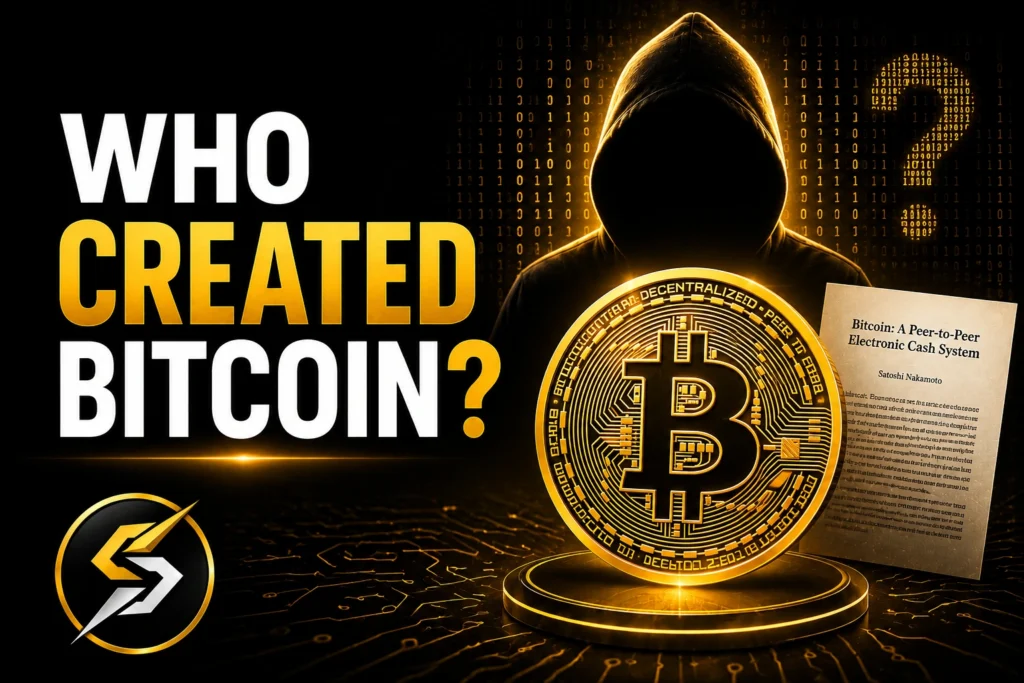
Bitcoin was created by a mysterious figure using the name Satoshi Nakamoto.
To this day, nobody knows for certain whether Satoshi was:
- one person
- a group of developers
- a government-linked team
- or a cryptography researcher hiding behind a pseudonym
In 2008, Satoshi published a whitepaper titled:
“Bitcoin: A Peer-to-Peer Electronic Cash System.”
That paper introduced the blueprint for decentralized digital money.
Shortly afterward, the Bitcoin network launched publicly.
What makes the story even more fascinating is that Satoshi disappeared from public communication years ago, leaving the project in the hands of the global community.
Why Bitcoin Was Invented
To understand Bitcoin, you need to understand the frustration that existed after the 2008 financial collapse.
Banks failed.
Governments printed trillions.
People lost homes, jobs, and savings.
Many critics believed the financial system gave too much power to centralized institutions.
Bitcoin emerged as an alternative idea:
- transparent money
- borderless payments
- limited supply
- financial independence
- censorship resistance
The first Bitcoin block even contained a hidden newspaper headline referencing bank bailouts — a symbolic message about the problems Bitcoin aimed to challenge.
How Bitcoin Works
At first glance, Bitcoin sounds complicated.
Underneath the technical language, though, the core concept is surprisingly straightforward.
Imagine a giant public accounting book shared across the internet.
Every Bitcoin transaction gets recorded in that book permanently.
Instead of one bank owning the records, thousands of computers worldwide maintain synchronized copies.
This system is called the Bitcoin blockchain.
Understanding the Bitcoin Blockchain
The blockchain acts like a decentralized virtual ledger.
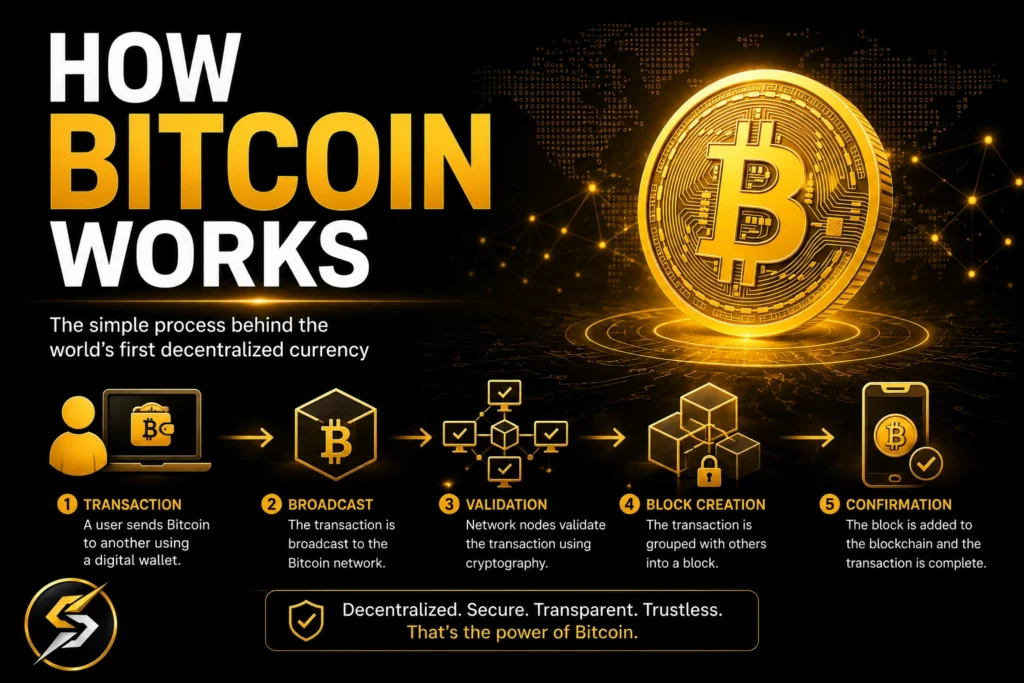
Here’s how it works in simple terms:
- Someone sends Bitcoin
- The transaction gets broadcast to the network
- Computers verify the transaction
- Verified transactions are grouped into blocks
- Those blocks are added permanently to the blockchain
Each block connects to previous blocks cryptographically, creating a secure chain of records.
That’s where the word “blockchain” comes from.
Why the Blockchain Matters
Traditional banking systems rely heavily on trust.
Bitcoin relies on mathematics, cryptography, and distributed verification instead.
This creates:
- transparency
- security
- resistance to tampering
- reduced dependence on intermediaries
Bitcoin Mining Explained
Bitcoin mining is one of the most misunderstood parts of cryptocurrency.
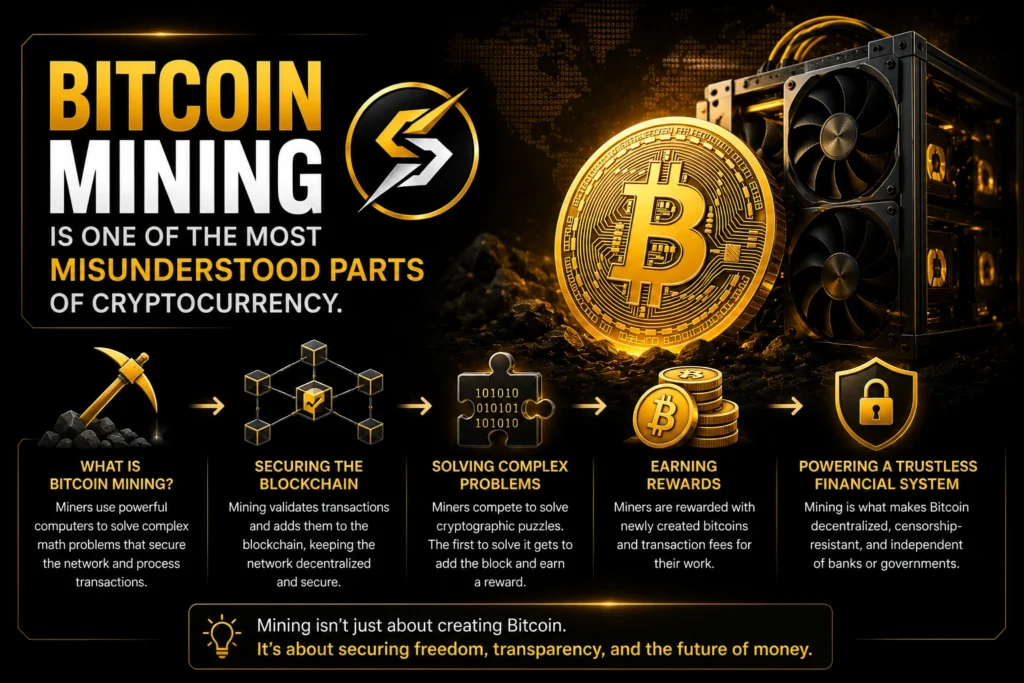
Mining is the process through which:
- transactions are verified
- new BTC enters circulation
- the network stays secure
Miners use specialized computers to solve complex mathematical puzzles.
When a miner successfully validates a block:
- the blockchain updates
- the miner earns newly created Bitcoin rewards
This system incentivizes people to help secure the network.
Why Mining Uses So Much Energy
Bitcoin mining consumes significant electricity because the network intentionally makes verification computationally difficult.
Supporters argue this energy secures one of the world’s most censorship-resistant financial systems.
Critics argue the environmental cost remains controversial.
The debate continues globally.
Bitcoin Wallets and Security
A Bitcoin wallet does not technically “store” Bitcoin the way a physical wallet stores cash.
Instead, it stores:
- public keys
- private keys
Public Key
Like an account number people can send BTC to.
Private Key
A secret password-like cryptographic key proving ownership.
If someone gains access to your private key, they can control your Bitcoin.
That’s why security matters enormously in crypto.
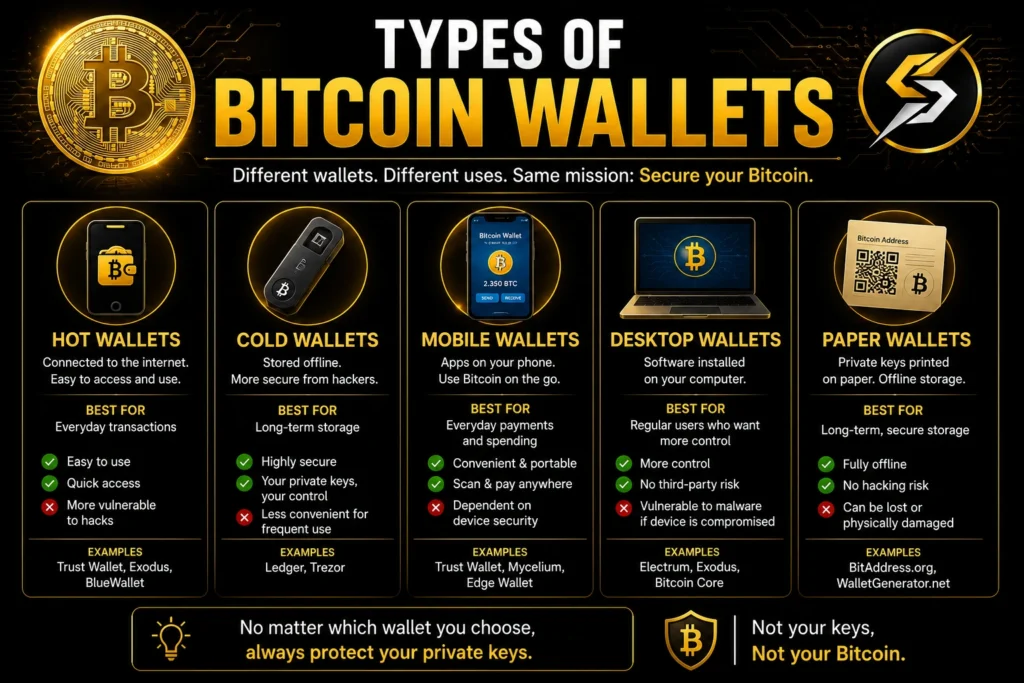
Types of Bitcoin Wallets
Hot Wallets
Connected to the internet.
Convenient but more vulnerable.
Cold Wallets
Offline storage devices.
Much safer for long-term holdings.
Popular wallet categories include:
- mobile wallets
- desktop wallets
- hardware wallets
- paper wallets
How Bitcoin Transactions Work
When you send Bitcoin:
- your wallet creates a transaction request
- the network verifies ownership
- miners confirm the transaction
- the blockchain records it permanently
Unlike traditional banking:
- transactions can operate globally
- no bank approval is required
- transfers may happen 24/7
This borderless design helped Bitcoin gain popularity internationally.
Especially in regions facing:
- inflation
- banking restrictions
- unstable currencies
- capital controls
Why Bitcoin Has Value
One of the biggest beginner questions is simple:
“If Bitcoin isn’t physical, why is it worth anything?”
The answer combines psychology, economics, scarcity, and network effects.
Bitcoin’s Limited Supply
Only 21 million Bitcoin will ever exist.
This scarcity is built into the code itself.
Unlike traditional currencies, governments cannot print unlimited BTC.
That limited supply became one of Bitcoin’s strongest narratives.
Many investors compare it to:
- digital gold
- scarce internet property
- a hedge against inflation
Bitcoin as a Store of Value
Over time, Bitcoin evolved from an experimental payment system into something many people treat as a store of value.
Large institutions now view Bitcoin as:
- a macroeconomic hedge
- a diversification asset
- a long-term speculative investment
- protection against currency debasement
Major companies and investment firms have publicly added Bitcoin exposure in recent years.
That institutional interest dramatically increased mainstream credibility.
Bitcoin vs Traditional Money
| Feature | Bitcoin | Traditional Currency |
|---|---|---|
| Controlled By | Decentralized network | Central banks |
| Supply | Fixed | Expandable |
| Transfer Speed | Global and digital | Often bank-dependent |
| Accessibility | Internet-based | Bank-based |
| Transparency | Public blockchain | Private banking systems |
| Inflation Control | Programmed scarcity | Policy-based |
Bitcoin doesn’t fully replace traditional finance today, but it introduced a fundamentally different monetary model.
Why Bitcoin Prices Swing So Wildly
Bitcoin is famous for volatility.
Prices can rise or crash dramatically within short periods.
Several factors drive this:
- investor speculation
- institutional buying
- regulation news
- macroeconomic trends
- ETF developments
- market psychology
- global liquidity conditions
Bitcoin remains a relatively young asset compared to traditional markets like gold or stocks.
That immaturity contributes heavily to price instability.
Risks of Bitcoin
Despite its popularity, Bitcoin is not risk-free.
New investors often underestimate this.
Major Bitcoin Risks
Extreme Volatility
Large price swings can create emotional investing mistakes.
Security Risks
Lost private keys can permanently lock access to funds.
Regulatory Changes
Governments worldwide continue developing crypto laws.
Scams and Fraud
Fake exchanges and phishing attacks remain common.
Market Manipulation
Crypto markets can behave unpredictably.
Balanced understanding matters more than hype.
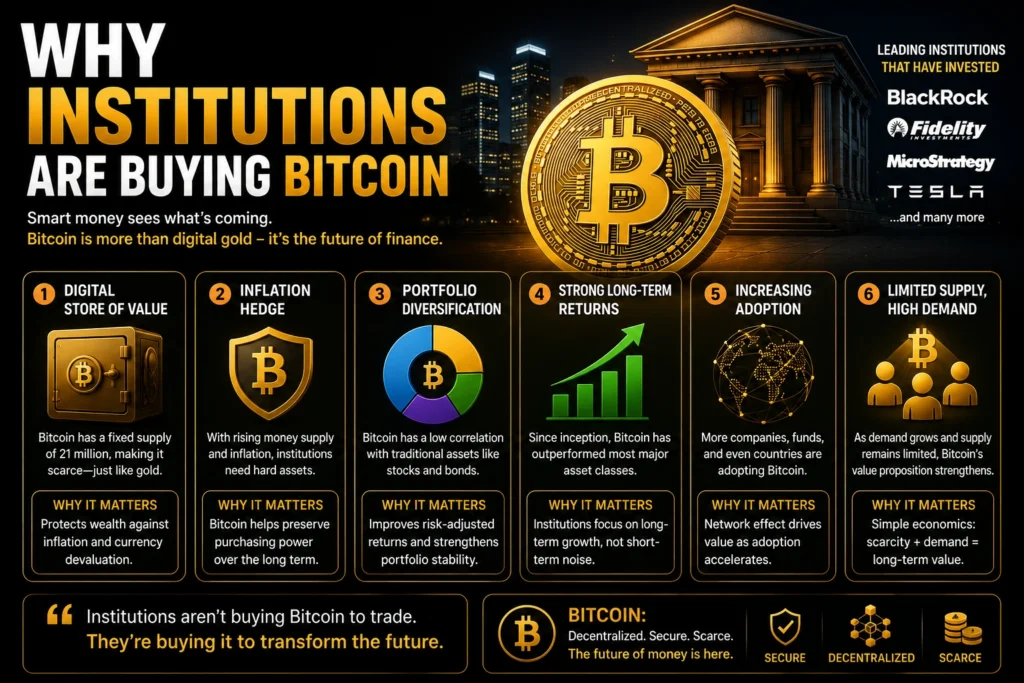
Why Institutions Are Buying Bitcoin
A decade ago, many financial institutions openly mocked Bitcoin.
That changed dramatically.
Today, Bitcoin exposure exists across:
- hedge funds
- ETFs
- fintech platforms
- payment companies
- asset managers
Several factors fueled institutional adoption:
- inflation concerns
- growing public demand
- portfolio diversification
- digital asset innovation
- long-term scarcity narratives
This shift transformed Bitcoin from fringe technology into a globally recognized financial asset.
Bitcoin and Governments
Governments have had mixed reactions to Bitcoin.
Some countries embraced crypto innovation.
Others imposed restrictions or outright bans.
Key concerns include:
- taxation
- anti-money laundering
- financial stability
- capital flight
- investor protection
Meanwhile, central banks worldwide began exploring their own digital currencies partly because Bitcoin accelerated interest in digital finance.
Common Bitcoin Myths
“Bitcoin Is Completely Anonymous”
Not exactly.
Bitcoin transactions are publicly visible on the blockchain.
While identities may not appear directly, blockchain analysis tools can sometimes trace activity.
“Bitcoin Is Only Used by Criminals”
Early headlines created this perception, but today Bitcoin is widely used by:
- investors
- companies
- institutions
- fintech platforms
- payment systems
“Bitcoin Has No Real Value”
Markets determine value through demand, scarcity, adoption, and utility.
The same principle applies to many financial assets.
How Beginners Buy Bitcoin
Buying Bitcoin has become far easier than it was years ago.
Most beginners use cryptocurrency exchanges.
Basic Buying Process
- Choose a reputable crypto exchange
- Create an account
- Complete identity verification
- Deposit funds
- Buy BTC
- Transfer to a secure wallet if needed
Many investors start with small amounts while learning.
That cautious approach often reduces emotional decision-making.
Is Bitcoin a Good Investment?
There’s no universal answer.
Bitcoin has created enormous wealth for some investors while causing painful losses for others.
Its future depends on:
- adoption
- regulation
- technology evolution
- macroeconomic trends
- investor confidence
Bitcoin Investment Reality
Bitcoin is:
- high-risk
- highly volatile
- potentially high-reward
- emotionally demanding
Long-term investors often focus on:
- scarcity
- global adoption
- institutional participation
- decentralized finance growth
Short-term traders usually focus on price movements instead.
The Psychological Side of Bitcoin
Bitcoin isn’t just a financial asset.
It’s deeply psychological.
People project hopes, fears, ideology, and economic beliefs onto it.
Some view Bitcoin as:
- freedom from centralized systems
- protection against inflation
- technological progress
- speculative opportunity
Others see:
- dangerous volatility
- regulatory uncertainty
- speculative bubbles
This emotional divide partly explains why Bitcoin discussions become so intense online.
The Future of Bitcoin
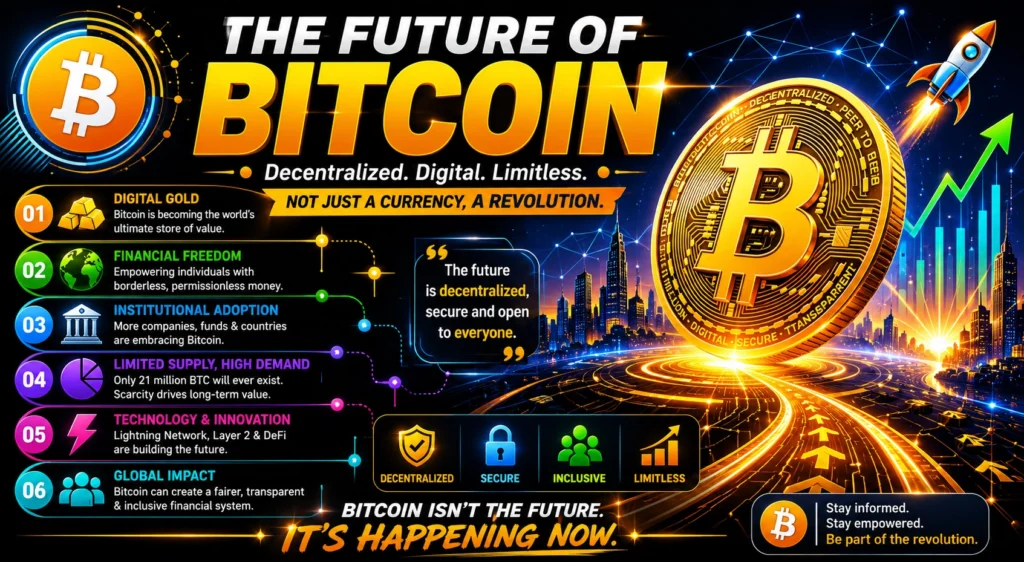
Bitcoin’s future remains one of the most debated topics in global finance.
Several trends are shaping the next phase:
Institutional Integration
Traditional finance continues integrating crypto services.
Regulatory Frameworks
Clearer laws may increase mainstream participation.
Global Economic Uncertainty
Inflation and debt concerns continue driving interest in alternative assets.
Technological Infrastructure
Wallets, payment systems, and blockchain scalability keep improving.
Generational Shift
Younger generations generally show stronger interest in digital assets.
Still, uncertainty remains unavoidable.
Bitcoin could continue evolving into a mainstream global asset — or face major structural challenges along the way.
That uncertainty is part of what keeps global attention locked onto it.
Real Advise
“After learning all this, I feel like you might also invest in Bitcoin and generate a great source of income from it! If you enjoyed our insights, please do visit our website again. Thank you!”
From: StormNex Team please do visit our website again. Thank you! And hey, don’t leave without sharing your thoughts in the comments!
What is Bitcoin in simple words?
Bitcoin is a digital currency that allows people to send and receive money online without banks or central authorities.
What does BTC mean?
BTC is the ticker symbol used for Bitcoin on exchanges and trading platforms.
Is Bitcoin safe?
Bitcoin itself is highly secure due to blockchain technology, but users can still lose funds through scams, poor security practices, or stolen private keys.
Who controls Bitcoin?
No single government, company, or person controls Bitcoin. It operates through a decentralized global network.
Can Bitcoin be converted into cash?
Yes. Bitcoin can be sold on cryptocurrency exchanges and converted into local currencies.
Why is Bitcoin expensive?
Its value comes from scarcity, demand, adoption, investor confidence, and its limited supply of 21 million coins.
Is Bitcoin legal?
Bitcoin legality varies by country. Many nations regulate it, while some restrict its use.
Can beginners invest in Bitcoin?
Yes, but beginners should understand the risks, volatility, and security basics before investing.
Stormnex
“If you found our information helpful, please do visit our website again—it would be an absolute honor for us. Thank you, and we look forward to welcoming you back!”
5 thoughts on “What Is Bitcoin? The Ultimate Beginner-Friendly Guide to BTC, Blockchain & Crypto in 2026”