What Is a Blockchain Block?
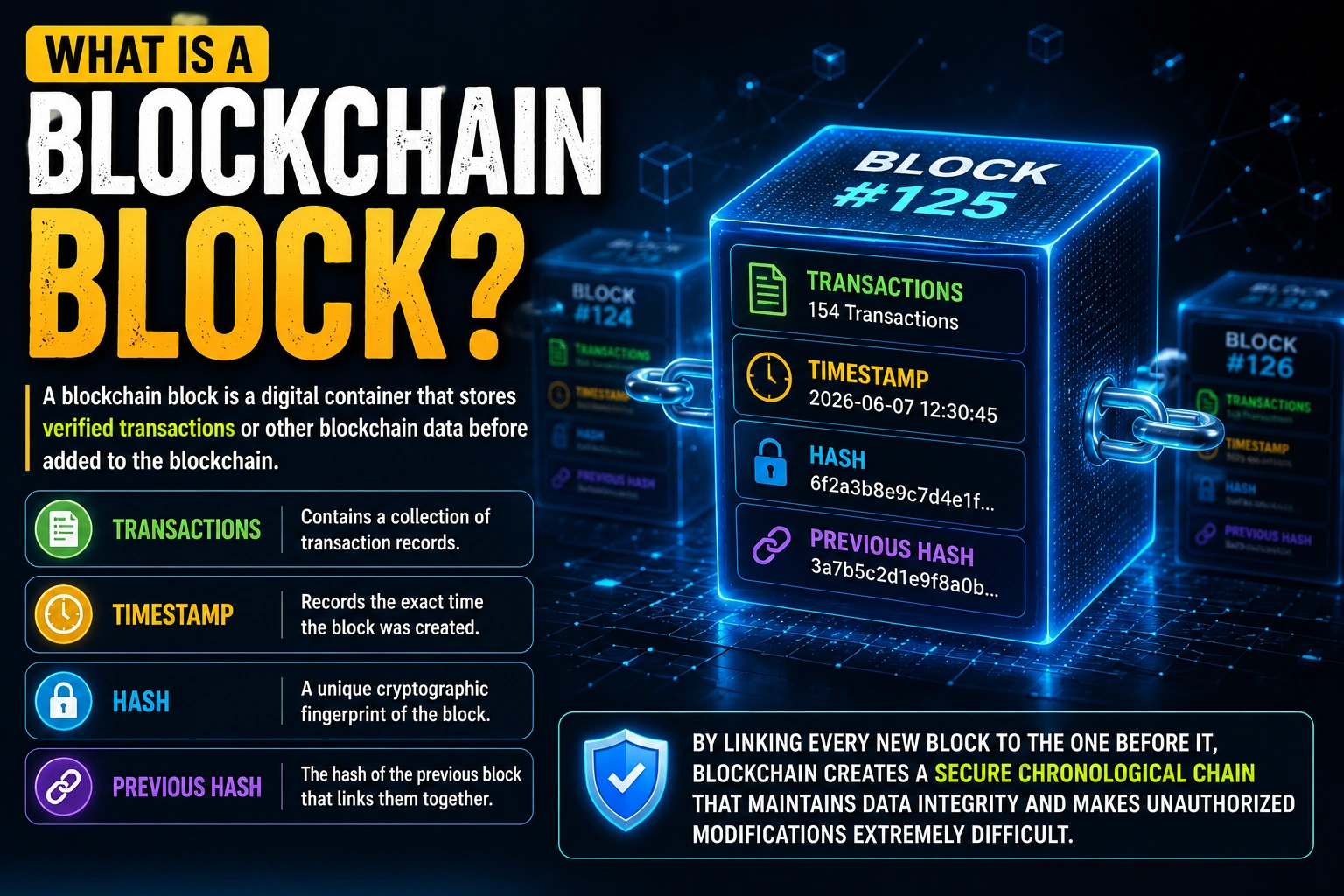
A blockchain block is a digital container that stores verified transactions or other blockchain data before it is permanently added to the blockchain. Each block contains a collection of transaction records, a timestamp, a cryptographic hash, and the hash of the previous block. By linking every new block to the one before it, blockchain creates a secure chronological chain of records that helps maintain data integrity and makes unauthorized modifications extremely difficult.
Educational Disclaimer: This article is for educational and informational purposes only. It does not provide financial, legal, tax, or investment advice. If you are considering using cryptocurrencies or blockchain-based services, always verify information through official documentation and trusted sources.
Key Takeaways
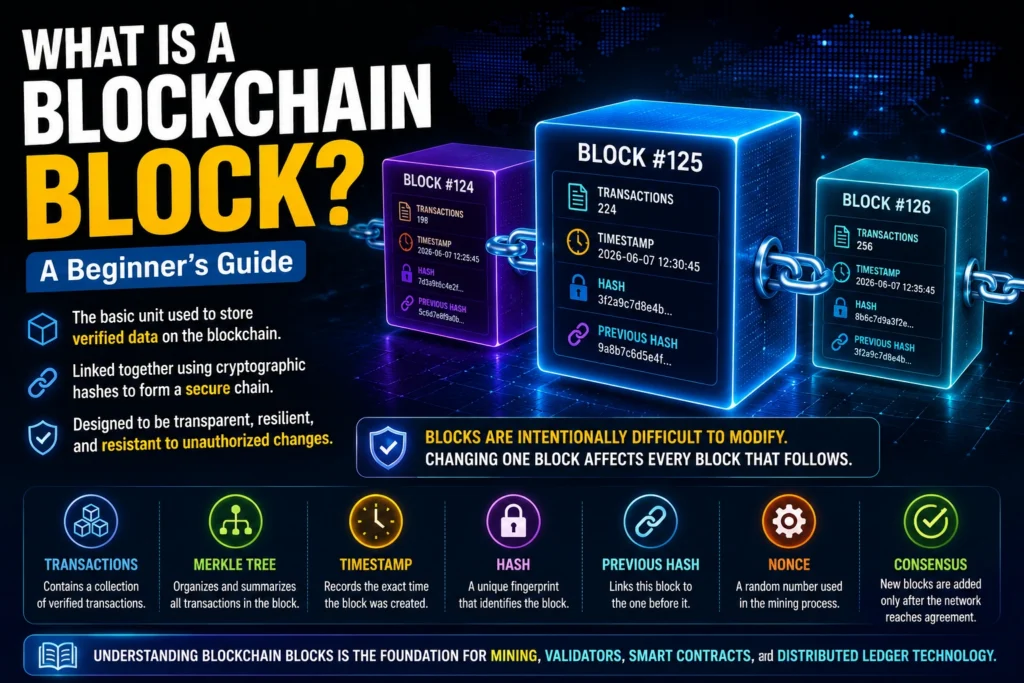
- A blockchain block is the basic unit used to store verified data on a blockchain.
- Every block contains transactions, metadata, and cryptographic information.
- Blocks are linked together using the previous block’s hash, creating the blockchain.
- Once confirmed, blocks are intentionally difficult to modify because changing one block affects every block that follows.
- Components such as the block header, Merkle tree, timestamp, and nonce help verify and secure each block.
- New blocks are added only after the network reaches consensus according to its rules.
- Understanding blockchain blocks provides a foundation for learning about mining, validators, smart contracts, and distributed ledger technology.
What Is a Blockchain Block? A Beginner’s Guide
A blockchain is often described as a chain of blocks, but what exactly is a block?
A blockchain block is the fundamental building unit of every blockchain network. Whether you’re exploring cryptocurrencies like Bitcoin, learning about Ethereum, or studying distributed ledger technology, understanding how blocks work is essential.
Rather than storing information in one continuously editable database, blockchain groups verified transactions into blocks. These blocks are then linked together in chronological order using cryptographic techniques, creating a secure and verifiable record of activity.
Understanding blockchain blocks helps explain why blockchain networks are designed to be transparent, resilient, and resistant to unauthorized changes.
Understanding Blockchain Blocks
What Is a Blockchain Block?
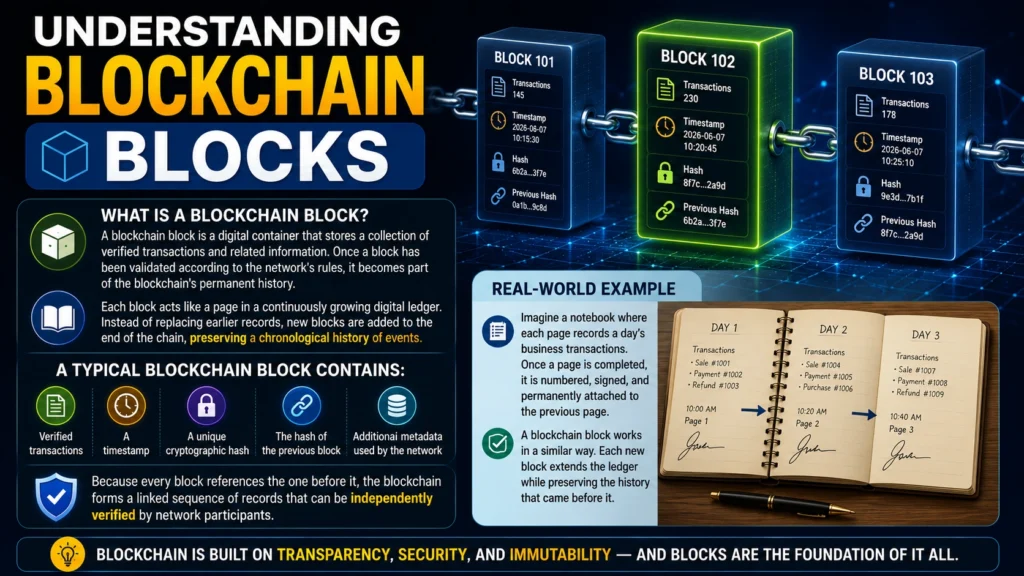
A blockchain block is a digital container that stores a collection of verified transactions and related information. Once a block has been validated according to the network’s rules, it becomes part of the blockchain’s permanent history.
Each block acts like a page in a continuously growing digital ledger. Instead of replacing earlier records, new blocks are added to the end of the chain, preserving a chronological history of events.
A typical blockchain block contains:
- Verified transactions
- A timestamp
- A unique cryptographic hash
- The hash of the previous block
- Additional metadata used by the blockchain network
Because every block references the one before it, the blockchain forms a linked sequence of records that can be independently verified by network participants.
Real-World Example
Imagine a notebook where each page records a day’s business transactions. Once a page is completed, it is numbered, signed, and permanently attached to the previous page. New pages can be added, but earlier pages are not rewritten.
A blockchain block works in a similar way. Each new block extends the ledger while preserving the history that came before it.
Difference Between a Block and a Blockchain
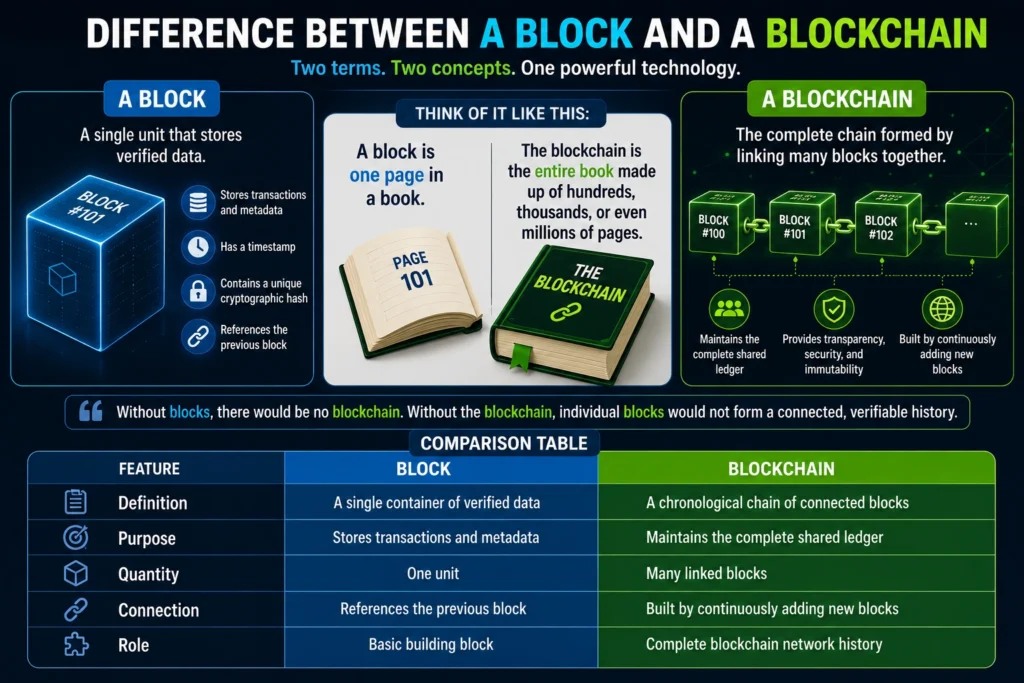
Many beginners use the terms block and blockchain interchangeably, but they refer to different concepts.
A block is a single unit that stores verified data.
A blockchain is the complete chain formed by linking many blocks together.
Think of it like this:
- A block is one page in a book.
- The blockchain is the entire book made up of hundreds, thousands, or even millions of pages.
Without blocks, there would be no blockchain. Without the blockchain, individual blocks would not form a connected, verifiable history.
Comparison Table
| Feature | Block | Blockchain |
|---|---|---|
| Definition | A single container of verified data | A chronological chain of connected blocks |
| Purpose | Stores transactions and metadata | Maintains the complete shared ledger |
| Quantity | One unit | Many linked blocks |
| Connection | References the previous block | Built by continuously adding new blocks |
| Role | Basic building block | Complete blockchain network history |
Understanding this distinction is important because many blockchain concepts—such as mining, validation, and consensus—operate at the level of individual blocks before contributing to the larger blockchain.
Why Are Blockchain Blocks Important?
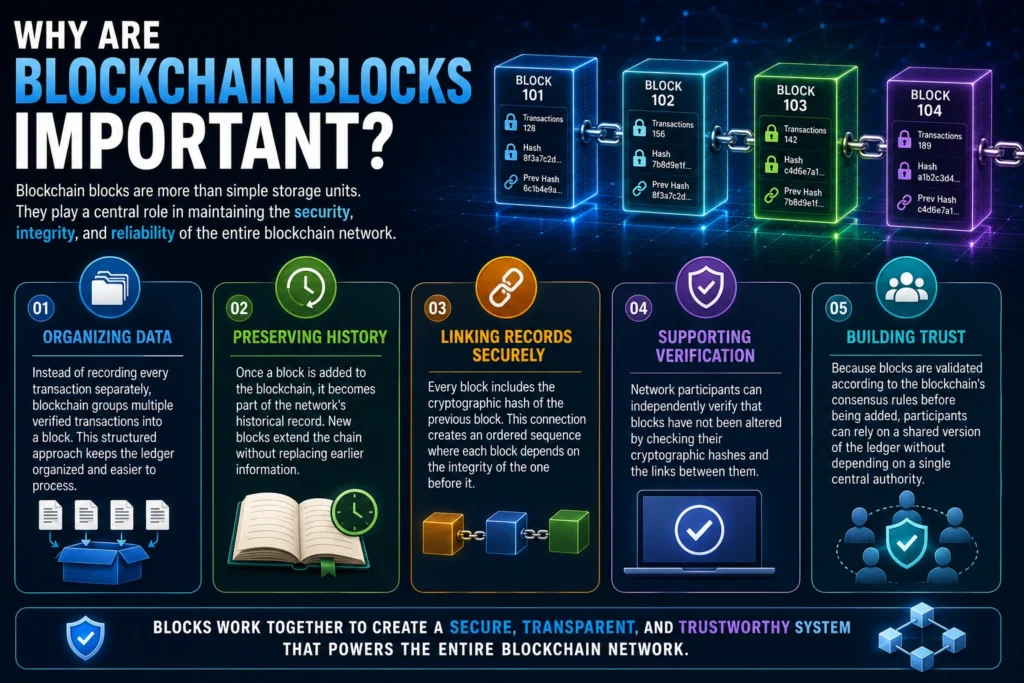
Blockchain blocks are more than simple storage units. They play a central role in maintaining the security, integrity, and reliability of the entire blockchain network.
Each block contributes to several key functions.
Organizing Data
Instead of recording every transaction separately, blockchain groups multiple verified transactions into a block. This structured approach keeps the ledger organized and easier to process.
Preserving History
Once a block is added to the blockchain, it becomes part of the network’s historical record. New blocks extend the chain without replacing earlier information.
Linking Records Securely
Every block includes the cryptographic hash of the previous block. This connection creates an ordered sequence where each block depends on the integrity of the one before it.
Supporting Verification
Network participants can independently verify that blocks have not been altered by checking their cryptographic hashes and the links between them.
Building Trust
Because blocks are validated according to the blockchain’s consensus rules before being added, participants can rely on a shared version of the ledger without depending on a single central authority.
Why Understanding Blocks Matters
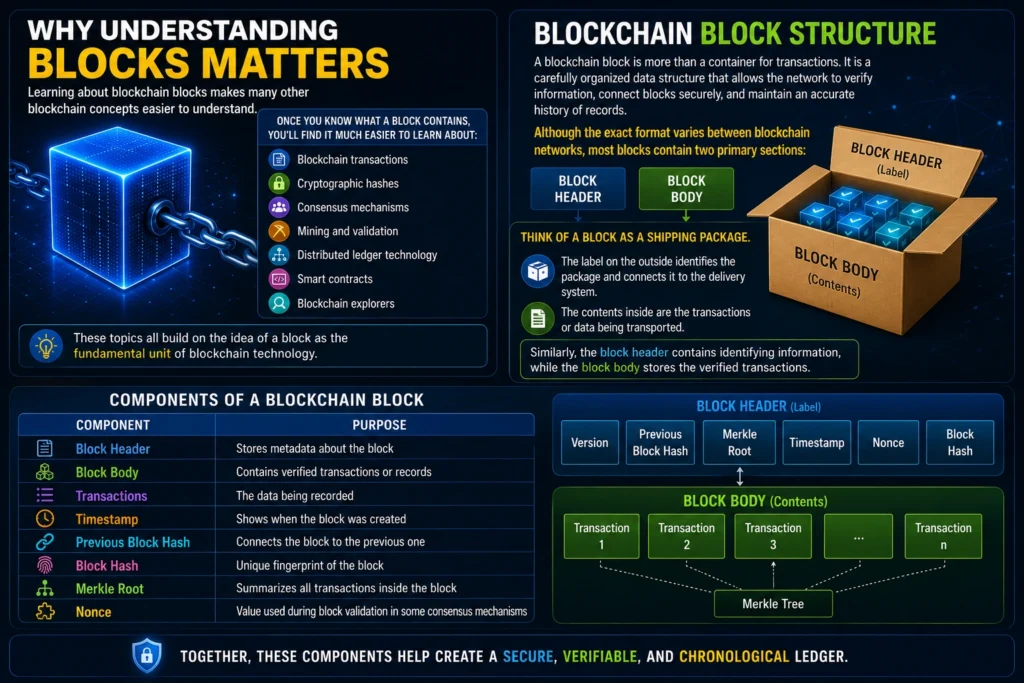
Learning about blockchain blocks makes many other blockchain concepts easier to understand.
Once you know what a block contains, you’ll find it much easier to learn about:
- Blockchain transactions
- Cryptographic hashes
- Consensus mechanisms
- Mining and validation
- Distributed ledger technology
- Smart contracts
- Blockchain explorers
These topics all build on the idea of a block as the fundamental unit of blockchain technology.
Blockchain Block Structure
A blockchain block is more than a container for transactions. It is a carefully organized data structure that allows the network to verify information, connect blocks securely, and maintain an accurate history of records.
Although the exact format varies between blockchain networks, most blocks contain two primary sections:
- Block Header
- Block Body
Think of a block as a shipping package.
The label on the outside identifies the package and connects it to the delivery system. The contents inside are the transactions or data being transported.
Similarly, the block header contains identifying information, while the block body stores the verified transactions.
Components of a Blockchain Block
| Component | Purpose |
|---|---|
| Block Header | Stores metadata about the block |
| Block Body | Contains verified transactions or records |
| Transactions | The data being recorded |
| Timestamp | Shows when the block was created |
| Previous Block Hash | Connects the block to the previous one |
| Block Hash | Unique fingerprint of the block |
| Merkle Root | Summarizes all transactions inside the block |
| Nonce | Value used during block validation in some consensus mechanisms |
Together, these components help create a secure, verifiable, and chronological ledger.
What Is a Block Header?
The block header is the identification section of a blockchain block.
Rather than storing every transaction, it contains metadata that describes the block and allows network participants to verify its authenticity.
Although different blockchain networks organize header information differently, a typical block header may include:
- Previous block hash
- Merkle root
- Timestamp
- Nonce (where applicable)
- Block version
- Difficulty target (on some networks)
The block header is relatively small compared with the block body, yet it plays a critical role in securing the blockchain.
Why the Block Header Matters
The block header allows nodes to:
- Verify the block efficiently
- Link it to the previous block
- Detect unauthorized modifications
- Participate in consensus
- Identify the block within the blockchain
Without the header, the blockchain would lose the secure links that connect one block to the next.
What Is the Block Body?

The block body contains the actual information being recorded on the blockchain.
In cryptocurrency networks, this primarily consists of verified transactions.
Other blockchain applications may store references to:
- Smart contract activity
- Digital asset ownership
- Supply chain updates
- Identity verification records
- Business events
The block body grows larger as more transactions are included, up to the network’s block size or data limits.
What Data Is Stored in a Blockchain Block?
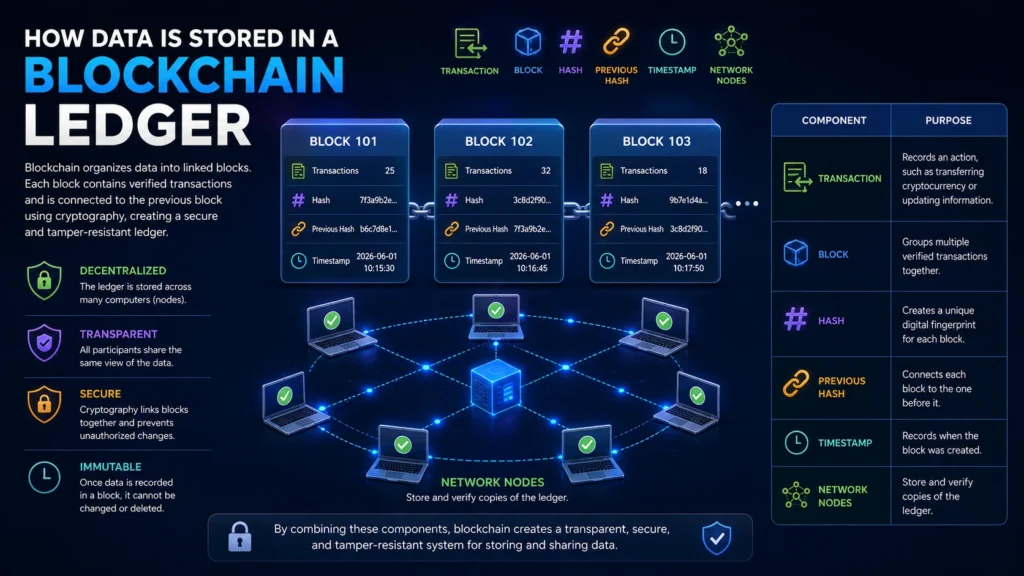
The exact contents depend on the blockchain, but a block commonly stores:
- Verified transactions
- Sender and recipient wallet addresses (or account identifiers)
- Digital signatures
- Transaction amounts
- Transaction fees
- Smart contract interactions (where supported)
- Block metadata
- Cryptographic hashes
- Timestamp
- Merkle root
Some blockchain applications store only references or proofs on-chain while keeping larger files in external storage systems.
Transactions
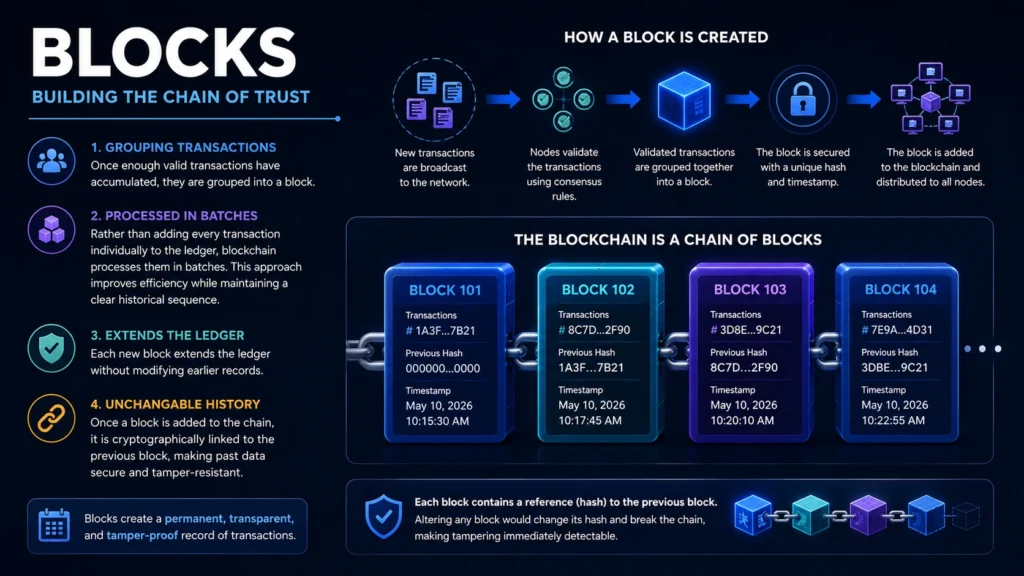
Transactions are the primary reason blocks exist.
Each transaction represents an action that has been validated according to the blockchain’s rules.
Examples include:
- Sending cryptocurrency
- Executing a smart contract
- Recording ownership of a digital asset
- Registering supply chain information
- Verifying a digital certificate
A single block may contain a handful of transactions or thousands of them, depending on the blockchain’s design and the size of each transaction.
Timestamp
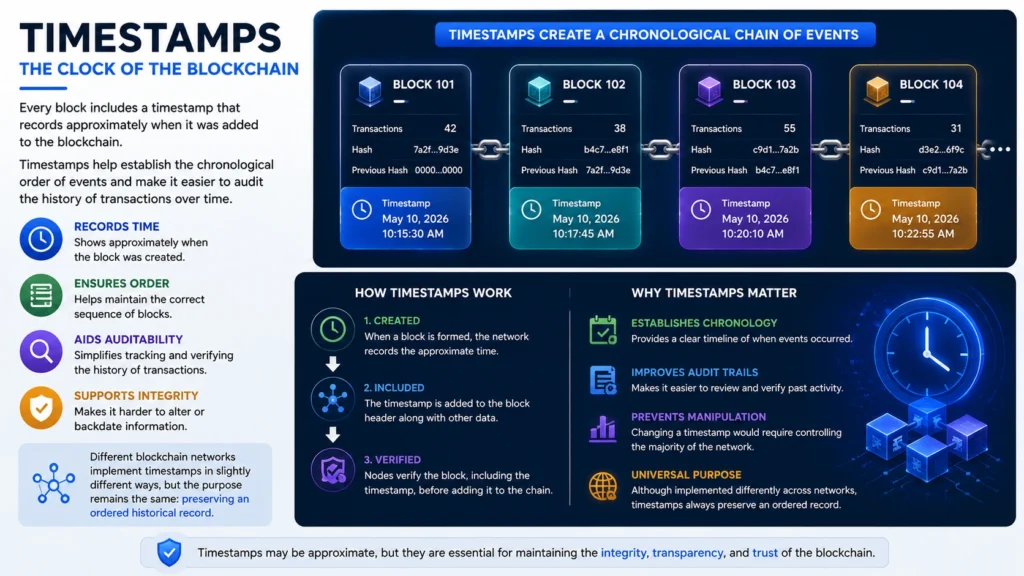
Every blockchain block includes a timestamp.
A timestamp records approximately when the block was created or accepted by the network.
This serves several purposes:
- Maintains chronological order
- Helps verify the sequence of events
- Supports blockchain auditing
- Assists with consensus processes
Because every block has a timestamp, participants can reconstruct the history of the blockchain from the first block to the latest one.
Cryptographic Hash
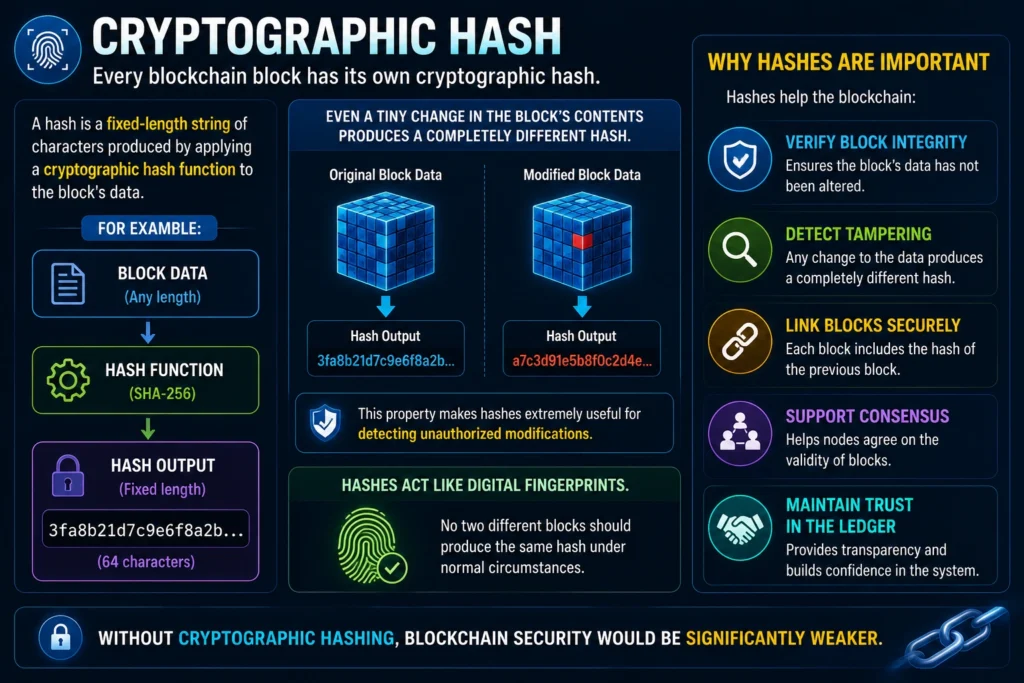
Every blockchain block has its own cryptographic hash.
A hash is a fixed-length string of characters produced by applying a cryptographic hash function to the block’s data.
For example:
Block Data

↓

Hash Function

↓

3fa8b21d7c9e...
Even a tiny change to the block’s contents produces a completely different hash.
This property makes hashes extremely useful for detecting unauthorized modifications.
Hashes act like digital fingerprints.
No two different blocks should produce the same hash under normal circumstances.
Why Hashes Are Important
Hashes help the blockchain:
- Verify block integrity
- Detect tampering
- Link blocks securely
- Support consensus
- Maintain trust in the ledger
Without cryptographic hashing, blockchain security would be significantly weaker.
Previous Block Hash
One of blockchain’s most important features is that every block stores the hash of the previous block.
This simple idea creates the chain in “blockchain.”
For example:
Block 1

↓

Hash A

↓

Block 2 stores Hash A

↓

Hash B

↓

Block 3 stores Hash B

↓

Hash C
If someone changes information inside Block 2, its hash changes immediately.
Because Block 3 still contains the original hash, the connection breaks.
This inconsistency alerts the network that something has changed.
Why Previous Hashes Matter
Previous hashes provide:
- Secure linking
- Historical integrity
- Tamper detection
- Chronological organization
- Reliable verification
This chaining mechanism is one reason blockchain records are intentionally difficult to alter after confirmation.
Merkle Tree
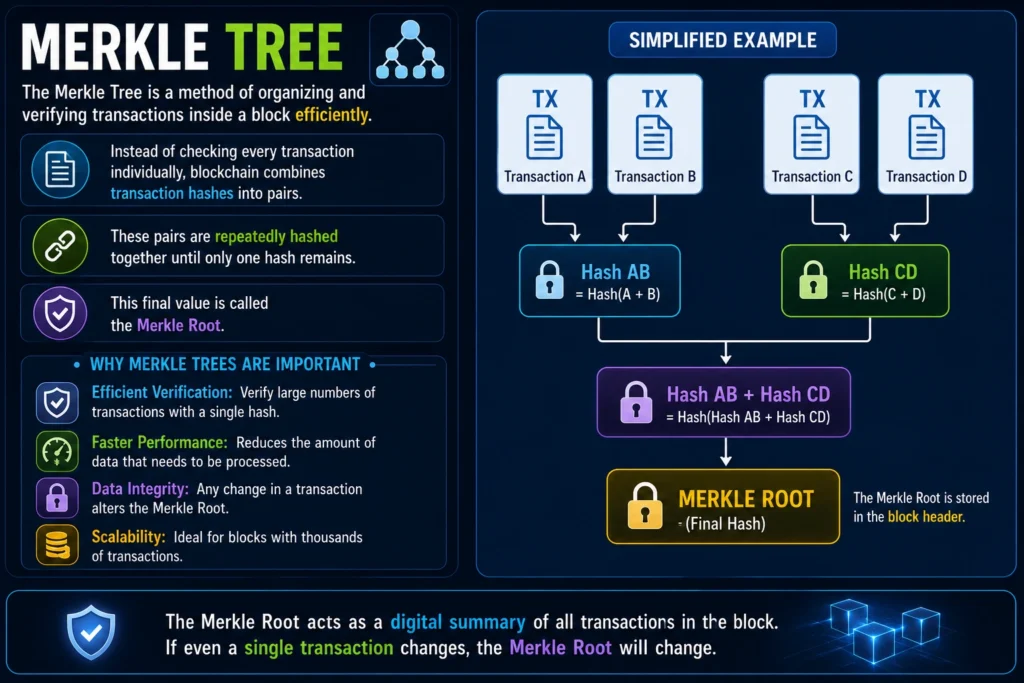
The Merkle Tree is a method of organizing and verifying transactions inside a block efficiently.
Instead of checking every transaction individually, blockchain combines transaction hashes into pairs.
These pairs are repeatedly hashed together until only one hash remains.
This final value is called the Merkle Root.
Simplified Example
Transaction A

Transaction B

↓

Hash AB

Transaction C

Transaction D

↓

Hash CD

↓

Hash AB + Hash CD

↓

Merkle Root
The Merkle Root is stored in the block header.
If even one transaction changes, the Merkle Root also changes.
This allows nodes to verify transaction integrity without reprocessing every transaction individually.
Benefits of Merkle Trees
Merkle Trees improve:
- Verification speed
- Network efficiency
- Storage efficiency
- Tamper detection
- Scalability
They are particularly valuable on large blockchain networks that process significant numbers of transactions.
Nonce
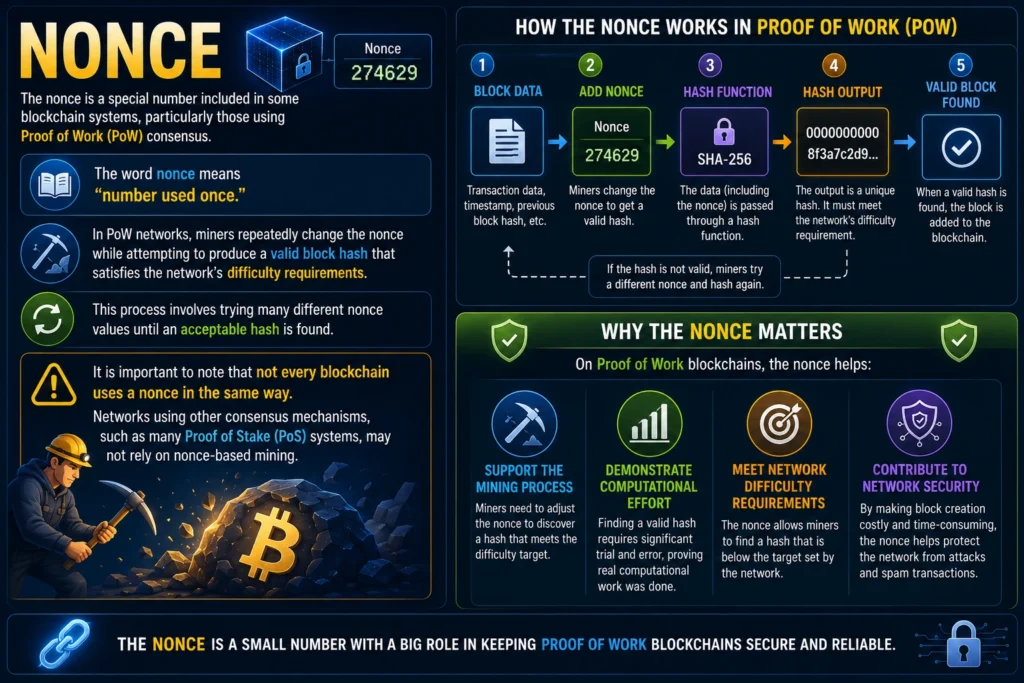
The nonce is a special number included in some blockchain systems, particularly those using Proof of Work (PoW) consensus.
The word nonce means “number used once.”
In PoW networks, miners repeatedly change the nonce while attempting to produce a valid block hash that satisfies the network’s difficulty requirements.
This process involves trying many different nonce values until an acceptable hash is found.
It is important to note that not every blockchain uses a nonce in the same way. Networks using other consensus mechanisms, such as many Proof of Stake (PoS) systems, may not rely on nonce-based mining.
Why the Nonce Matters
On Proof of Work blockchains, the nonce helps:
- Support the mining process
- Demonstrate computational effort
- Meet network difficulty requirements
- Contribute to network security
The role of the nonce depends on the blockchain’s underlying consensus mechanism.
How the Components Work Together
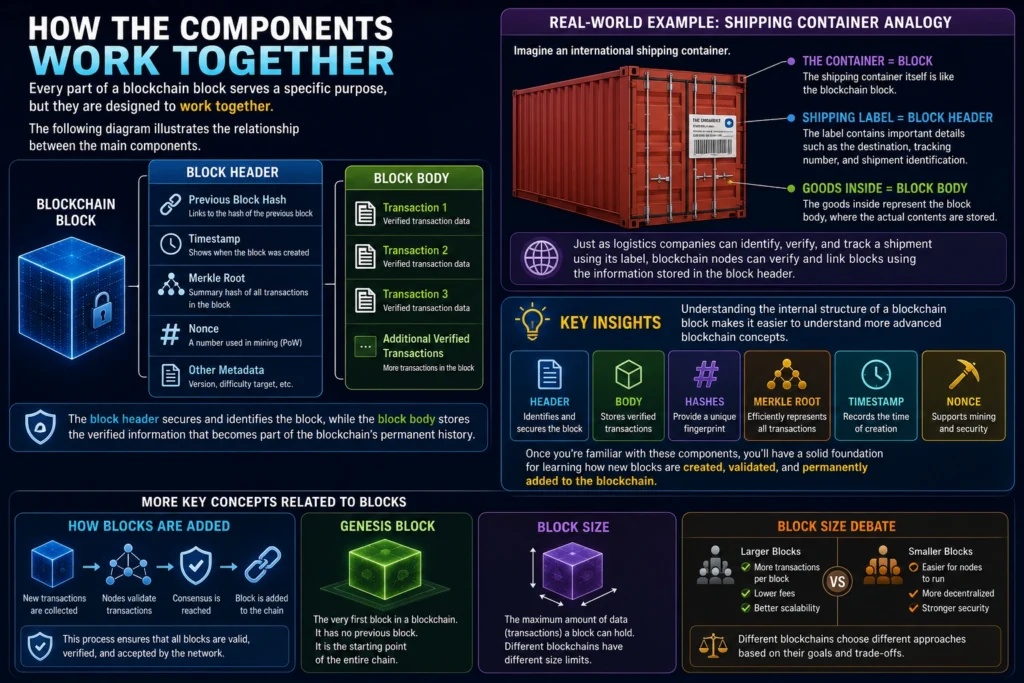
Every part of a blockchain block serves a specific purpose, but they are designed to work together.
The following diagram illustrates the relationship between the main components.
Blockchain Block

│

├── Block Header

│ ├── Previous Block Hash

│ ├── Timestamp

│ ├── Merkle Root

│ ├── Nonce

│ └── Other Metadata

│

└── Block Body

├── Transaction 1

├── Transaction 2

├── Transaction 3

└── Additional Verified Transactions
The block header secures and identifies the block, while the block body stores the verified information that becomes part of the blockchain’s permanent history.
Real-World Example: Shipping Container Analogy
Imagine an international shipping container.
The container itself is like the blockchain block.
The shipping label acts like the block header, containing important details such as the destination, tracking number, and shipment identification.
The goods inside represent the block body, where the actual contents are stored.
Just as logistics companies can identify, verify, and track a shipment using its label, blockchain nodes can verify and link blocks using the information stored in the block header.
Key Insights
Understanding the internal structure of a blockchain block makes it easier to understand more advanced blockchain concepts.
Once you’re familiar with the header, body, hashes, Merkle Root, timestamp, and nonce, you’ll have a solid foundation for learning how new blocks are created, validated, and permanently added to the blockchain.
How Blockchain Blocks Are Added, Genesis Block, Block Size, Benefits, Risks & Best Practices
How Are New Blocks Added to the Blockchain?
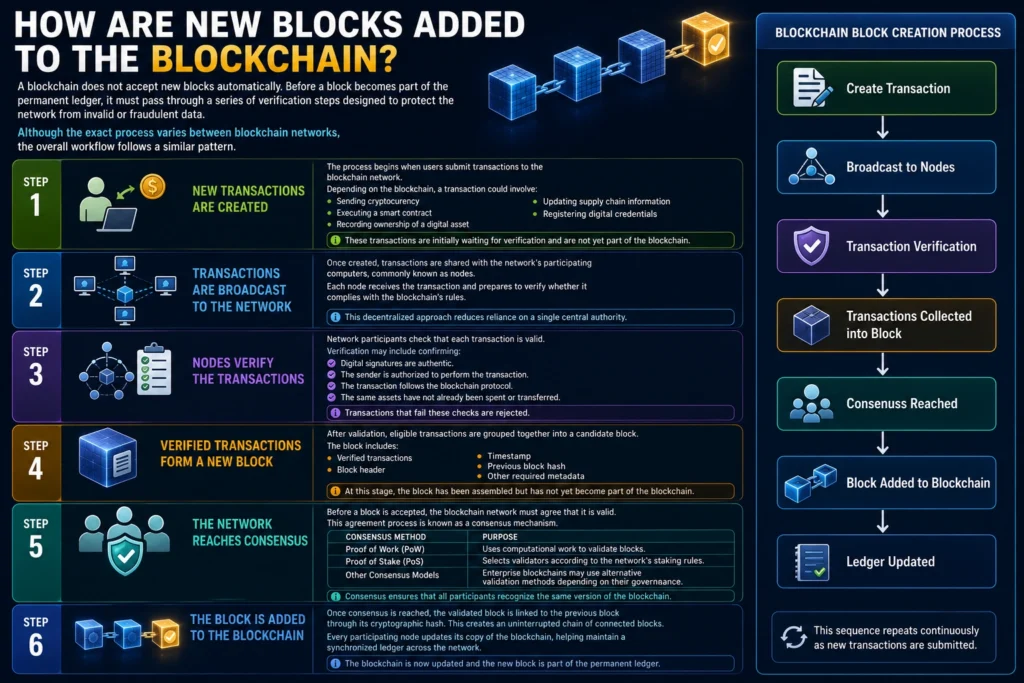
A blockchain does not accept new blocks automatically. Before a block becomes part of the permanent ledger, it must pass through a series of verification steps designed to protect the network from invalid or fraudulent data.
Although the exact process varies between blockchain networks, the overall workflow follows a similar pattern.
Step 1: New Transactions Are Created
The process begins when users submit transactions to the blockchain network.
Depending on the blockchain, a transaction could involve:
- Sending cryptocurrency
- Executing a smart contract
- Recording ownership of a digital asset
- Updating supply chain information
- Registering digital credentials
These transactions are initially waiting for verification and are not yet part of the blockchain.
Step 2: Transactions Are Broadcast to the Network
Once created, transactions are shared with the network’s participating computers, commonly known as nodes.
Each node receives the transaction and prepares to verify whether it complies with the blockchain’s rules.
This decentralized approach reduces reliance on a single central authority.
Step 3: Nodes Verify the Transactions
Network participants check that each transaction is valid.
Verification may include confirming:
- Digital signatures are authentic.
- The sender is authorized to perform the transaction.
- The transaction follows the blockchain protocol.
- The same assets have not already been spent or transferred.
Transactions that fail these checks are rejected.
Step 4: Verified Transactions Form a New Block
After validation, eligible transactions are grouped together into a candidate block.
The block includes:
- Verified transactions
- Block header
- Timestamp
- Previous block hash
- Other required metadata
At this stage, the block has been assembled but has not yet become part of the blockchain.
Step 5: The Network Reaches Consensus
Before a block is accepted, the blockchain network must agree that it is valid.
This agreement process is known as a consensus mechanism.
Different blockchain networks use different approaches, including:
| Consensus Method | Purpose |
|---|---|
| Proof of Work (PoW) | Uses computational work to validate blocks. |
| Proof of Stake (PoS) | Selects validators according to the network’s staking rules. |
| Other Consensus Models | Enterprise blockchains may use alternative validation methods depending on their governance. |
Consensus ensures that all participants recognize the same version of the blockchain.
Step 6: The Block Is Added to the Blockchain
Once consensus is reached, the validated block is linked to the previous block through its cryptographic hash.
This creates an uninterrupted chain of connected blocks.
Every participating node updates its copy of the blockchain, helping maintain a synchronized ledger across the network.
Blockchain Block Creation Process
Create Transaction
        │
        ▼
Broadcast to Nodes
        │
        ▼
Transaction Verification
        │
        ▼
Transactions Collected into Block
        │
        ▼
Consensus Reached
        │
        ▼
Block Added to Blockchain
        │
        ▼
Ledger Updated
This sequence repeats continuously as new transactions are submitted.
What Is the Genesis Block?
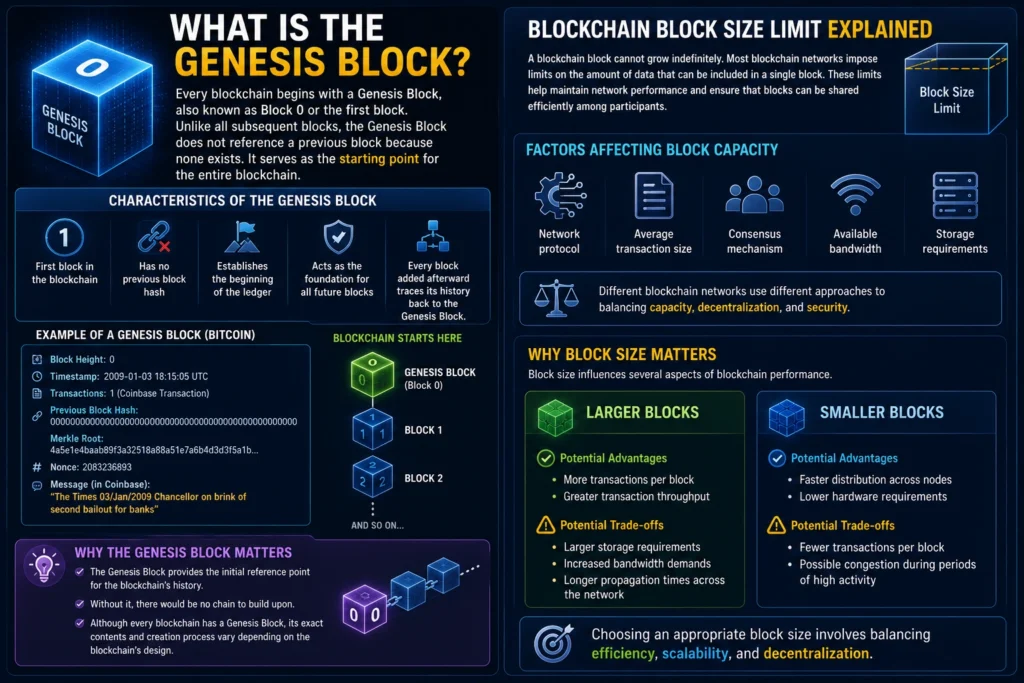
Every blockchain begins with a Genesis Block, also known as Block 0 or the first block.
Unlike all subsequent blocks, the Genesis Block does not reference a previous block because none exists.
It serves as the starting point for the entire blockchain.
Characteristics of the Genesis Block
- First block in the blockchain
- Has no previous block hash
- Establishes the beginning of the ledger
- Acts as the foundation for all future blocks
Every block added afterward traces its history back to the Genesis Block.
Why the Genesis Block Matters
The Genesis Block provides the initial reference point for the blockchain’s history.
Without it, there would be no chain to build upon.
Although every blockchain has a Genesis Block, its exact contents and creation process vary depending on the blockchain’s design.
Blockchain Block Size Limit Explained
A blockchain block cannot grow indefinitely.
Most blockchain networks impose limits on the amount of data that can be included in a single block.
These limits help maintain network performance and ensure that blocks can be shared efficiently among participants.
Factors Affecting Block Capacity
- Network protocol
- Average transaction size
- Consensus mechanism
- Available bandwidth
- Storage requirements
Different blockchain networks use different approaches to balancing capacity, decentralization, and security.
Why Block Size Matters
Block size influences several aspects of blockchain performance.
Larger Blocks
Potential advantages:
- More transactions per block
- Greater transaction throughput
Potential trade-offs:
- Larger storage requirements
- Increased bandwidth demands
- Longer propagation times across the network
Smaller Blocks
Potential advantages:
- Faster distribution across nodes
- Lower hardware requirements
Potential trade-offs:
- Fewer transactions per block
- Possible congestion during periods of high activity
Choosing an appropriate block size involves balancing efficiency, scalability, and decentralization.
How Long Does It Take to Create a Block?
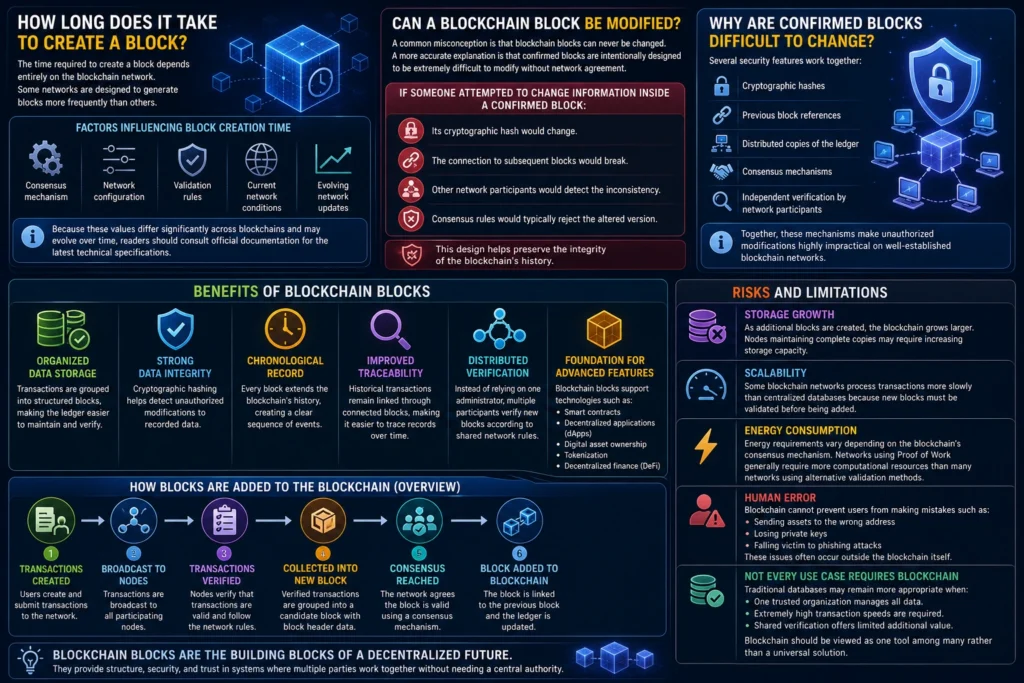
The time required to create a block depends entirely on the blockchain network.
Some networks are designed to generate blocks more frequently than others.
Factors influencing block creation time include:
- Consensus mechanism
- Network configuration
- Validation rules
- Current network conditions
Because these values differ significantly across blockchains and may evolve over time, readers should consult official documentation for the latest technical specifications.
Can a Blockchain Block Be Modified?
A common misconception is that blockchain blocks can never be changed.
A more accurate explanation is that confirmed blocks are intentionally designed to be extremely difficult to modify without network agreement.
If someone attempted to change information inside a confirmed block:
- Its cryptographic hash would change.
- The connection to subsequent blocks would break.
- Other network participants would detect the inconsistency.
- Consensus rules would typically reject the altered version.
This design helps preserve the integrity of the blockchain’s history.
Why Are Confirmed Blocks Difficult to Change?
Several security features work together:
- Cryptographic hashes
- Previous block references
- Distributed copies of the ledger
- Consensus mechanisms
- Independent verification by network participants
Together, these mechanisms make unauthorized modifications highly impractical on well-established blockchain networks.
Benefits of Blockchain Blocks
Blockchain blocks contribute several important advantages to distributed ledger technology.
Organized Data Storage
Transactions are grouped into structured blocks, making the ledger easier to maintain and verify.
Strong Data Integrity
Cryptographic hashing helps detect unauthorized modifications to recorded data.
Chronological Record
Every block extends the blockchain’s history, creating a clear sequence of events.
Improved Traceability
Historical transactions remain linked through connected blocks, making it easier to trace records over time.
Distributed Verification
Instead of relying on one administrator, multiple participants verify new blocks according to shared network rules.
Foundation for Advanced Blockchain Features
Blockchain blocks support technologies such as:
- Smart contracts
- Decentralized applications (dApps)
- Digital asset ownership
- Tokenization
- Decentralized finance (DeFi)
Risks and Limitations
Although blockchain blocks strengthen data integrity, they are not without limitations.
Storage Growth
As additional blocks are created, the blockchain grows larger.
Nodes maintaining complete copies may require increasing storage capacity.
Scalability
Some blockchain networks process transactions more slowly than centralized databases because new blocks must be validated before being added.
Energy Consumption
Energy requirements vary depending on the blockchain’s consensus mechanism.
Networks using Proof of Work generally require more computational resources than many networks using alternative validation methods.
Human Error
Blockchain cannot prevent users from making mistakes such as:
- Sending assets to the wrong address
- Losing private keys
- Falling victim to phishing attacks
These issues often occur outside the blockchain itself.
Not Every Use Case Requires Blockchain
Traditional databases may remain more appropriate when:
- One trusted organization manages all data.
- Extremely high transaction speeds are required.
- Shared verification offers limited additional value.
Blockchain should be viewed as one tool among many rather than a universal solution.
Practical Applications of Blockchain Blocks
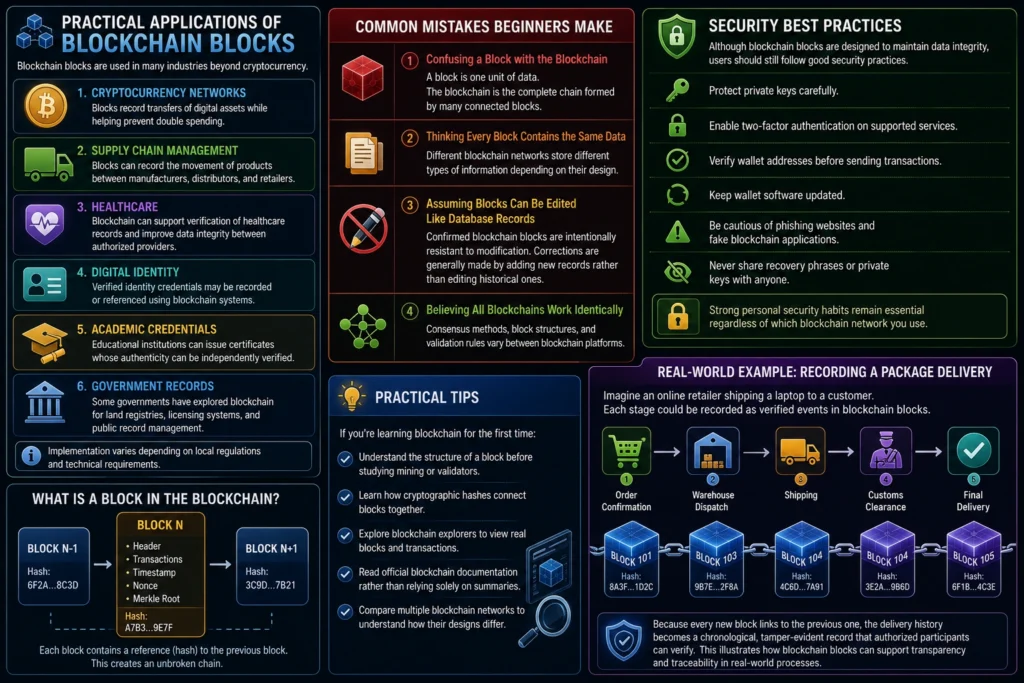
Blockchain blocks are used in many industries beyond cryptocurrency.
Cryptocurrency Networks
Blocks record transfers of digital assets while helping prevent double spending.
Supply Chain Management
Blocks can record the movement of products between manufacturers, distributors, and retailers.
Healthcare
Blockchain can support verification of healthcare records and improve data integrity between authorized providers.
Digital Identity
Verified identity credentials may be recorded or referenced using blockchain systems.
Academic Credentials
Educational institutions can issue certificates whose authenticity can be independently verified.
Government Records
Some governments have explored blockchain for land registries, licensing systems, and public record management.
Implementation varies depending on local regulations and technical requirements.
Common Mistakes Beginners Make
Confusing a Block with the Blockchain
A block is one unit of data.
The blockchain is the complete chain formed by many connected blocks.
Thinking Every Block Contains the Same Data
Different blockchain networks store different types of information depending on their design.
Assuming Blocks Can Be Edited Like Database Records
Confirmed blockchain blocks are intentionally resistant to modification.
Corrections are generally made by adding new records rather than editing historical ones.
Believing All Blockchains Work Identically
Consensus methods, block structures, and validation rules vary between blockchain platforms.
Practical Tips
If you’re learning blockchain for the first time:
- Understand the structure of a block before studying mining or validators.
- Learn how cryptographic hashes connect blocks together.
- Explore blockchain explorers to view real blocks and transactions.
- Read official blockchain documentation rather than relying solely on summaries.
- Compare multiple blockchain networks to understand how their designs differ.
Security Best Practices
Although blockchain blocks are designed to maintain data integrity, users should still follow good security practices.
- Protect private keys carefully.
- Enable two-factor authentication on supported services.
- Verify wallet addresses before sending transactions.
- Keep wallet software updated.
- Be cautious of phishing websites and fake blockchain applications.
- Never share recovery phrases or private keys with anyone.
Strong personal security habits remain essential regardless of which blockchain network you use.
Real-World Example: Recording a Package Delivery
Imagine an online retailer shipping a laptop to a customer.
Each stage—order confirmation, warehouse dispatch, shipping, customs clearance, and final delivery—could be recorded as verified events in blockchain blocks.
Because every new block links to the previous one, the delivery history becomes a chronological, tamper-evident record that authorized participants can verify.
This illustrates how blockchain blocks can support transparency and traceability well beyond cryptocurrency.
Frequently Asked Questions (FAQs)
1. What is a blockchain block?

A blockchain block is a digital container that stores verified transactions and related metadata. Once validated by the network, the block is linked to the previous block using cryptographic hashes, becoming a permanent part of the blockchain.
2. What is inside a blockchain block?

A blockchain block typically contains:
Verified transactions
Block header
Block body
Timestamp
Previous block hash
Block hash
Merkle root
Nonce (on some blockchain networks)
Other network-specific metadata
The exact contents vary depending on the blockchain protocol.
3. What is the difference between a block and a blockchain?
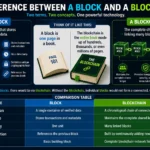
A block is a single unit that stores verified data.
A blockchain is the complete chain of connected blocks arranged in chronological order.
Think of a block as one page, while the blockchain is the entire book.
4. How does a blockchain block work?

A blockchain block works through a series of steps:
Users create transactions.
The network verifies them.
Valid transactions are grouped into a block.
The network reaches consensus.
The block is linked to the previous block.
The blockchain ledger is updated across participating nodes.
5. What is the purpose of a block header?

The block header stores metadata used to identify and verify a block.
It commonly contains:
Previous block hash
Merkle root
Timestamp
Nonce (where applicable)
Other protocol-specific information
The header helps connect blocks and supports the blockchain’s security mechanisms.
6. What is the Genesis Block?

The Genesis Block is the first block in a blockchain.
Unlike every other block, it does not reference a previous block because it begins the blockchain’s history.
7. Can a blockchain block be modified?

Confirmed blockchain blocks are intentionally designed to be extremely difficult to modify.
Changing one block would alter its cryptographic hash, breaking its connection with subsequent blocks. Network consensus rules typically reject unauthorized modifications.
8. What is a Merkle Tree?
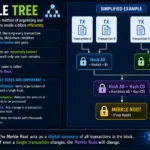
A Merkle Tree is a data structure that organizes transaction hashes efficiently.
Instead of verifying every transaction individually, blockchain networks can verify groups of transactions using a single value called the Merkle Root, improving efficiency and scalability.
9. What is a nonce in blockchain?
A nonce is a value used in some blockchain networks, particularly those using Proof of Work (PoW).
Miners repeatedly change the nonce while searching for a block hash that satisfies the network’s difficulty requirements.
Not all blockchain networks use nonces in the same way.
10. How long does it take to create a blockchain block?

The time required depends on the blockchain network.
Different protocols have different target block creation times based on their design and consensus mechanisms.
Readers should consult official documentation for current technical specifications.
Continue reading:
What Is Blockchain Technology?
How Does a Blockchain Transaction Work?
What Is a Blockchain Ledger? Beginner’s Complete Guide
Best ChatGPT Prompts for Students
Written by StormNex Editorial Team
The StormNex Editorial Team publishes in-depth educational guides on blockchain, cryptocurrency, artificial intelligence, and emerging technologies. Every guide is carefully researched to make complex topics easier to understand for beginners and professionals alike.