
If you want to measure the profitability of your campaigns or business ventures, using a free online ROI calculator for businesses is the smartest way to start. Understanding how to calculate ROI on investment online doesn’t have to be complicated. Instead of dealing with manual math or complex spreadsheets, our simple return on investment calculator does the heavy lifting for you in just one click.
Whether you are tracking marketing spend or capital assets, this easy roi percentage calculator tool provides instant, accurate results. For those looking to make data-driven decisions without any hidden costs, this business roi calculator free tool is designed to help you analyze your net profit margins and optimize your budget efficiently. To understand the core financial concepts behind these calculations, you can explore Investopedia’s guide on ROI
or use Google Search Central to see how tracking your site’s performance can further boost your business growth.
ROI Calculator
Calculate your Return on Investment (ROI) instantly using our free online ROI calculator. Enter your investment amount and final value to calculate ROI percentage, profit or loss, and overall investment performance.
Result Summary
Enter your investment details and click Calculate ROI to view your investment performance.
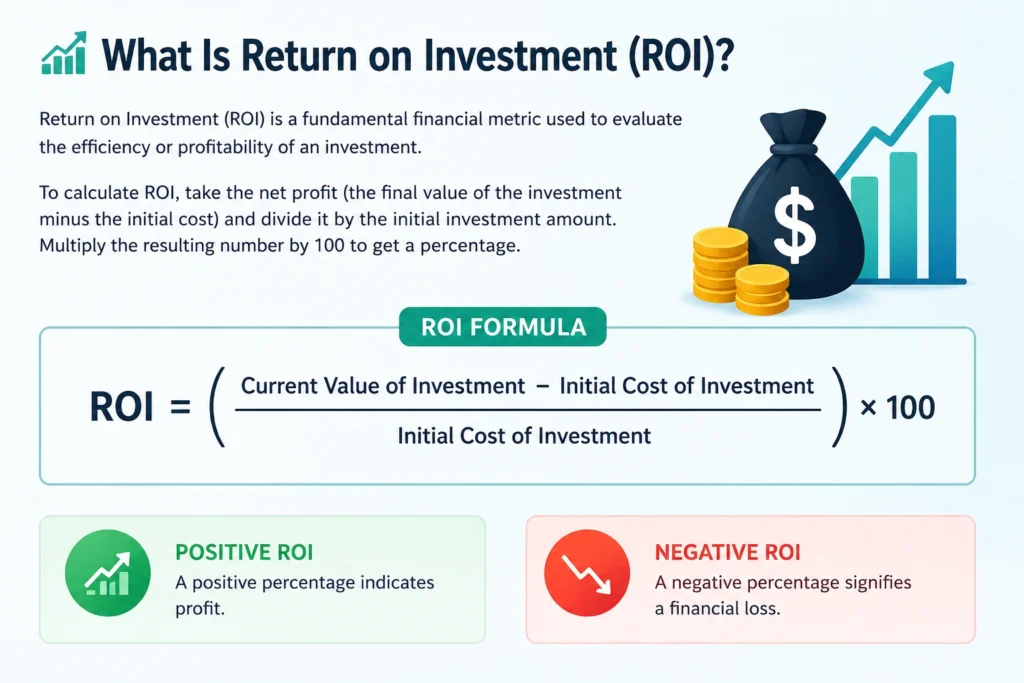
Quick Answer: Return on Investment (ROI) is a fundamental financial metric used to evaluate the efficiency or profitability of an investment. To calculate ROI, take the net profit (the final value of the investment minus the initial cost) and divide it by the initial investment amount. Multiply the resulting number by 100 to get a percentage.
$$\text{ROI} = \left( \frac{\text{Current Value of Investment} – \text{Initial Cost of Investment}}{\text{Initial Cost of Investment}} \right) \times 100$$
A positive percentage indicates profit, while a negative percentage signifies a financial loss.
📌 Key Takeaways
- Efficiency Metric: ROI measures the performance efficiency of capital across different asset types.
- Time Blindness: Standard ROI does not account for how long an asset is held; a 50% return over 10 years is vastly different from a 50% return over 1 year.
- Net vs Gross: True ROI accuracy depends entirely on subtracting hidden fees, transaction costs, and maintenance expenses from your gross gains.
- Comparative Tool: Use annualized ROI when comparing investments with different lifespans to ensure a fair analysis.
What is Return on Investment (ROI)?
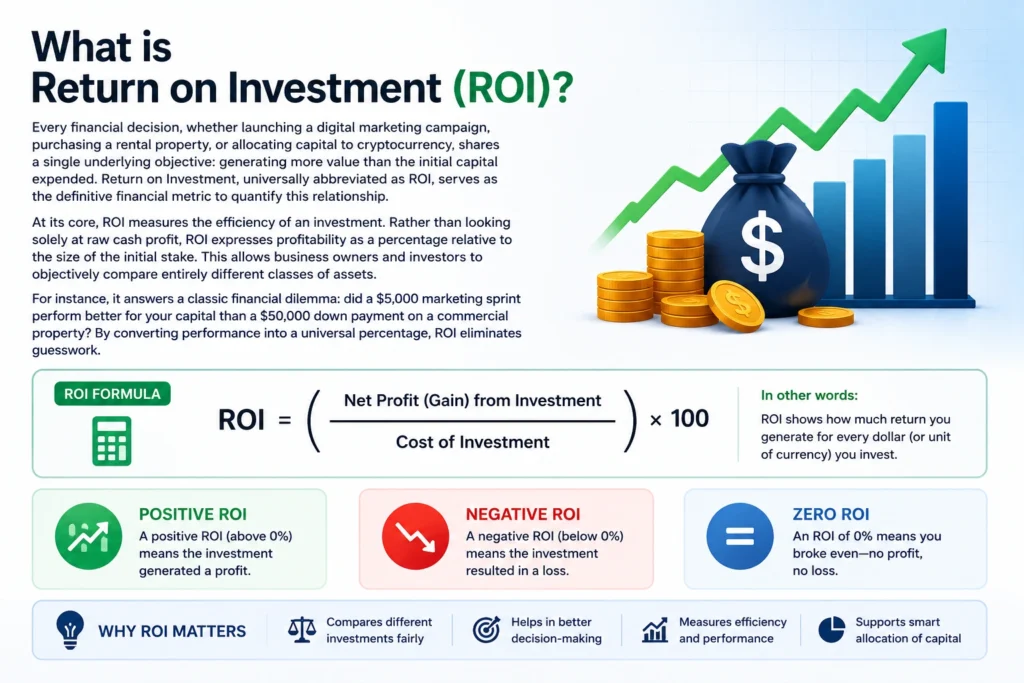
Every financial decision, whether launching a digital marketing campaign, purchasing a rental property, or allocating capital to cryptocurrency, shares a single underlying objective: generating more value than the initial capital expended. Return on Investment, universally abbreviated as ROI, serves as the definitive financial metric to quantify this relationship.
At its core, ROI measures the efficiency of an investment. Rather than looking solely at raw cash profit, ROI expresses profitability as a percentage relative to the size of the initial stake. This allows business owners and investors to objectively compare entirely different classes of assets. For instance, it answers a classic financial dilemma: did a $5,000 marketing sprint perform better for your capital than a $50,000 down payment on a commercial property? By converting performance into a universal percentage, ROI eliminates guesswork.
The Core ROI Formula and Calculation Method
To deploy an online investment return calculator effectively, one must understand how the underlying equations handle inputs. There are two primary variations of the ROI formula utilized by analysts worldwide.
Standard ROI Formula
The most common approach relies on the Net Benefit method, which isolates the net profit margin generated by the capital:
$$\text{ROI} = \left( \frac{\text{Net Profit}}{\text{Cost of Investment}} \right) \times 100$$
Alternatively, if you do not know your net profit upfront, you can derive it directly from the asset values using the second variation:
$$\text{ROI} = \left( \frac{\text{Gain from Investment} – \text{Cost of Investment}}{\text{Cost of Investment}} \right) \times 100$$
Breaking Down the Components: Gains vs Costs
Errors in calculating ROI almost always stem from an incorrect understanding of what constitutes a “gain” or a “cost.”
- Cost of Investment (Initial Investment Amount): This includes the purchase price of the asset plus all ancillary fees required to make the asset operational. For example, brokerage commissions, legal fees, transport costs, and installation expenses must be bundled into the initial investment amount. Treating these as ongoing expenses rather than upfront capital costs artificially inflates your perceived ROI.
- Gain from Investment: This is the total proceeds realized from the sale, usage, or ongoing dividends of the asset. When tracking capital gains, the final valuation must reflect the actual cash received after subtracting any regional exit fees, brokerage deductions, or clearing costs.
Step-by-Step Tutorial: How to Calculate Return on Investment
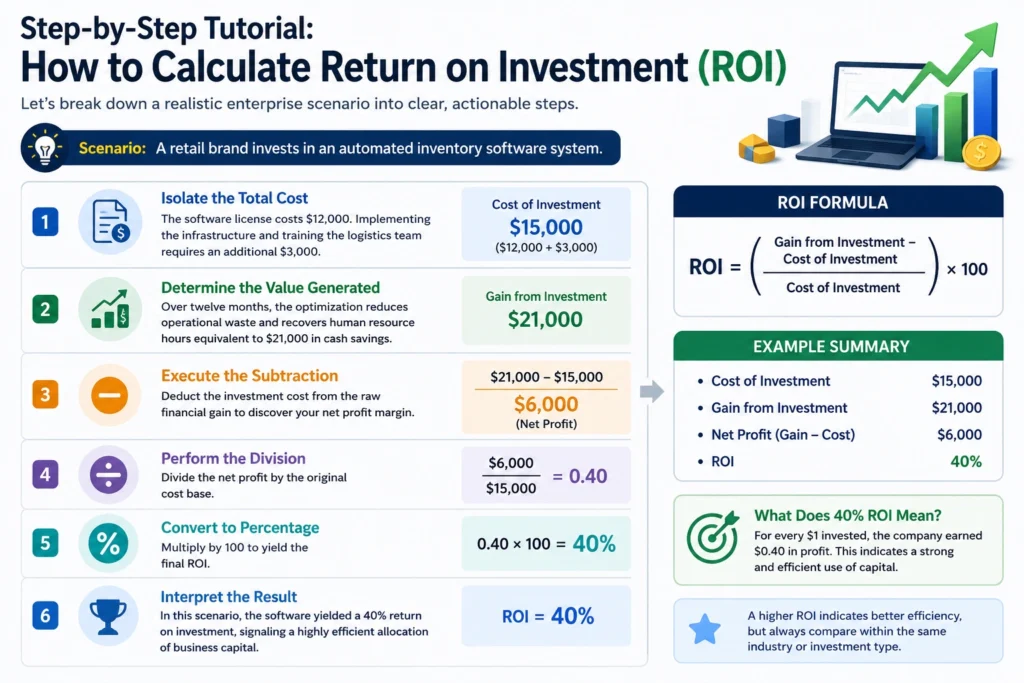
To ensure architectural accuracy when utilizing an ROI calculator online, let us break down a realistic enterprise scenario into distinct operational steps.
Imagine a retail brand investing capital into an automated inventory software system.
- Isolate the Total Cost: The software license costs $12,000. Implementing the infrastructure and training the logistics team requires an additional $3,000. The true Cost of Investment is $15,000.
- Determine the Value Generated: Over twelve months, the optimization reduces operational waste and recovers human resource hours equivalent to $21,000 in cash savings. This represents the Gain from Investment.
- Execute the Subtraction: Deduct the investment cost from the raw financial gain to discover your net profit margin.$$\$21,000 – \$15,000 = \$6,000 \text{ (Net Profit)}$$
- Perform the Division: Divide the net profit by the original cost base.$$\frac{\$6,000}{\$15,000} = 0.40$$
- Convert to Percentage: Multiply by 100 to yield the final ROI.$$0.40 \times 100 = 40\%$$
In this scenario, the software yielded a 40% return on investment, signaling a highly efficient allocation of business capital.
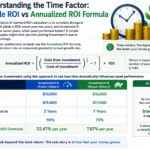
Understanding the Time Factor: Simple ROI vs Annualized ROI Formula
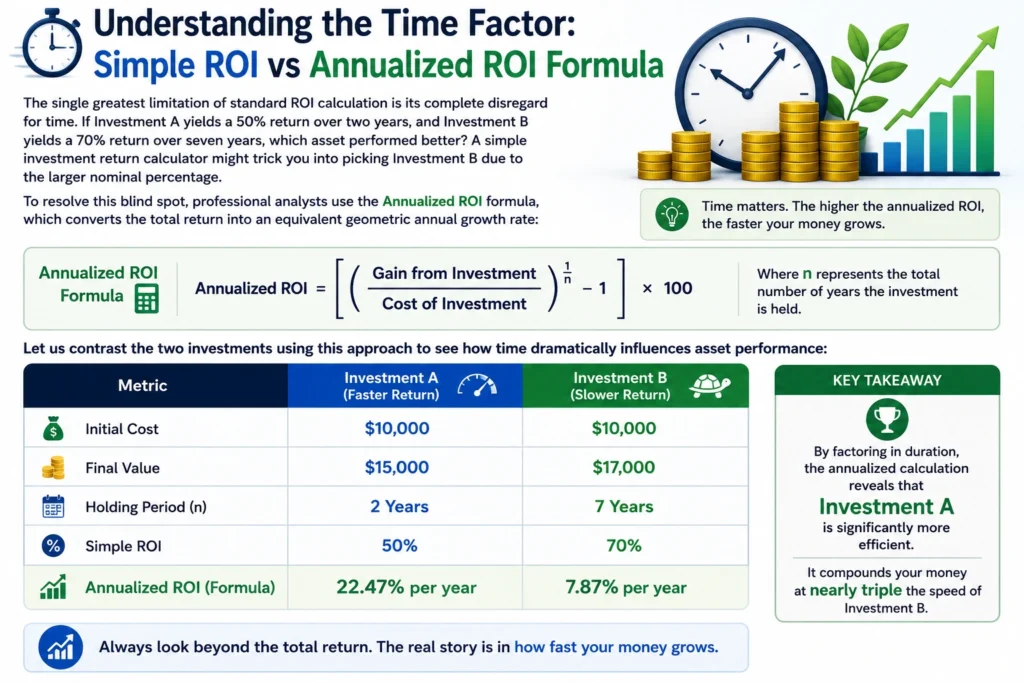
The single greatest limitation of standard ROI calculation is its complete disregard for time. If Investment A yields a 50% return over two years, and Investment B yields a 70% return over seven years, which asset performed better? A simple investment return calculator might trick you into picking Investment B due to the larger nominal percentage.
To resolve this blind spot, professional analysts use the Annualized ROI formula, which converts the total return into an equivalent geometric annual growth rate:
$$\text{Annualized ROI} = \left[ \left( \frac{\text{Gain from Investment}}{\text{Cost of Investment}} \right)^{\frac{1}{n}} – 1 \right] \times 100$$
Where $n$ represents the total number of years the investment is held.
Let us contrast the two investments using this approach to see how time dramatically influences asset performance:
| Metric | Investment A | Investment B |
| Initial Cost | $10,000 | $10,000 |
| Final Value | $15,000 | $17,000 |
| Holding Period ($n$) | 2 Years | 7 Years |
| Simple ROI | 50% | 70% |
| Annualized ROI Formula | 22.47% per year | 7.87% per year |
By factoring in duration, the annualized calculation reveals that Investment A is significantly more efficient. It compounds your money at nearly triple the speed of Investment B.
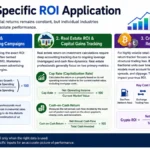
Industry-Specific ROI Application
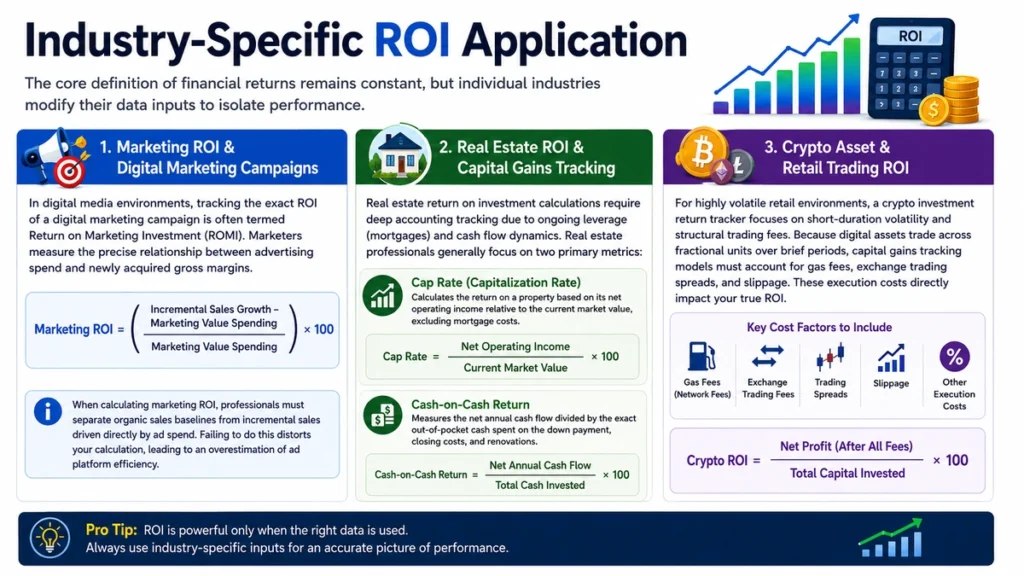
The core definition of financial returns remains constant, but individual industries modify their data inputs to isolate performance.
Marketing ROI & Digital Marketing Campaigns
In digital media environments, tracking the exact ROI of a digital marketing campaign is often termed Return on Marketing Investment (ROMI). Marketers measure the precise relationship between advertising spend and newly acquired gross margins.
$$\text{Marketing ROI} = \left( \frac{\text{Incremental Sales Growth} – \text{Marketing Value Spending}}{\text{Marketing Value Spending}} \right) \times 100$$
When calculating marketing ROI, professionals must separate organic sales baselines from incremental sales driven directly by ad spend. Failing to do this distorts your calculation, leading to an overestimation of ad platform efficiency.
Real Estate ROI & Capital Gains Tracking
Real estate return on investment calculations require deep accounting tracking due to ongoing leverage (mortgages) and cash flow dynamics. Real estate professionals generally focus on two primary metrics:
- Cap Rate (Capitalization Rate): Calculates the return on a property based on its net operating income relative to the current market value, excluding mortgage costs.
- Cash-on-Cash Return: Measures the net annual cash flow divided by the exact out-of-pocket cash spent on the down payment, closing costs, and renovations.
Crypto Asset & Retail Trading ROI
For highly volatile retail environments, a crypto investment return tracker focuses on short-duration volatility and structural trading fees. Because digital assets trade across fractional units over brief periods, capital gains tracking models must account for gas fees, exchange trading spreads, and slippage. These execution expenses quickly erode nominal gains if they are not explicitly factored into the cost base.
The Limitations of Return on Investment (ROI)
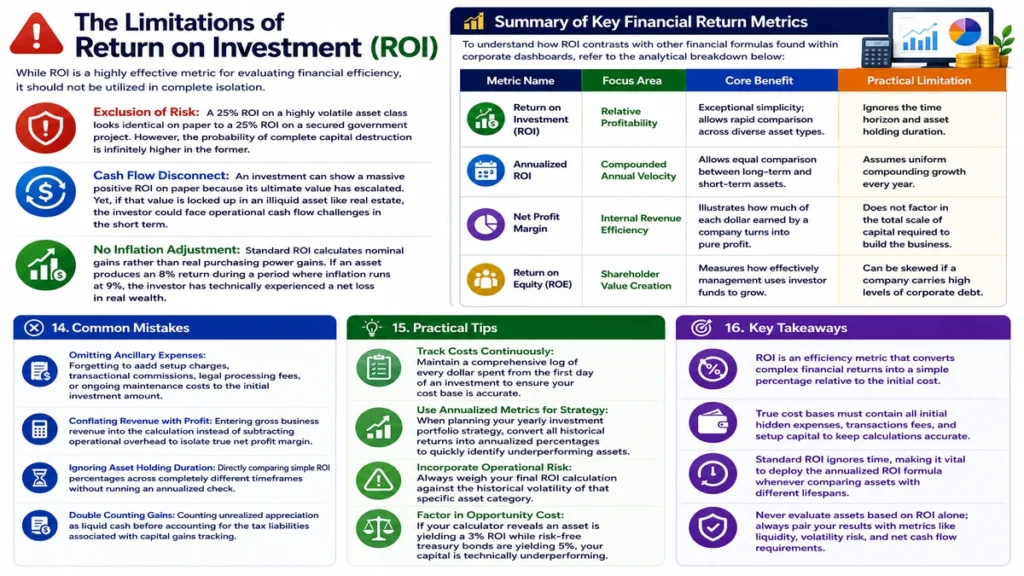
While ROI is a highly effective metric for evaluating financial efficiency, it should not be utilized in complete isolation.
- Exclusion of Risk: A 25% ROI on a highly volatile asset class looks identical on paper to a 25% ROI on a secured government project. However, the probability of complete capital destruction is infinitely higher in the former.
- Cash Flow Disconnect: An investment can show a massive positive ROI on paper because its ultimate value has escalated. Yet, if that value is locked up in an illiquid asset like real estate, the investor could face operational cash flow challenges in the short term.
- No Inflation Adjustment: Standard ROI calculates nominal gains rather than real purchasing power gains. If an asset produces an 8% return during a period where inflation runs at 9%, the investor has technically experienced a net loss in real wealth.
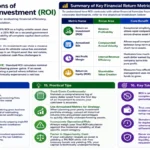
Summary of Key Financial Return Metrics
To understand how ROI contrasts with other financial formulas found within corporate dashboards, refer to the analytical breakdown below:
| Metric Name | Focus Area | Core Benefit | Practical Limitation |
| Return on Investment (ROI) | Relative Profitability | Exceptional simplicity; allows rapid comparison across diverse asset types. | Ignores the time horizon and asset holding duration. |
| Annualized ROI | Compounded Annual Velocity | Allows equal comparison between long-term and short-term assets. | Assumes uniform compounding growth every year. |
| Net Profit Margin | Internal Revenue Efficiency | Illustrates how much of each dollar earned by a company turns into pure profit. | Does not factor in the total scale of capital required to build the business. |
| Return on Equity (ROE) | Shareholder Value Creation | Measures how effectively management uses investor funds to grow. | Can be skewed if a company carries high levels of corporate debt. |
Common Mistakes
- Omitting Ancillary Expenses: Forgetting to add setup charges, transactional commissions, legal processing fees, or ongoing maintenance costs to the initial investment amount.
- Conflating Revenue with Profit: Entering gross business revenue into the calculation instead of subtracting operational overhead to isolate true net profit margin.
- Ignoring Asset Holding Duration: Directly comparing simple ROI percentages across completely different timeframes without running an annualized check.
- Double Counting Gains: Counting unrealized appreciation as liquid cash before accounting for the tax liabilities associated with capital gains tracking.
Practical Tips
- Track Costs Continuously: Maintain a comprehensive log of every dollar spent from the first day of an investment to ensure your cost base is accurate.
- Use Annualized Metrics for Strategy: When planning your yearly investment portfolio strategy, convert all historical returns into annualized percentages to quickly identify underperforming assets.
- Incorporate Operational Risk: Always weigh your final ROI calculation against the historical volatility of that specific asset category.
- Factor in Opportunity Cost: If your calculator reveals an asset is yielding a 3% ROI while risk-free treasury bonds are yielding 5%, your capital is technically underperforming.
Key Takeaways
- ROI is an efficiency metric that converts complex financial returns into a simple percentage relative to the initial cost.
- True cost bases must contain all initial hidden expenses, transactions fees, and setup capital to keep calculations accurate.
- Standard ROI ignores time, making it vital to deploy the annualized ROI formula whenever comparing assets with different lifespans.
- Never evaluate assets based on ROI alone; always pair your results with metrics like liquidity, volatility risk, and net cash flow requirements.
Frequently Asked Questions
What is the difference between ROI and profit margin?
Profit margin measures the percentage of revenue a business retains after subtracting direct production costs. ROI measures the total efficiency of a specific investment relative to the capital required to initiate it.
Can you have a negative investment return?

Yes. If the final value of your asset drops below your initial cost base, your calculation will yield a negative percentage, indicating a net financial loss.
Why is an annualized return metric better for long-term investments?
It normalizes time, letting you see exactly how much an investment grew each year on a compounded basis. This prevents a long, slow investment from looking better than a fast, high-yielding one.
Does a standard online ROI tool include tax liabilities?
Most free tools calculate gross returns before taxes. To get a precise net figure, you must manually subtract your capital gains tax obligation from your total return.
What is considered a historically healthy ROI percentage?
This depends entirely on the industry. Traditional stock market indices average around 7% to 10% annually after adjusting for inflation, whereas real estate averages fluctuate based on leverage and location.
How does inflation affect my calculated investment returns?
Inflation reduces the purchasing power of your money over time. If your asset achieves a 5% ROI while annual inflation is 5%, your real economic return is zero.
Why You Should Use an ROI Calculator Online Instead of Manual Spreadsheets
For years, corporate accountants and small business owners relied on manual spreadsheets to parse their performance data. However, as modern digital asset landscapes grow increasingly complex, executing these formulations by hand introduces substantial operational risk. Utilizing a dedicated ROI calculator online transforms financial auditing from a tedious task into an instant, error-free workflow.
Manual tracking often falls victim to human oversight. A single misplaced decimal point or an omitted cell reference in an Excel sheet can distort your metrics, leading to skewed projections that could misguide your entire venture capital distribution strategy. When you transition to a purpose-built investment return calculator, the algorithm guarantees uniform mathematical execution every single time.
Beyond standard accuracy, speed is a defining competitive advantage. Whether you are actively bidding on high-stakes digital real estate or calculating the immediate viability of a cross-channel ad sprint, time is directly tied to capital efficiency. A public, high-speed free ROI calculator lets cross-functional teams run rapid scenario analyses instantly on their mobile browsers without spending hours configuring complex pivot tables.
How Our Free ROI Calculator Simplifies Complex Business Decisions
Choosing the right utility architecture for your day-to-day analytics is crucial. Our platform delivers a comprehensive, highly accessible ROI calculator online designed to process multi-variable capital allocations with extreme precision. It strips away technical accounting jargon, offering a clean user interface that fields your financial inputs and returns clean data visualizations instantly.
Here is what happens behind the scenes when you execute a query inside the system:
[User Input: Initial Cost + Final Value]
                 │
                 ▼
     [Validation Check System]
                 │
                 ▼
  [Standard ROI & Annualized Formula Processing]
                 │
                 ▼
[Output: Percent Return Card + Dynamic Performance Badge]
Our software stack doesn’t just calculate basic nominal percentages. The core engine is calibrated to act as a multi-asset Return on Investment calculator. This means it can seamlessly pivot between evaluating low-overhead digital assets and heavy physical investments that carry unique upfront logistics expenses.
Furthermore, our design isolates the precise net profit margins alongside your core percentage returns, preventing the typical mistakes where gross turnovers are accidentally confused with liquid returns. By using this best free ROI calculator, you equip your business with a reliable, production-ready framework to audit historical expenses and confidently forecast your next profitable milestone.
Continue reading:
What Is Blockchain Technology?
How Does a Blockchain Transaction Work?
What Is a Blockchain Ledger? Beginner’s Complete Guide
Best ChatGPT Prompts for Students
Written by StormNex Editorial Team
The StormNex Editorial Team publishes in-depth educational guides on blockchain, cryptocurrency, artificial intelligence, and emerging technologies. Every guide is carefully researched to make complex topics easier to understand for beginners and professionals alike.