
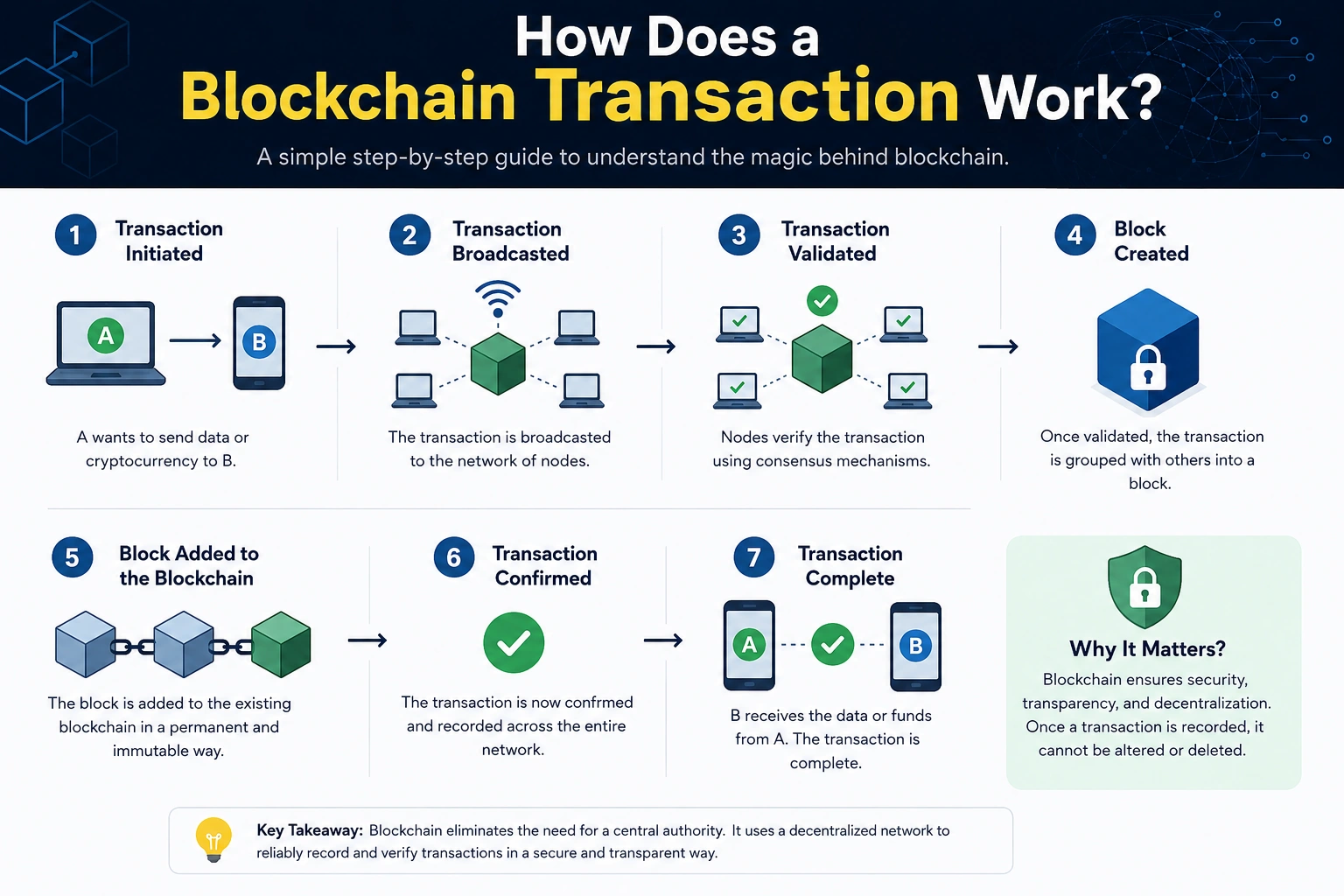
How Does a Blockchain Transaction Work?
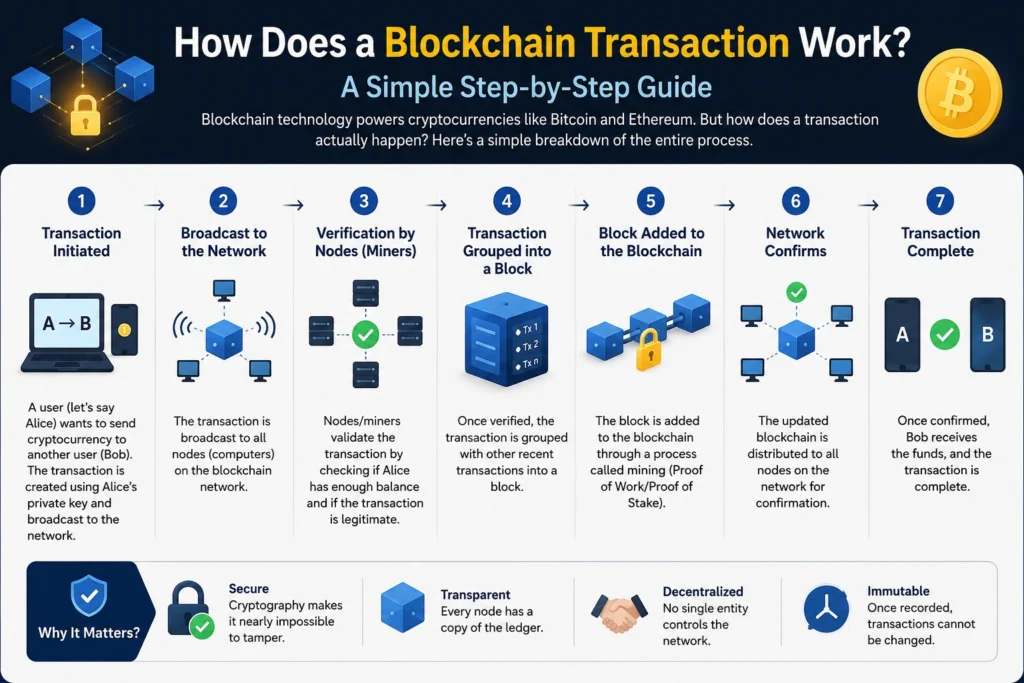
A blockchain transaction begins when someone sends cryptocurrency from a digital wallet. The transaction is broadcast to thousands of computers, called nodes, across the blockchain network. These nodes verify the sender’s balance and digital signature before approving the transaction. Once verified, the transaction is grouped with others into a block. Through a consensus mechanism, such as Proof of Work or Proof of Stake, the network confirms the block and permanently adds it to the blockchain. Once recorded, the transaction becomes extremely difficult to alter, making blockchain secure, transparent, and trustworthy.
Key Takeaways
Before diving into the details, here are the most important things you’ll learn:
- A blockchain transaction passes through several verification stages before it becomes permanent.
- Nodes work together to verify transactions without relying on a central authority.
- Consensus mechanisms prevent fraud and double spending.
- Every confirmed transaction becomes part of an immutable digital ledger.
- Transaction speed depends on the blockchain network, congestion, and transaction fees.
How Does a Blockchain Transaction Work? Step-by-Step Guide for Beginners
What Happens When You Send Cryptocurrency?
Imagine sending Bitcoin to a friend living in another country.
With a traditional bank transfer, your payment may pass through multiple banks, payment processors, and clearing systems before reaching the recipient. Depending on the countries involved, this process can take hours or even several days.
A blockchain transaction works differently.
Instead of asking a bank to approve the payment, your wallet sends the transaction directly to a decentralized network of computers. These computers work together to verify that everything is legitimate before adding the transaction to a shared digital ledger.
No single bank approves the payment.
No central authority owns the database.
Instead, thousands of independent computers help maintain the network.
That decentralized approach is what makes blockchain fundamentally different from traditional payment systems.
A Quick Overview
Every blockchain transaction follows the same basic lifecycle.
- You create a transaction using your crypto wallet.
- The transaction is broadcast to the blockchain network.
- Thousands of nodes verify the information.
- Valid transactions are grouped into a new block.
- The network reaches consensus.
- The block is added to the blockchain.
- Your transaction becomes part of the permanent ledger.
At first glance, those steps sound technical.
In reality, each one solves a specific problem: making sure digital money cannot be copied, altered, or spent twice.
That’s one of blockchain’s greatest achievements.
How Does a Blockchain Transaction Work?
Although every blockchain has its own rules, the overall process is surprisingly similar across networks such as Bitcoin and Ethereum.
Let’s walk through each stage in simple language.
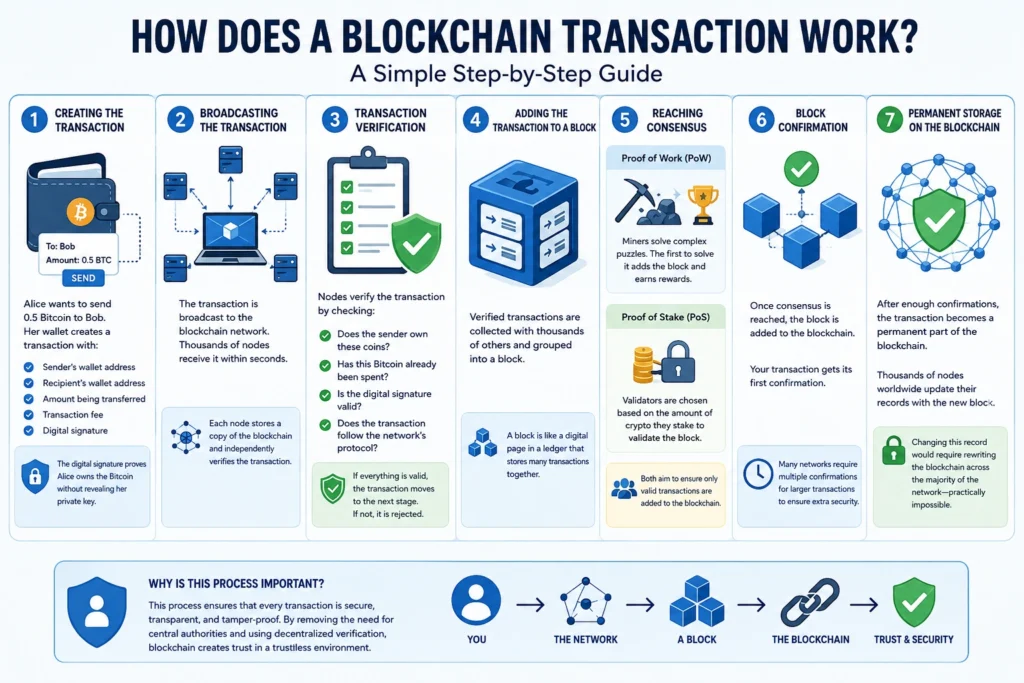
Step 1 — Creating the Transaction
Everything begins inside your cryptocurrency wallet.
Suppose Alice wants to send 0.5 Bitcoin to Bob.
When she enters Bob’s wallet address and clicks Send, her wallet creates a digital transaction containing several important pieces of information:
- Sender’s wallet address
- Recipient’s wallet address
- Amount being transferred
- Transaction fee
- Digital signature
The digital signature is especially important.
It proves that Alice owns the Bitcoin without revealing her private key.
This cryptographic verification helps protect users from fraud while maintaining security across the network.
Step 2 — Broadcasting the Transaction
After the transaction is created, it isn’t sent to a bank.
Instead, it’s broadcast to the blockchain network.
Thousands of computers around the world receive the same transaction within seconds.
These computers are known as nodes.
Each node stores a copy of the blockchain and independently checks whether the transaction follows the network’s rules.
Rather than trusting one organization, blockchain relies on collective verification.
This distributed approach makes the network far more resilient against manipulation and single points of failure.
Step 3 — Transaction Verification
Now the real work begins.
Every participating node checks questions such as:
- Does the sender actually own these coins?
- Has this Bitcoin already been spent?
- Is the digital signature valid?
- Does the transaction follow the network’s protocol?
Only after these checks pass does the transaction move to the next stage.
If something doesn’t add up, the network rejects the transaction automatically.
That automated verification process is one of the key reasons blockchain is considered secure.
Step 4 — Adding the Transaction to a Block
After your transaction passes verification, it isn’t immediately written to the blockchain.
Instead, it joins thousands of other verified transactions waiting to be processed.
These verified transactions are collected into a block.
You can think of a block as a digital page in a ledger. Rather than containing just one payment, each block stores many transactions together.
For example, if thousands of people are sending Bitcoin around the world at the same time, many of those payments will be included in the next available block.
This batching process keeps the blockchain organized and efficient.
Step 5 — Reaching Consensus
Now the network needs to agree that the new block is valid.
This agreement process is called consensus.
Without consensus, anyone could create fake transactions or spend the same cryptocurrency multiple times.
Different blockchains use different consensus mechanisms.
Proof of Work (PoW)
Bitcoin uses Proof of Work.
Specialized computers, called miners, compete to solve a complex mathematical puzzle. The first miner to solve it earns the right to add the next block to the blockchain and receives a block reward plus transaction fees.
Although Proof of Work is highly secure, it requires significant computing power.
Proof of Stake (PoS)
Many newer blockchains, including modern Ethereum, use Proof of Stake.
Instead of solving mathematical puzzles, validators are chosen to verify new blocks based partly on the amount of cryptocurrency they have staked.
This approach generally uses much less energy while still maintaining strong security.
Both systems aim to achieve the same goal: ensuring that only valid transactions become part of the blockchain.
Step 6 — Block Confirmation
Once consensus is reached, the block is officially accepted by the network.
The block is linked to the previous block using cryptographic hashes, creating an unbroken chain of records.
At this point, your transaction receives its first confirmation.
On many blockchain networks, one confirmation is enough for smaller payments.
For larger transactions, exchanges and businesses often wait for multiple confirmations before considering the payment final.
This extra layer of verification further reduces the risk of fraud.
Step 7 — Permanent Storage on the Blockchain
After enough confirmations, the transaction becomes part of the blockchain’s permanent history.
Every full node updates its copy of the blockchain to include the new block.
This means thousands of computers around the world now hold the same verified record.
Changing that record would require rewriting the blockchain across a majority of the network simultaneously—something that is practically impossible on large, well-established blockchains.
This immutability is one of blockchain’s most valuable features.
Who Verifies Blockchain Transactions?
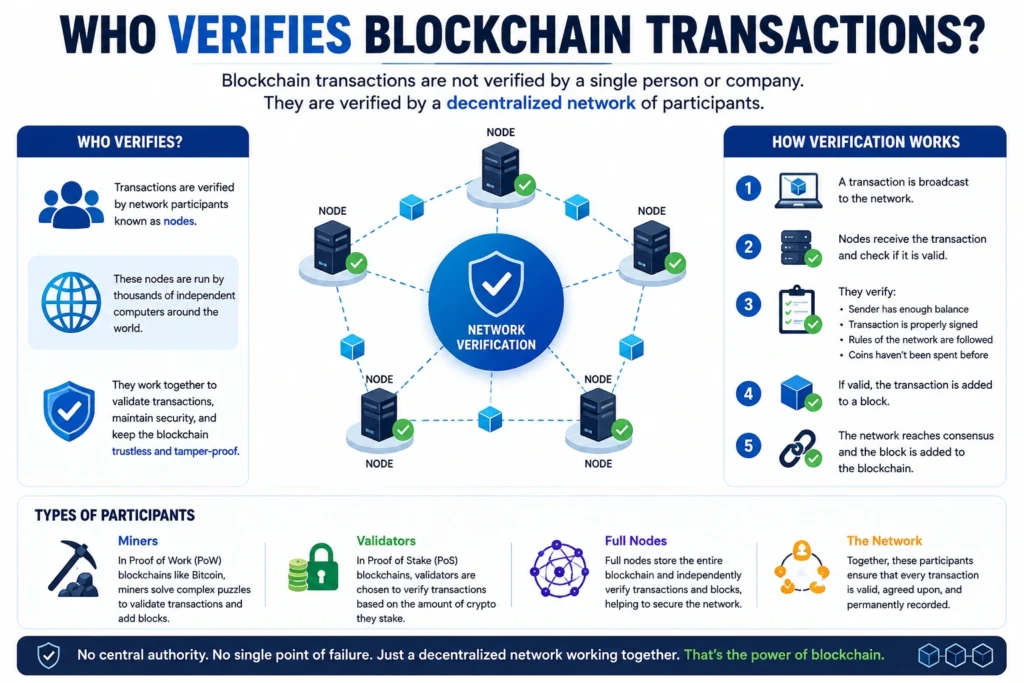
One common misconception is that a single company verifies blockchain transactions.
In reality, verification is performed by independent participants across the network.
Depending on the blockchain, these participants may include:
- Full nodes
- Validators
- Miners
Each participant follows the same protocol and independently checks whether a transaction is valid.
This decentralized verification model removes the need for a central authority while helping maintain trust across the network.
What Are Blockchain Nodes?
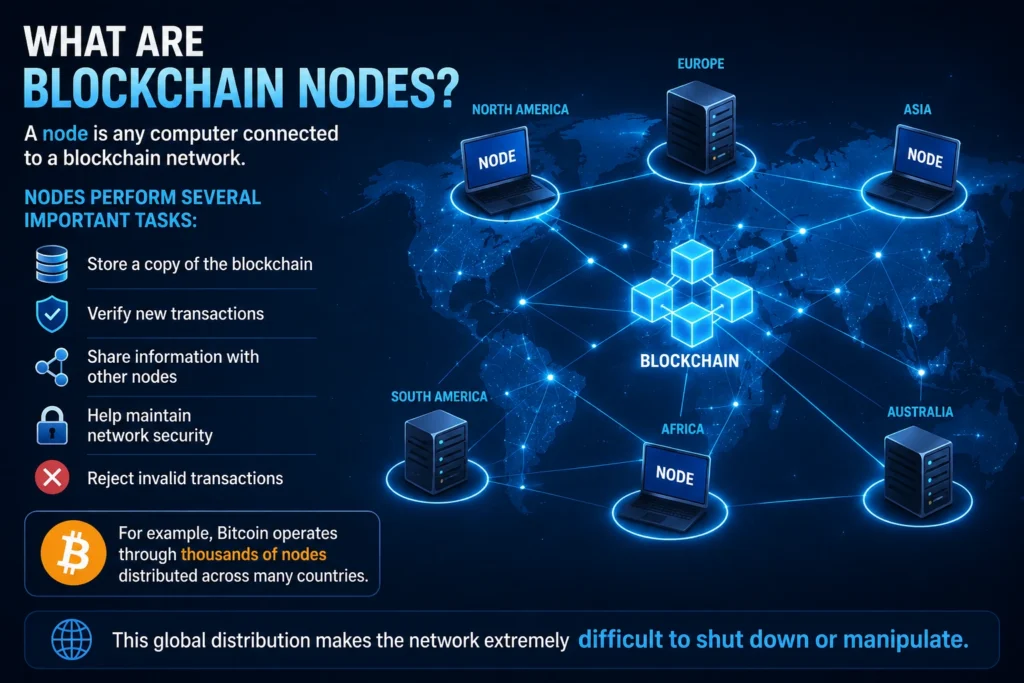
A node is any computer connected to a blockchain network.
Nodes perform several important tasks:
- Store a copy of the blockchain
- Verify new transactions
- Share information with other nodes
- Help maintain network security
- Reject invalid transactions
The larger the number of active nodes, the more decentralized and resilient the network becomes.
For example, Bitcoin operates through thousands of nodes distributed across many countries.
This global distribution makes the network extremely difficult to shut down or manipulate.
Blockchain Transaction Lifecycle
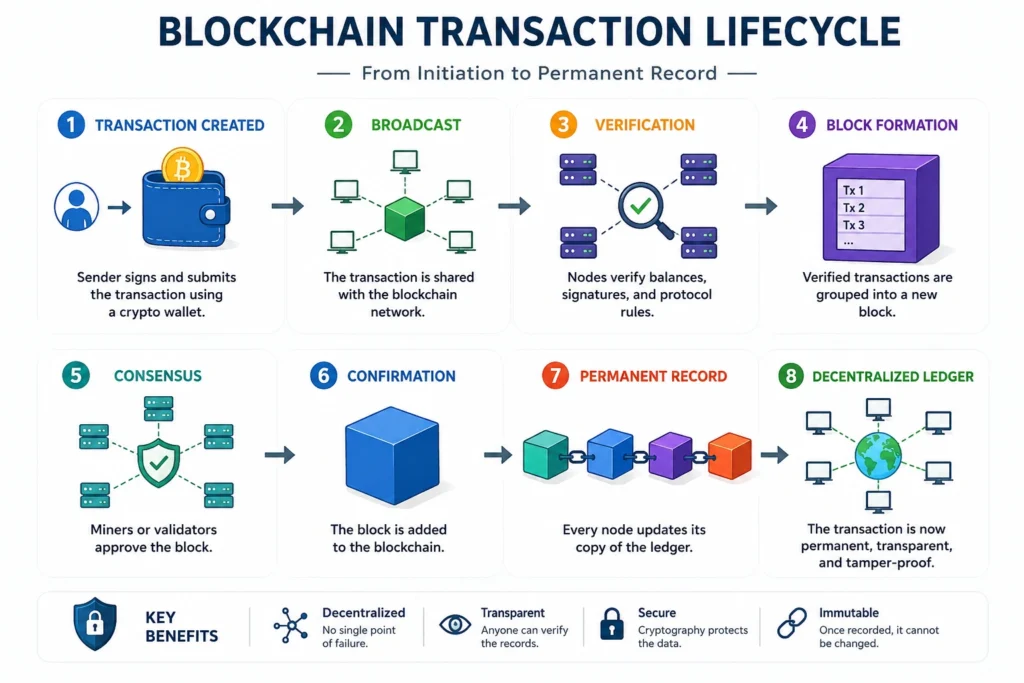
The entire process can be summarized like this:
| Stage | What Happens |
|---|---|
| Transaction Created | Sender signs and submits the transaction using a crypto wallet. |
| Broadcast | The transaction is shared with the blockchain network. |
| Verification | Nodes verify balances, signatures, and protocol rules. |
| Block Formation | Verified transactions are grouped into a new block. |
| Consensus | Miners or validators approve the block. |
| Confirmation | The block is added to the blockchain. |
| Permanent Record | Every node updates its copy of the ledger. |
How Long Does a Blockchain Transaction Take?
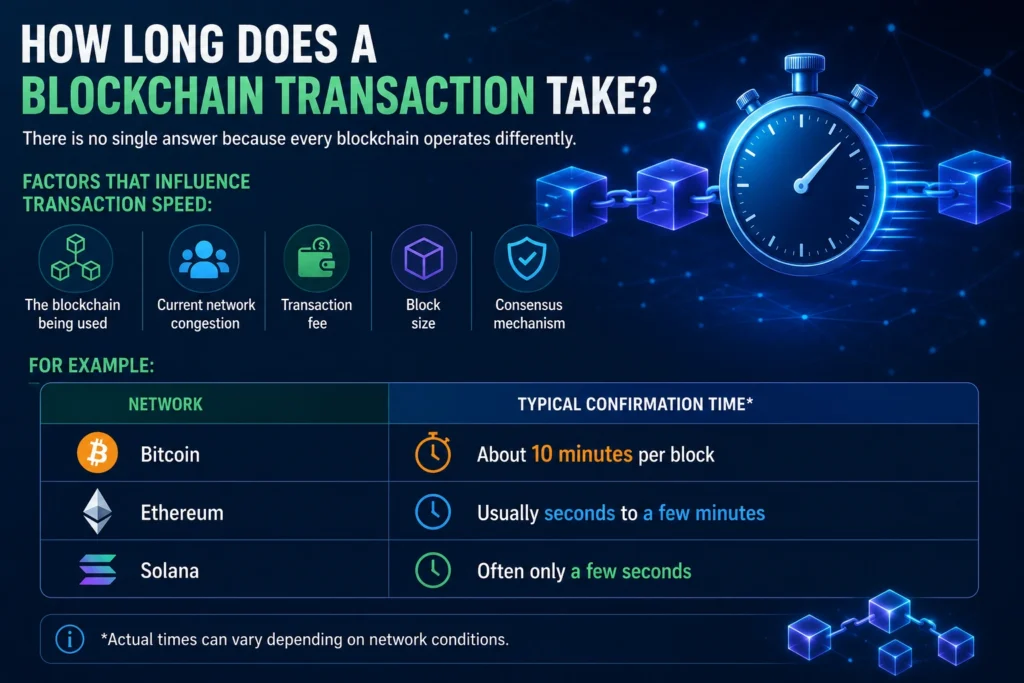
There is no single answer because every blockchain operates differently.
Several factors influence transaction speed:
- The blockchain being used
- Current network congestion
- Transaction fee
- Block size
- Consensus mechanism
For example:
| Network | Typical Confirmation Time* |
|---|---|
| Bitcoin | About 10 minutes per block |
| Ethereum | Usually seconds to a few minutes |
| Solana | Often only a few seconds |
*Actual times can vary depending on network conditions.
Why Do Some Blockchain Transactions Get Delayed?
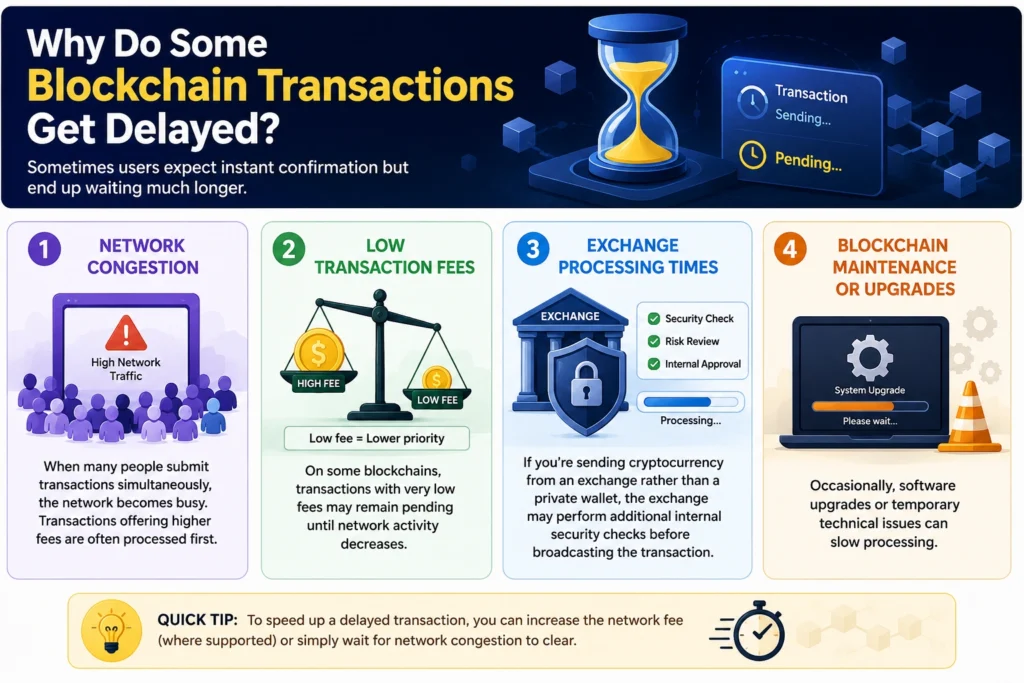
Sometimes users expect instant confirmation but end up waiting much longer.
Common reasons include:
Network Congestion
When many people submit transactions simultaneously, the network becomes busy.
Transactions offering higher fees are often processed first.
Low Transaction Fees
On some blockchains, transactions with very low fees may remain pending until network activity decreases.
Exchange Processing Times
If you’re sending cryptocurrency from an exchange rather than a private wallet, the exchange may perform additional internal security checks before broadcasting the transaction.
Blockchain Maintenance or Upgrades
Occasionally, software upgrades or temporary technical issues can slow processing.
Why Blockchain Transactions Cannot Easily Be Changed
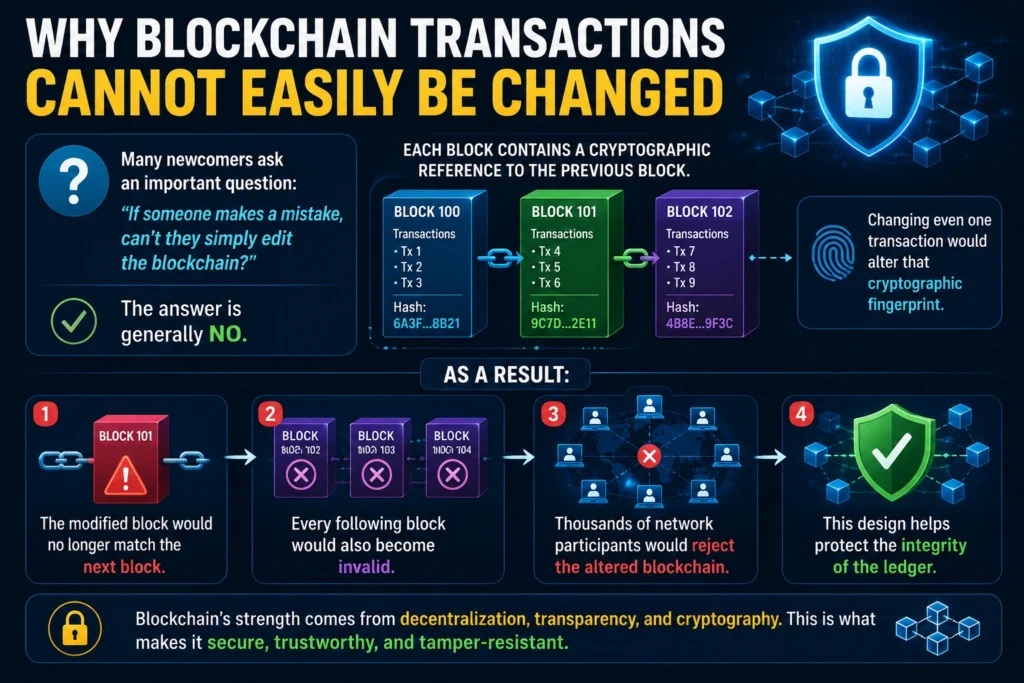
Many newcomers ask an important question:
“If someone makes a mistake, can’t they simply edit the blockchain?”
The answer is generally no.
Each block contains a cryptographic reference to the previous block.
Changing even one transaction would alter that cryptographic fingerprint.
As a result:
- The modified block would no longer match the next block.
- Every following block would also become invalid.
- Thousands of network participants would reject the altered blockchain.
This design helps protect the integrity of the ledger.
Blockchain vs Traditional Bank Transfers
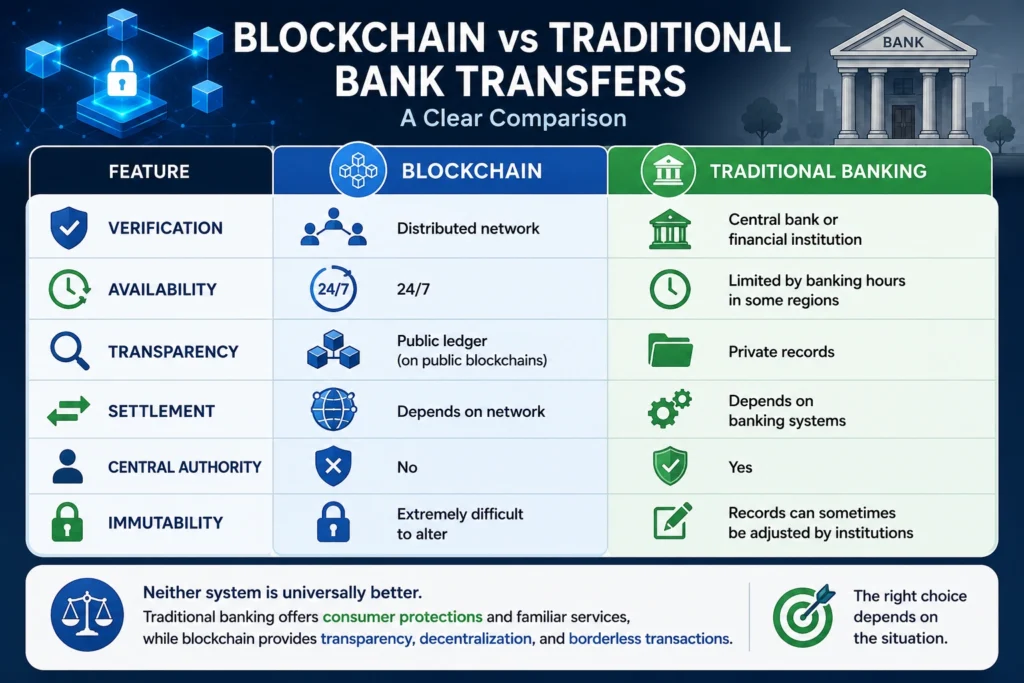
| Feature | Blockchain | Traditional Banking |
|---|---|---|
| Verification | Distributed network | Central bank or financial institution |
| Availability | 24/7 | Limited by banking hours in some regions |
| Transparency | Public ledger (on public blockchains) | Private records |
| Settlement | Depends on network | Depends on banking systems |
| Central Authority | No | Yes |
| Immutability | Extremely difficult to alter | Records can sometimes be adjusted by institutions |
Neither system is universally better.
Traditional banking offers consumer protections and familiar services, while blockchain provides transparency, decentralization, and borderless transactions.
The right choice depends on the situation.
Final Thoughts
A blockchain transaction may appear complicated from the outside, but its underlying process follows a logical sequence.
A transaction is created, shared across the network, verified by independent computers, grouped into a block, approved through consensus, and permanently recorded on the blockchain.
Each stage exists for a reason.
Verification prevents fraud.
Consensus builds trust.
Permanent records protect integrity.
Together, these mechanisms allow people around the world to transfer digital assets without relying on a central authority.
Understanding this lifecycle not only makes blockchain easier to understand—it also helps explain why the technology has become the foundation of cryptocurrencies, decentralized finance, and many emerging digital applications.
Common Mistakes Beginners Make
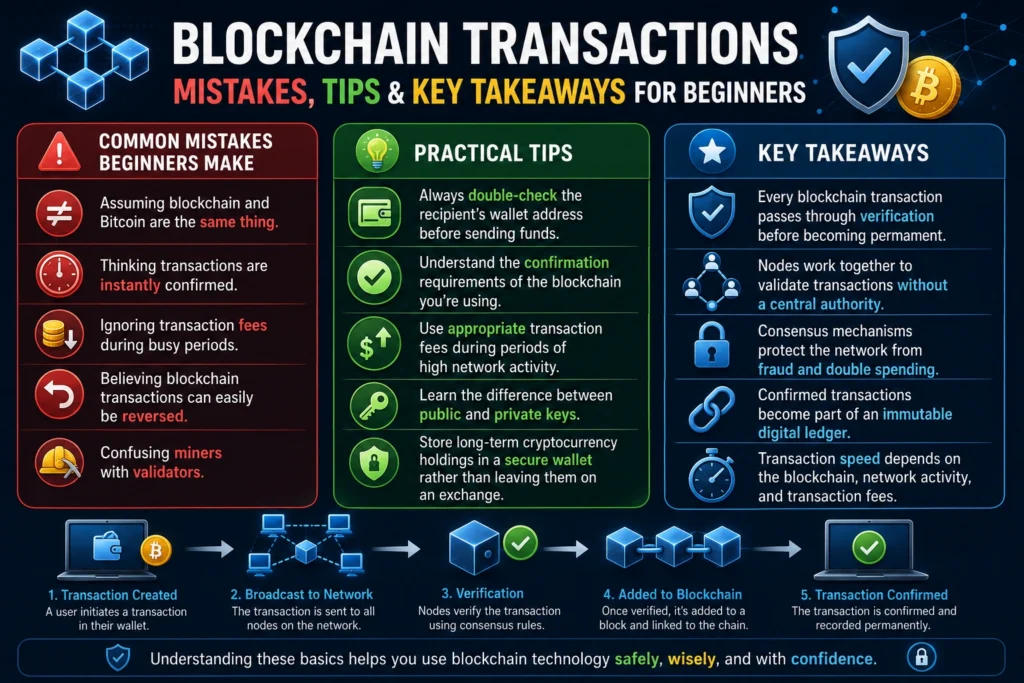
- Assuming blockchain and Bitcoin are the same thing.
- Thinking transactions are instantly confirmed.
- Ignoring transaction fees during busy periods.
- Believing blockchain transactions can easily be reversed.
- Confusing miners with validators.
Practical Tips
- Always double-check the recipient’s wallet address before sending funds.
- Understand the confirmation requirements of the blockchain you’re using.
- Use appropriate transaction fees during periods of high network activity.
- Learn the difference between public and private keys.
- Store long-term cryptocurrency holdings in a secure wallet rather than leaving them on an exchange.
Final Summary
- Every blockchain transaction passes through verification before becoming permanent.
- Nodes work together to validate transactions without a central authority.
- Consensus mechanisms protect the network from fraud and double spending.
- Confirmed transactions become part of an immutable digital ledger.
- Transaction speed depends on the blockchain, network activity, and transaction fees.
Frequently Asked Questions
1. How does a blockchain transaction work in simple words?
A blockchain transaction starts when someone sends cryptocurrency from a digital wallet. The transaction is broadcast to a decentralized network, verified by nodes, grouped into a block, approved through a consensus mechanism, and permanently recorded on the blockchain.
2. What verifies a blockchain transaction?
Blockchain transactions are verified by network participants such as nodes, miners, or validators. They check digital signatures, wallet balances, and network rules before approving a transaction.
3. How long does a blockchain transaction take?
It depends on the blockchain network, transaction fee, and current network congestion. Some transactions are confirmed within seconds, while others may take several minutes or longer during busy periods.
4. Can a blockchain transaction be reversed?
Generally, no. Once a transaction has been confirmed and added to the blockchain, it becomes extremely difficult to reverse. This immutability is one of blockchain’s key security features.
5. What are nodes in blockchain?
Nodes are computers connected to the blockchain network. They store copies of the blockchain, verify transactions, and help maintain the network’s security and decentralization.
6. What is the difference between miners and validators?
Miners secure Proof of Work blockchains, such as Bitcoin, by solving complex mathematical problems. Validators secure Proof of Stake blockchains by confirming transactions after staking cryptocurrency.
7. Why do blockchain transactions sometimes get delayed?
Delays are usually caused by network congestion, low transaction fees, exchange processing times, or temporary blockchain maintenance.
8. Is blockchain more secure than traditional banking systems?
Blockchain offers strong security through cryptography and decentralized verification. However, users are still responsible for protecting their wallets, private keys, and recovery phrases.
If you’re new to blockchain, your next step is understanding how blockchain technology works before exploring cryptocurrencies like Bitcoin or Ethereum.
Continue reading:
What Is Blockchain Technology?
Written by StormNex Editorial Team
The StormNex Editorial Team publishes in-depth educational guides on blockchain, cryptocurrency, artificial intelligence, and emerging technologies. Every guide is carefully researched to make complex topics easier to understand for beginners and professionals alike.
1 thought on “How Does a Blockchain Transaction Work? A Simple Step-by-Step Guide”