What Is a Blockchain Ledger?
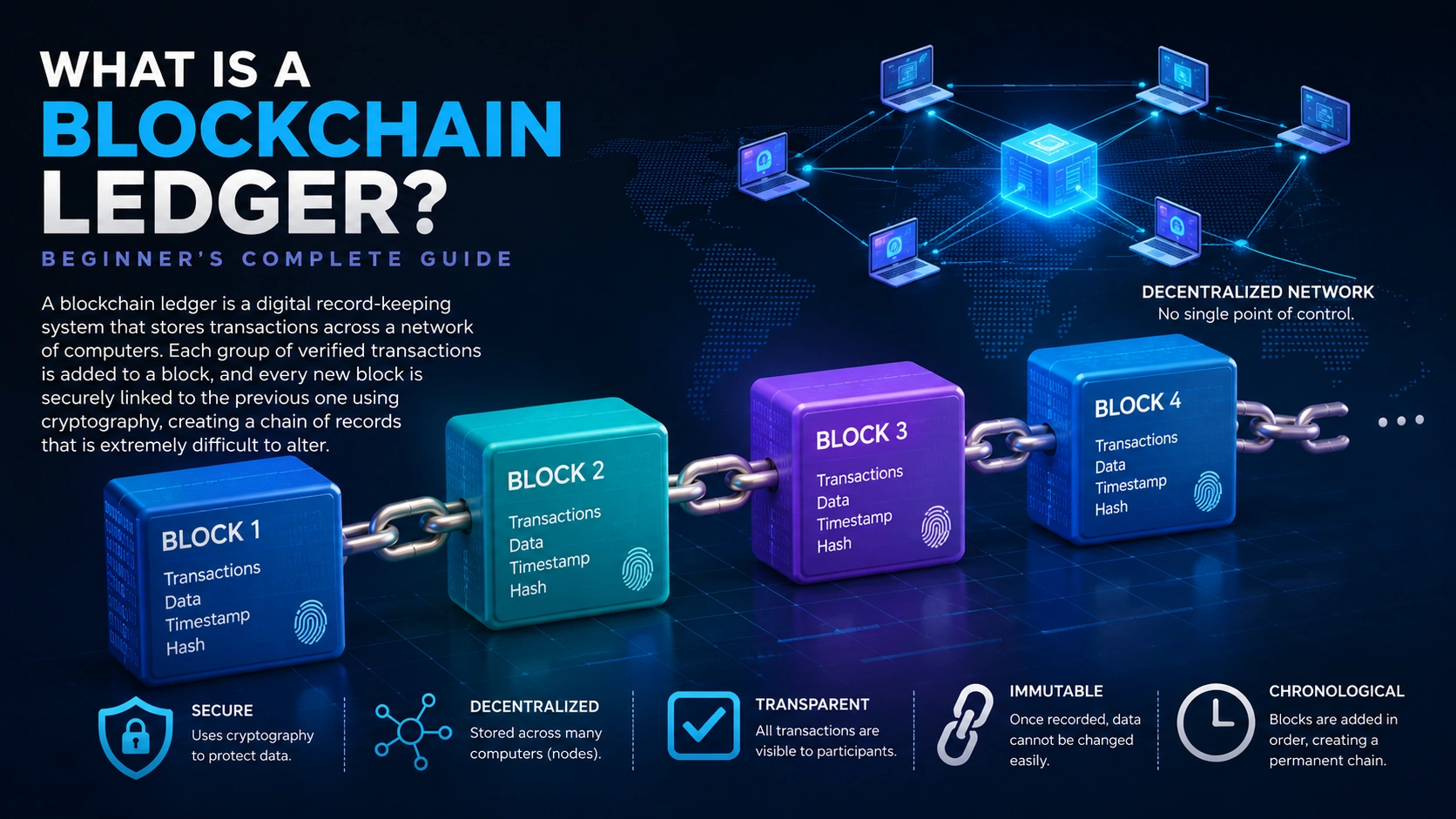
A blockchain ledger is a digital record-keeping system that stores transactions and other data across a network of computers instead of relying on a single central authority. Each group of verified transactions is added to a block, and every new block is securely linked to the previous one using cryptography. This creates a chronological chain of records that is extremely difficult to alter without the agreement of the network.
Unlike traditional financial ledgers maintained by banks or organizations, a blockchain ledger allows multiple participants to share and verify the same information, improving transparency, security, and data integrity.
Educational Disclaimer: This article is provided for informational and educational purposes only. It should not be considered financial, legal, tax, or investment advice. If you make financial decisions involving cryptocurrencies or blockchain-based assets, always conduct your own research and consult qualified professionals where appropriate.
Key Takeaways
- A blockchain ledger is a distributed digital record shared across many computers.
- Information is stored in blocks that are linked together using cryptographic techniques.
- Every participant on the network can verify transactions according to the blockchain’s rules.
- Once confirmed, blockchain records are intentionally difficult to modify, helping preserve data integrity.
- Public, private, consortium, and hybrid ledgers serve different purposes and use cases.
- Blockchain ledgers have applications beyond cryptocurrencies, including supply chains, healthcare, digital identity, and document verification.
- Understanding blockchain ledgers helps readers build a stronger foundation before learning about wallets, mining, smart contracts, or decentralized finance.
What Is a Blockchain Ledger? A Beginner’s Guide to Distributed Digital Records

When people first hear about blockchain, they often focus on cryptocurrencies like Bitcoin or Ethereum. However, the technology’s true foundation is the blockchain ledger—a digital system designed to record information in a secure, transparent, and tamper-resistant way.
A blockchain ledger is much more than a list of cryptocurrency transactions. It provides a shared record of information that can be verified by multiple participants without relying on a single organization to maintain trust. This approach has attracted interest across industries, from finance and logistics to healthcare and digital identity.
To understand how blockchain works, it helps to first understand the ledger itself.
Understanding Blockchain Ledgers
What Is a Blockchain Ledger?
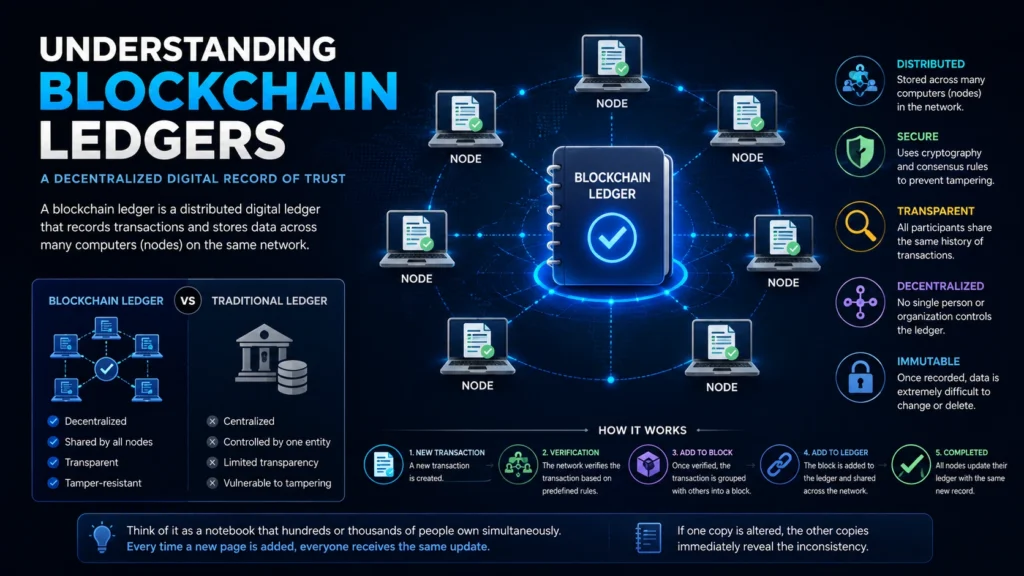
A blockchain ledger is a distributed digital ledger that records transactions and stores data across many computers connected to the same network.
Unlike a traditional ledger, where one organization controls the records, every participating computer—often called a node—maintains a copy of the ledger. When new transactions occur, the network verifies them according to predefined rules before adding them to the ledger.
Because every participant shares the same history of transactions, it becomes much harder for a single person or organization to secretly alter past records.
Think of it as a notebook that hundreds or even thousands of people own simultaneously. Every time a new page is added, everyone receives the same update. If one copy is altered, the other copies immediately reveal the inconsistency.
This shared verification process is one of the reasons blockchain technology is often described as being decentralized.
What Is a Distributed Ledger?
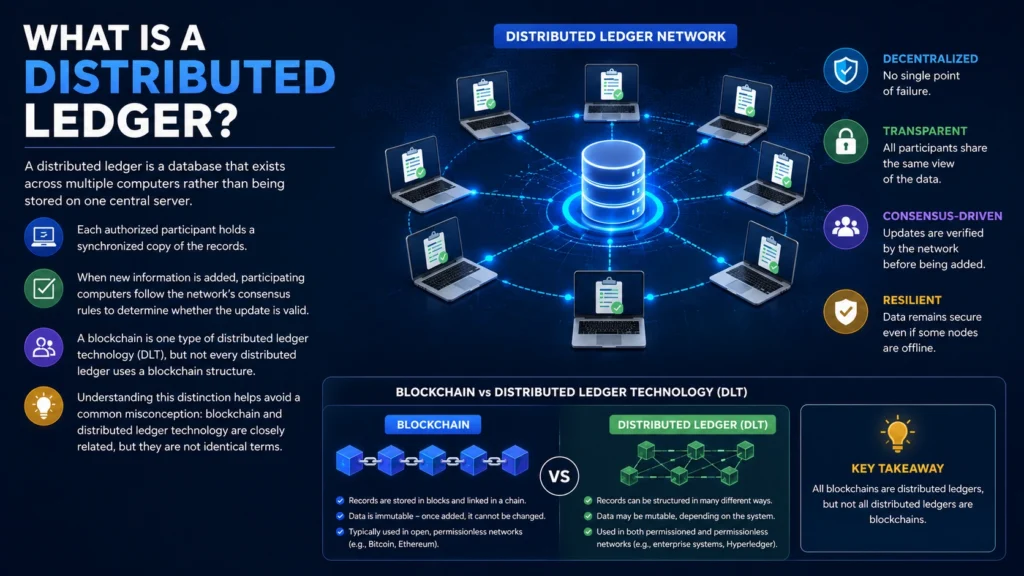
A distributed ledger is a database that exists across multiple computers rather than being stored on one central server.
Each authorized participant holds a synchronized copy of the records. When new information is added, participating computers follow the network’s consensus rules to determine whether the update is valid.
A blockchain is one type of distributed ledger technology (DLT), but not every distributed ledger uses a blockchain structure. Some DLT systems organize records differently while still distributing copies of the ledger across multiple participants.
Understanding this distinction helps avoid a common misconception: blockchain and distributed ledger technology are closely related, but they are not identical terms.
Why Is It Called a Blockchain?
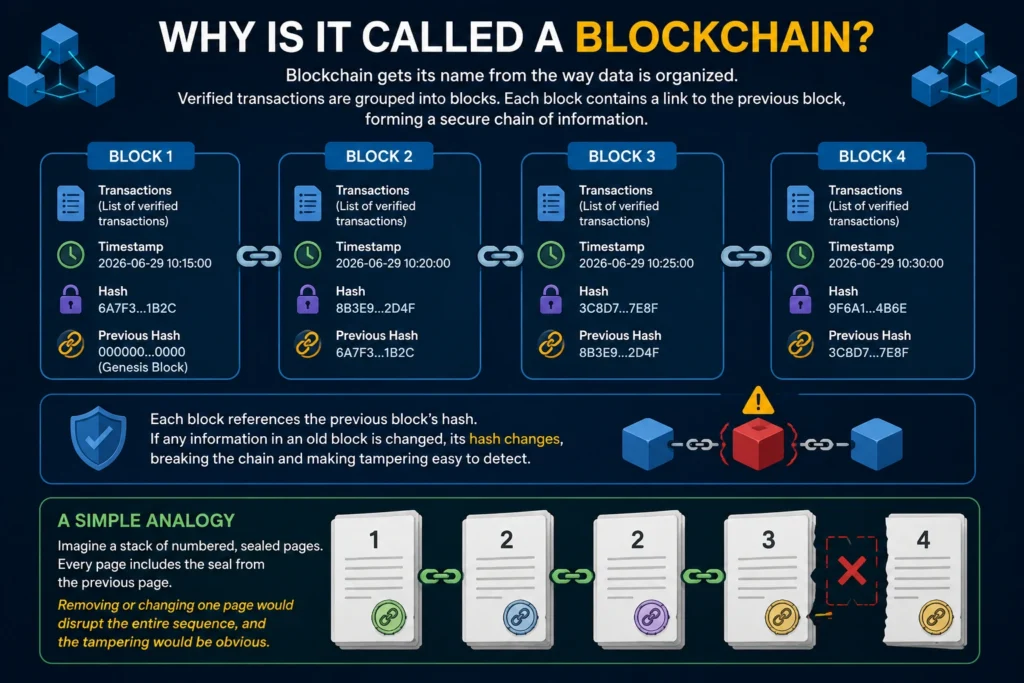
The name comes from the way information is organized.
Instead of storing records in one continuously editable file, blockchain groups verified transactions into blocks.
Each block contains:
- A collection of verified transactions
- A timestamp showing when the block was created
- A unique cryptographic hash
- A reference to the previous block’s hash
Because every block references the one before it, the blocks form a chronological chain.
Changing information inside an older block would alter its cryptographic hash, breaking the connection to every block that follows. This design makes unauthorized changes extremely difficult without broad network agreement.
A useful analogy is a stack of numbered, sealed pages where every page includes the seal from the previous page. Removing or changing one page would disrupt the entire sequence, making the tampering easy to detect.
How Data Is Stored in a Blockchain Ledger
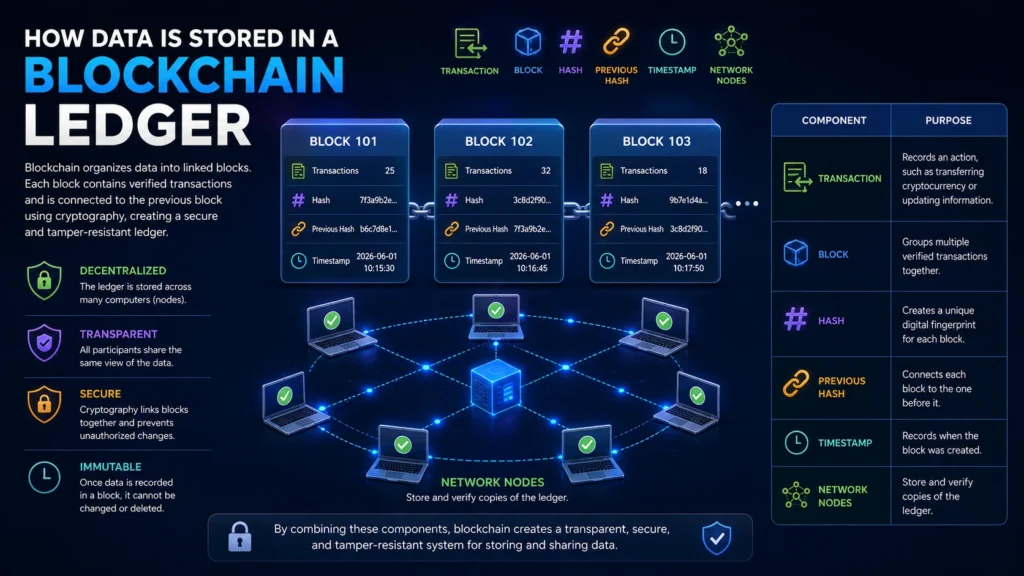
One of blockchain’s defining characteristics is the way it organizes and protects information. Instead of storing transactions as isolated entries in a central database, blockchain packages them into linked blocks that form a permanent historical record.
The following components work together to make this possible.
| Component | Purpose |
|---|---|
| Transaction | Records an action, such as transferring cryptocurrency or updating information. |
| Block | Groups multiple verified transactions together. |
| Hash | Creates a unique digital fingerprint for each block. |
| Previous Hash | Connects each block to the one before it. |
| Timestamp | Records when the block was created. |
| Network Nodes | Store and verify copies of the ledger. |
Together, these elements create a continuously growing chain of records that is synchronized across the network.
Transactions
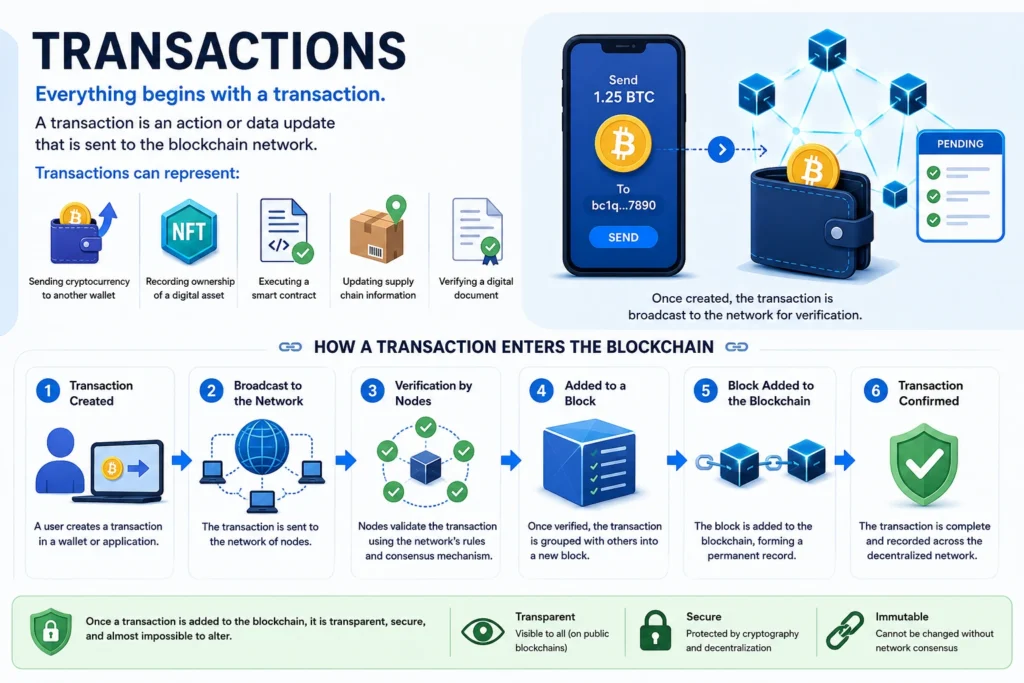
Everything begins with a transaction.
A transaction might represent:
- Sending cryptocurrency to another wallet
- Recording ownership of a digital asset
- Executing a smart contract
- Updating supply chain information
- Verifying a digital document
Before becoming part of the blockchain, the transaction must be validated according to the network’s rules.
Blocks
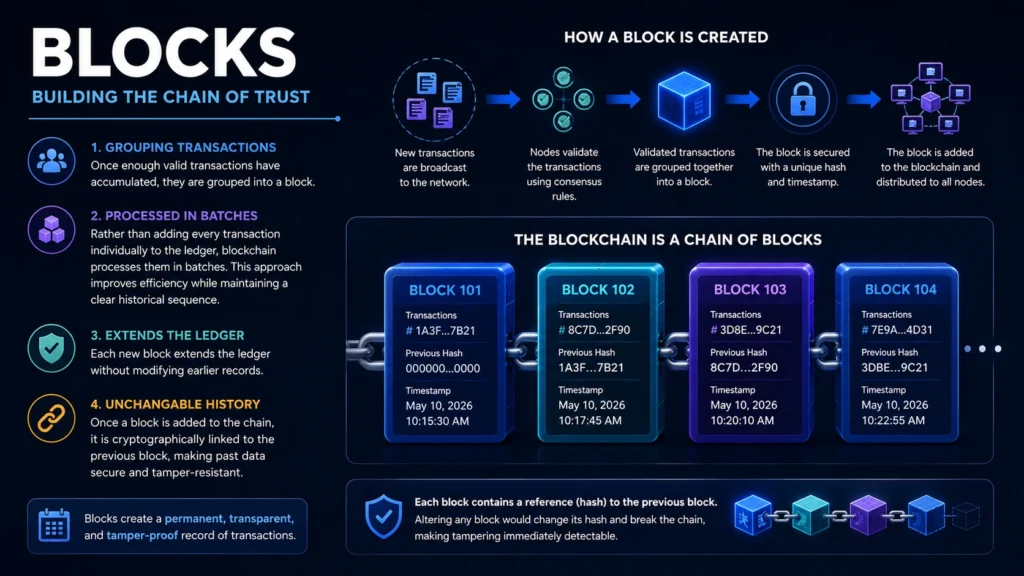
Once enough valid transactions have accumulated, they are grouped into a block.
Rather than adding every transaction individually to the ledger, blockchain processes them in batches. This approach improves efficiency while maintaining a clear historical sequence.
Each new block extends the ledger without modifying earlier records.
Cryptographic Hashes
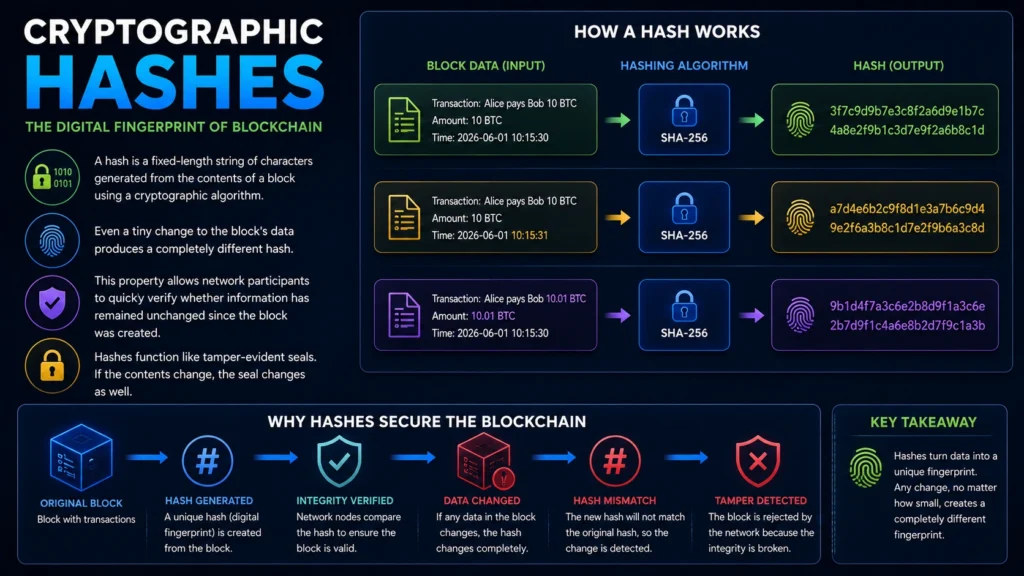
A hash is a fixed-length string of characters generated from the contents of a block using a cryptographic algorithm.
Even a tiny change to the block’s data produces a completely different hash.
This property allows network participants to quickly verify whether information has remained unchanged since the block was created.
Hashes function like tamper-evident seals. If the contents change, the seal changes as well.
Timestamps
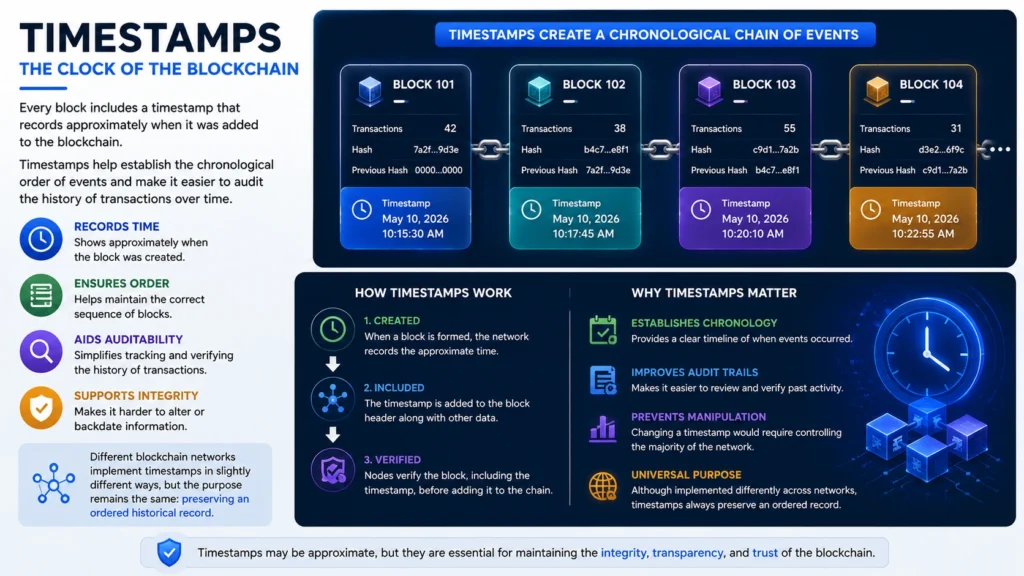
Every block includes a timestamp that records approximately when it was added to the blockchain.
Timestamps help establish the chronological order of events and make it easier to audit the history of transactions over time.
Although different blockchain networks implement timestamps in slightly different ways, they all serve the broader purpose of preserving an ordered historical record.
Public, Private, Consortium, and Hybrid Ledgers
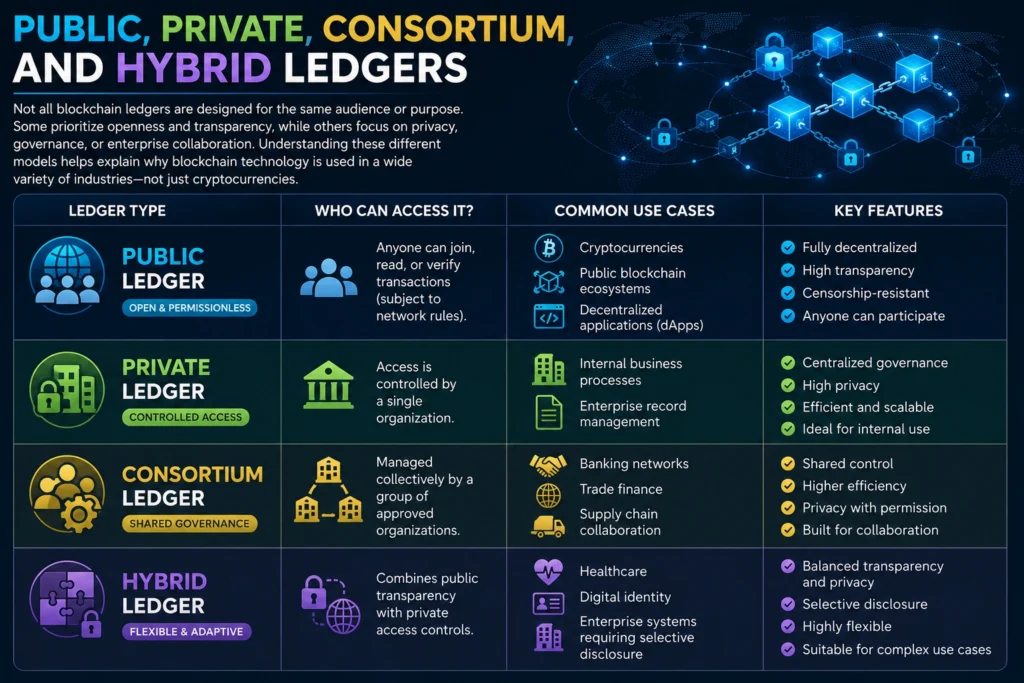
Not all blockchain ledgers are designed for the same audience or purpose. Some prioritize openness and transparency, while others focus on privacy, governance, or enterprise collaboration.
Understanding these different models helps explain why blockchain technology is used in a wide variety of industries—not just cryptocurrencies.
| Ledger Type | Who Can Access It? | Common Use Cases |
|---|---|---|
| Public Ledger | Anyone can join, read, or verify transactions (subject to network rules). | Cryptocurrencies, public blockchain ecosystems, decentralized applications |
| Private Ledger | Access is controlled by a single organization. | Internal business processes, enterprise record management |
| Consortium Ledger | Managed collectively by a group of approved organizations. | Banking networks, trade finance, supply chain collaboration |
| Hybrid Ledger | Combines public transparency with private access controls. | Healthcare, digital identity, enterprise systems requiring selective disclosure |
Each model involves different trade-offs between transparency, privacy, performance, and governance. Choosing the right type depends on the goals of the organization or network rather than one approach being universally better than another.
How Does a Blockchain Ledger Work Step by Step?
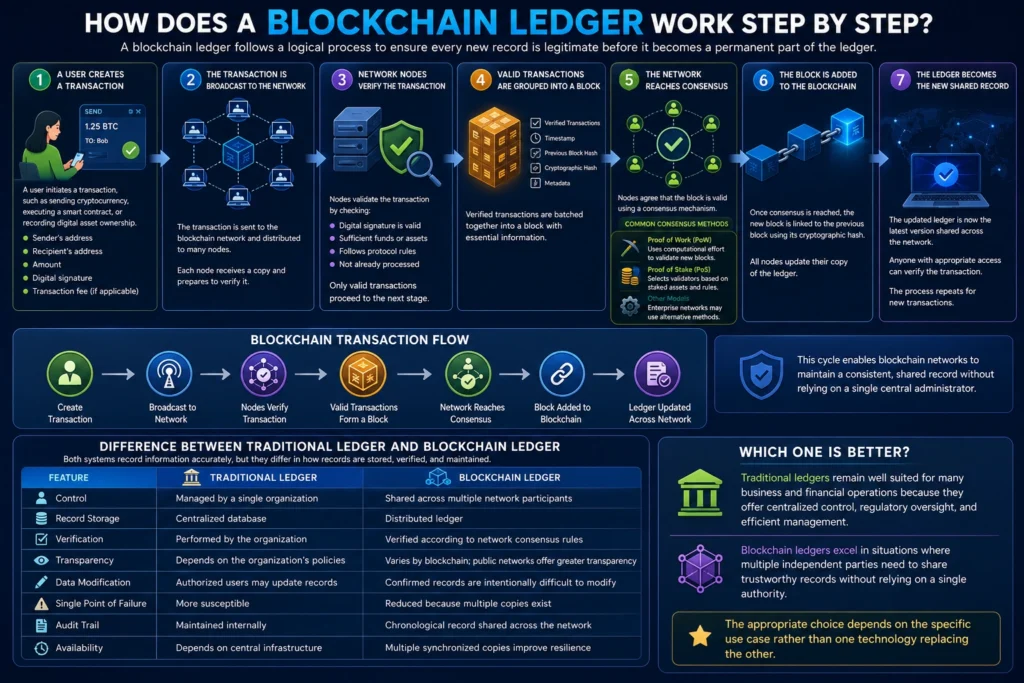
A blockchain ledger may seem complex at first, but its basic workflow follows a logical sequence. Every blockchain network has its own technical rules, yet most public blockchains follow the same core process for recording and verifying data.
The goal is simple: ensure that every new record is legitimate before it becomes a permanent part of the ledger.
Step 1: A User Creates a Transaction
Everything begins when someone initiates a transaction.
Depending on the blockchain, this could involve:
- Sending cryptocurrency to another wallet
- Recording ownership of a digital asset
- Executing a smart contract
- Registering supply chain information
- Updating a decentralized application (dApp)
For example, if Alice sends cryptocurrency to Bob, her wallet creates a digital transaction containing details such as:
- Sender’s address
- Recipient’s address
- Amount being transferred
- Digital signature
- Transaction fee (if applicable)
At this stage, the transaction has been created but is not yet part of the blockchain ledger.
Step 2: The Transaction Is Broadcast to the Network
The wallet sends the transaction to the blockchain network.
Instead of going to a central server, the transaction is distributed to many participating computers called nodes.
Each node receives a copy and prepares to verify whether the transaction follows the network’s rules.
This decentralized approach removes the need for a single authority to approve every transaction.
Step 3: Network Nodes Verify the Transaction
The network checks whether the transaction is valid.
Although verification methods vary between blockchains, nodes typically confirm that:
- The digital signature is valid.
- The sender has sufficient funds or assets.
- The transaction follows the protocol’s rules.
- The transaction has not already been processed.
Only valid transactions move to the next stage.
Invalid or fraudulent transactions are rejected.
Step 4: Valid Transactions Are Grouped into a Block
Verified transactions are collected into a new block.
Rather than adding transactions one by one, blockchain networks process them in batches.
A block generally contains:
- Verified transactions
- Timestamp
- Reference to the previous block
- Cryptographic hash
- Additional metadata required by the blockchain
Each block becomes another page in the blockchain’s permanent history.
Step 5: The Network Reaches Consensus
Before a block becomes part of the ledger, participating nodes must agree that it is valid.
This agreement process is called a consensus mechanism.
Different blockchain networks use different consensus methods, including:
| Consensus Method | General Purpose |
|---|---|
| Proof of Work (PoW) | Uses computational effort to validate new blocks. |
| Proof of Stake (PoS) | Selects validators based on network rules involving staked assets. |
| Other Consensus Models | Enterprise and private blockchains may use alternative methods suited to their governance models. |
The specific mechanism differs between networks, but the objective remains the same: ensure that only legitimate blocks are added to the ledger.
Step 6: The Block Is Added to the Blockchain
Once consensus is achieved, the new block is linked to the previous block using its cryptographic hash.
Because every block references the one before it, the blockchain grows as a continuous chronological chain.
Every participating node updates its copy of the ledger so that the network remains synchronized.
Step 7: The Ledger Becomes the New Shared Record
After the block is added, the updated ledger becomes the latest version shared across the network.
Anyone with appropriate access can verify that the transaction exists in the blockchain.
The process then repeats as new transactions are submitted.
Blockchain Transaction Flow
Create Transaction
        │
        ▼
Broadcast to Network
        │
        ▼
Nodes Verify Transaction
        │
        ▼
Valid Transactions Form a Block
        │
        ▼
Network Reaches Consensus
        │
        ▼
Block Added to Blockchain
        │
        ▼
Ledger Updated Across Network
This cycle enables blockchain networks to maintain a consistent, shared record without relying on a single central administrator.
Difference Between Traditional Ledger and Blockchain Ledger
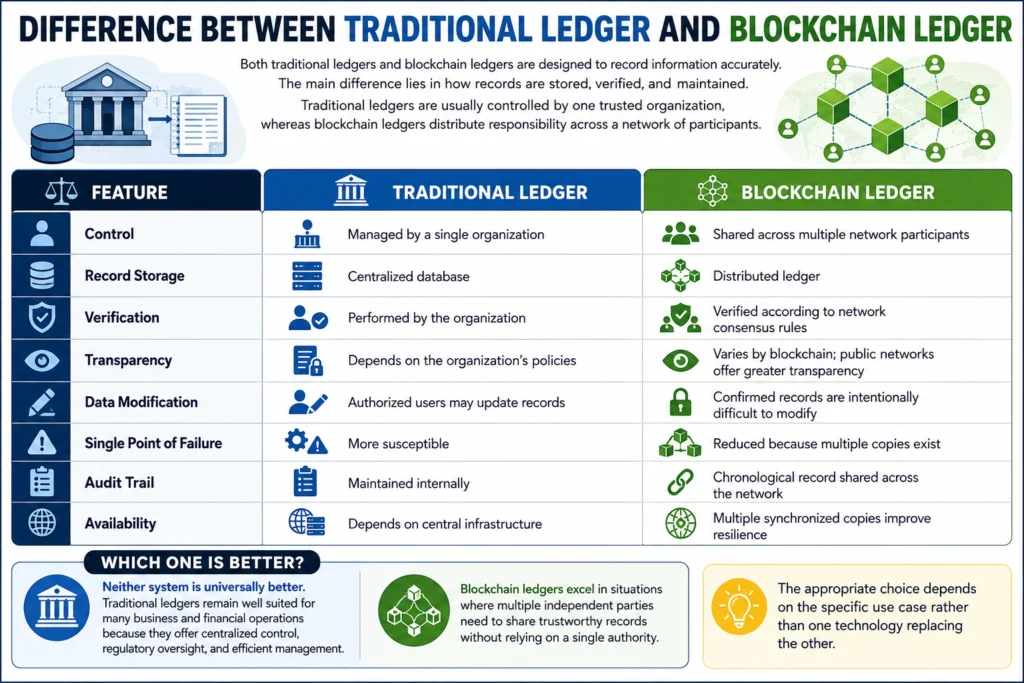
Both traditional ledgers and blockchain ledgers are designed to record information accurately. The main difference lies in how records are stored, verified, and maintained.
Traditional ledgers are usually controlled by one trusted organization, whereas blockchain ledgers distribute responsibility across a network of participants.
Comparison Table
| Feature | Traditional Ledger | Blockchain Ledger |
|---|---|---|
| Control | Managed by a single organization | Shared across multiple network participants |
| Record Storage | Centralized database | Distributed ledger |
| Verification | Performed by the organization | Verified according to network consensus rules |
| Transparency | Depends on the organization’s policies | Varies by blockchain; public networks offer greater transparency |
| Data Modification | Authorized users may update records | Confirmed records are intentionally difficult to modify |
| Single Point of Failure | More susceptible | Reduced because multiple copies exist |
| Audit Trail | Maintained internally | Chronological record shared across the network |
| Availability | Depends on central infrastructure | Multiple synchronized copies improve resilience |
Which One Is Better?
Neither system is universally better.
Traditional ledgers remain well suited for many business and financial operations because they offer centralized control, regulatory oversight, and efficient management.
Blockchain ledgers excel in situations where multiple independent parties need to share trustworthy records without relying on a single authority.
The appropriate choice depends on the specific use case rather than one technology replacing the other.
Why Is a Blockchain Ledger Immutable?
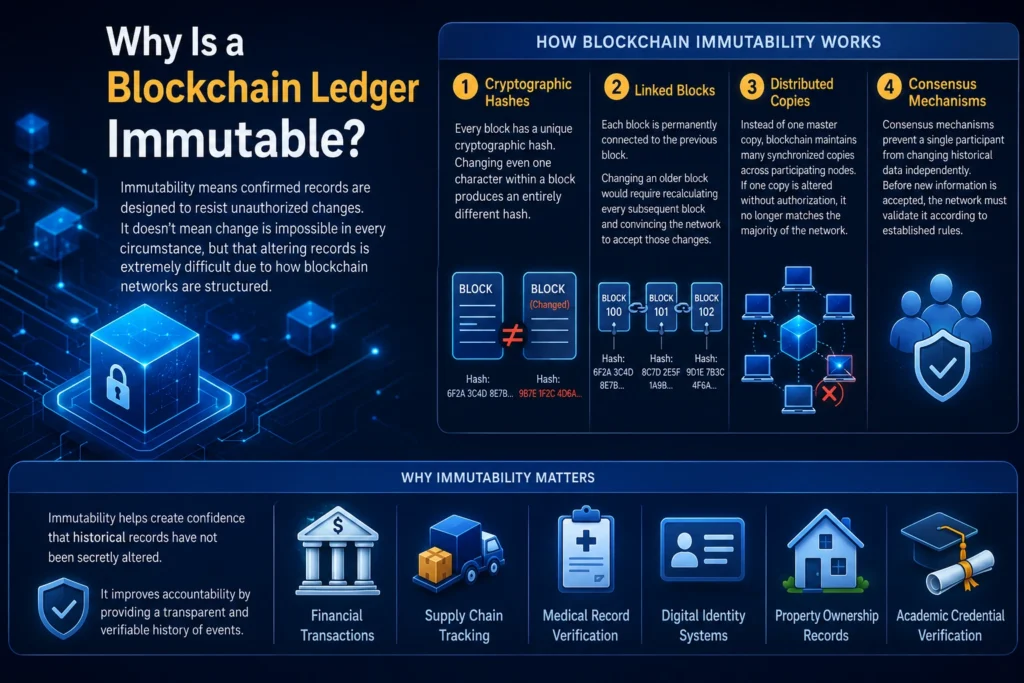
One of blockchain’s defining characteristics is immutability, meaning that confirmed records are intentionally designed to resist unauthorized changes.
However, “immutable” does not mean impossible to change under every circumstance. Instead, it means that altering confirmed records is extremely difficult because of the way blockchain networks are structured.
Several mechanisms work together to protect the ledger.
1. Cryptographic Hashes
Every block has a unique cryptographic hash.
Changing even one character within a block produces an entirely different hash.
Because each block contains the previous block’s hash, altering one block breaks the chain that follows.
2. Linked Blocks
Each block is permanently connected to the previous block.
Changing an older block would require recalculating every subsequent block and convincing the network to accept those changes.
On large, well-established public blockchains, this is generally considered computationally impractical under normal operating conditions.
3. Distributed Copies
Instead of one master copy, blockchain maintains many synchronized copies across participating nodes.
If one copy is altered without authorization, it no longer matches the majority of the network.
Consensus rules help reject inconsistent records.
4. Consensus Mechanisms
Consensus mechanisms prevent a single participant from changing historical data independently.
Before new information is accepted, the network must validate it according to established rules.
This collective verification strengthens the integrity of the ledger.
Why Immutability Matters
Immutability helps create confidence that historical records have not been secretly altered.
This property is valuable for:
- Financial transactions
- Supply chain tracking
- Medical record verification
- Digital identity systems
- Property ownership records
- Academic credential verification
It improves accountability by providing a transparent and verifiable history of events.
Types of Blockchain Ledgers Explained
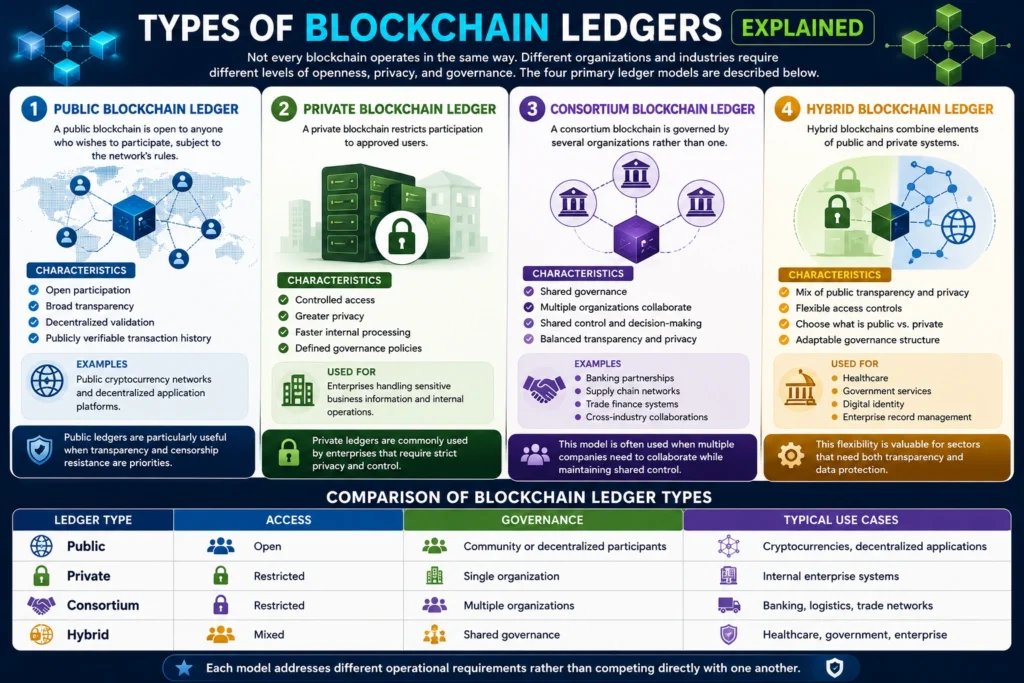
Not every blockchain operates in the same way. Different organizations and industries require different levels of openness, privacy, and governance.
The four primary ledger models are described below.
1. Public Blockchain Ledger
A public blockchain is open to anyone who wishes to participate, subject to the network’s rules.
Characteristics include:
- Open participation
- Broad transparency
- Decentralized validation
- Publicly verifiable transaction history
Examples include public cryptocurrency networks and decentralized application platforms.
Public ledgers are particularly useful when transparency and censorship resistance are priorities.
2. Private Blockchain Ledger
A private blockchain restricts participation to approved users.
Typically managed by one organization, it offers:
- Controlled access
- Greater privacy
- Faster internal processing
- Defined governance policies
Private ledgers are commonly used by enterprises handling sensitive business information.
3. Consortium Blockchain Ledger
A consortium blockchain is governed by several organizations rather than one.
This model is often used when multiple companies need to collaborate while maintaining shared control.
Examples include:
- Banking partnerships
- Supply chain networks
- Trade finance systems
- Cross-industry collaborations
4. Hybrid Blockchain Ledger
Hybrid blockchains combine elements of public and private systems.
Organizations can choose which information remains private and which data is made publicly verifiable.
This flexibility is valuable for sectors such as:
- Healthcare
- Government services
- Digital identity
- Enterprise record management
Comparison of Blockchain Ledger Types
| Ledger Type | Access | Governance | Typical Use Cases |
|---|---|---|---|
| Public | Open | Community or decentralized participants | Cryptocurrencies, decentralized applications |
| Private | Restricted | Single organization | Internal enterprise systems |
| Consortium | Restricted | Multiple organizations | Banking, logistics, trade networks |
| Hybrid | Mixed | Shared governance | Healthcare, government, enterprise |
Each model addresses different operational requirements rather than competing directly with one another.
Key Features of a Decentralized Blockchain Ledger
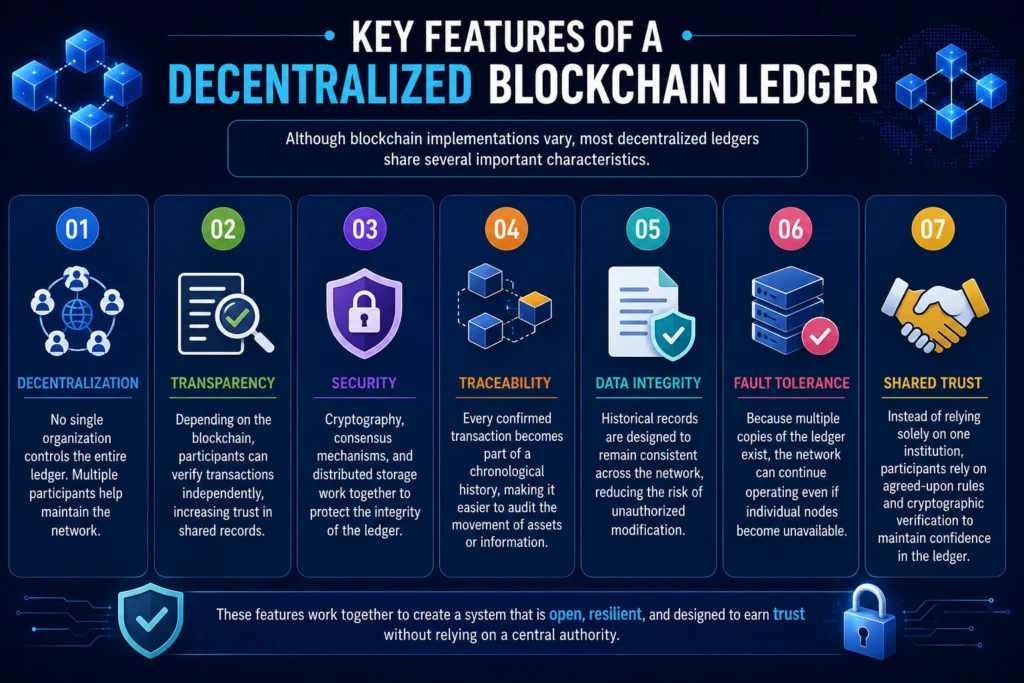
Although blockchain implementations vary, most decentralized ledgers share several important characteristics.
Decentralization
No single organization controls the entire ledger. Multiple participants help maintain the network.
Transparency
Depending on the blockchain, participants can verify transactions independently, increasing trust in shared records.
Security
Cryptography, consensus mechanisms, and distributed storage work together to protect the integrity of the ledger.
Traceability
Every confirmed transaction becomes part of a chronological history, making it easier to audit the movement of assets or information.
Data Integrity
Historical records are designed to remain consistent across the network, reducing the risk of unauthorized modification.
Fault Tolerance
Because multiple copies of the ledger exist, the network can continue operating even if individual nodes become unavailable.
Shared Trust
Instead of relying solely on one institution, participants rely on agreed-upon rules and cryptographic verification to maintain confidence in the ledger.
Real-World Example: Tracking a Coffee Bean’s Journey
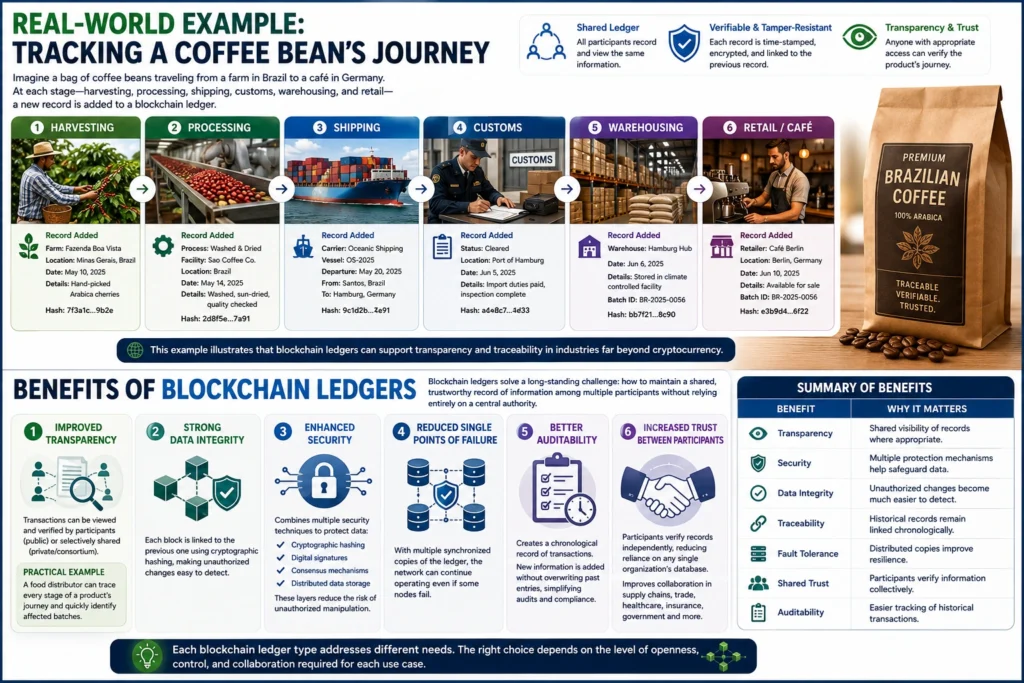
Imagine a bag of coffee beans traveling from a farm in Brazil to a café in Germany.
At each stage—harvesting, processing, shipping, customs, warehousing, and retail—a new record is added to a blockchain ledger.
Because every participant shares the same ledger, anyone with the appropriate access can verify the product’s journey without depending on a single company to maintain all the records.
This example illustrates that blockchain ledgers can support transparency and traceability in industries far beyond cryptocurrency.
Benefits of Blockchain Ledgers
Blockchain ledgers were designed to solve a long-standing challenge: how to maintain a shared, trustworthy record of information among multiple participants without relying entirely on a central authority. While blockchain is not the right solution for every situation, it offers several meaningful advantages in the right context.
1. Improved Transparency
On public blockchain networks, confirmed transactions can typically be viewed and verified by anyone. This transparency helps participants independently confirm that records exist without needing to trust a single organization.
For businesses using private or consortium blockchains, transparency can be selectively shared with authorized participants while protecting sensitive information.
Practical Example
A food distributor can record every stage of a product’s journey—from the farm to the supermarket. If a quality issue arises, the company can trace the affected batch more efficiently than with paper records or disconnected databases.
2. Strong Data Integrity
Each confirmed block is linked to the previous one through cryptographic hashing. This structure makes unauthorized changes much easier to detect.
Instead of relying on one administrator to protect records, blockchain distributes verification across multiple participants following agreed network rules.
3. Enhanced Security
Blockchain combines several security techniques rather than relying on a single protective measure.
These include:
- Cryptographic hashing
- Digital signatures
- Consensus mechanisms
- Distributed data storage
Together, these layers reduce the likelihood of unauthorized record manipulation.
It is important to remember that blockchain itself can be highly secure, but applications built on top of it—such as wallets or exchanges—may still face cybersecurity risks if not managed properly.
4. Reduced Single Points of Failure
Traditional databases often rely on centralized servers.
If that central infrastructure experiences technical issues, cyberattacks, or hardware failures, services may be disrupted.
Because blockchain maintains multiple synchronized copies of the ledger, the network can often continue operating even if some nodes become unavailable.
5. Better Auditability
Blockchain creates a chronological record of transactions.
Rather than overwriting previous entries, new information is added to the ledger while preserving historical records.
This characteristic can simplify auditing in industries where maintaining an accurate history is essential.
6. Increased Trust Between Participants
In many business relationships, organizations may not fully trust one another.
A shared blockchain ledger allows each participant to verify records independently instead of relying solely on one company’s internal database.
This can improve collaboration in areas such as:
- Supply chains
- International trade
- Healthcare
- Insurance
- Government record management
Summary of Benefits
| Benefit | Why It Matters |
|---|---|
| Transparency | Shared visibility of records where appropriate |
| Security | Multiple protection mechanisms help safeguard data |
| Data Integrity | Unauthorized changes become much easier to detect |
| Traceability | Historical records remain linked chronologically |
| Fault Tolerance | Distributed copies improve resilience |
| Shared Trust | Participants verify information collectively |
| Auditability | Easier tracking of historical transactions |
Risks and Limitations of Blockchain Ledgers
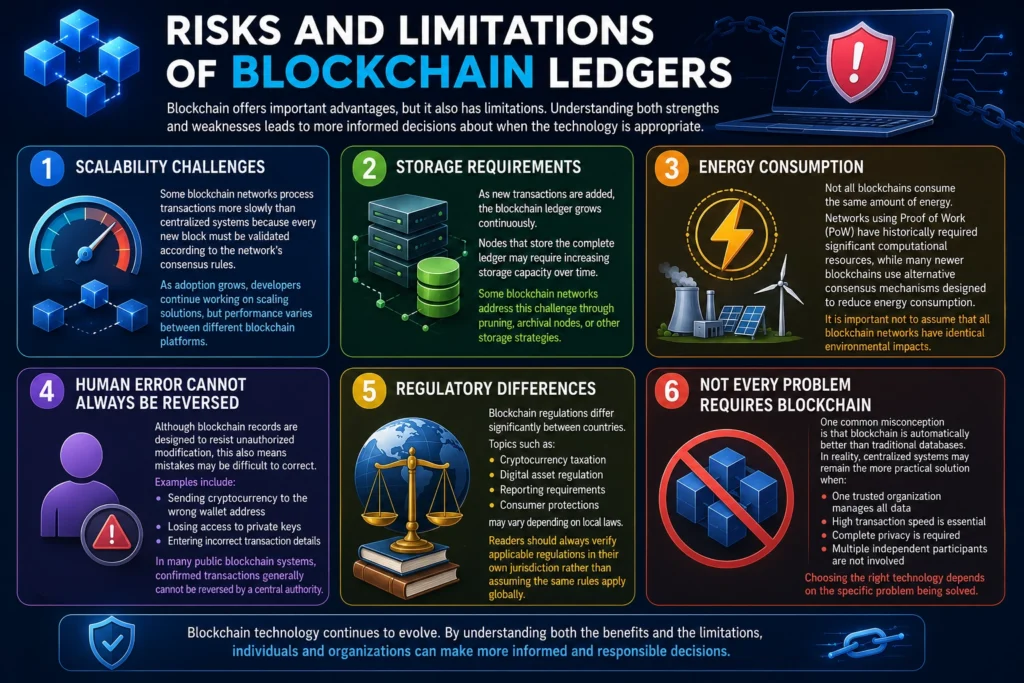
Blockchain offers important advantages, but it also has limitations. Understanding both strengths and weaknesses leads to more informed decisions about when the technology is appropriate.
1. Scalability Challenges
Some blockchain networks process transactions more slowly than centralized systems because every new block must be validated according to the network’s consensus rules.
As adoption grows, developers continue working on scaling solutions, but performance varies between different blockchain platforms.
2. Storage Requirements
As new transactions are added, the blockchain ledger grows continuously.
Nodes that store the complete ledger may require increasing storage capacity over time.
Some blockchain networks address this challenge through pruning, archival nodes, or other storage strategies.
3. Energy Consumption
Not all blockchains consume the same amount of energy.
Networks using Proof of Work (PoW) have historically required significant computational resources, while many newer blockchains use alternative consensus mechanisms designed to reduce energy consumption.
It is important not to assume that all blockchain networks have identical environmental impacts.
4. Human Error Cannot Always Be Reversed
Although blockchain records are designed to resist unauthorized modification, this also means mistakes may be difficult to correct.
Examples include:
- Sending cryptocurrency to the wrong wallet address
- Losing access to private keys
- Entering incorrect transaction details
In many public blockchain systems, confirmed transactions generally cannot be reversed by a central authority.
5. Regulatory Differences
Blockchain regulations differ significantly between countries.
Topics such as:
- Cryptocurrency taxation
- Digital asset regulation
- Reporting requirements
- Consumer protections
may vary depending on local laws.
Readers should always verify applicable regulations in their own jurisdiction rather than assuming the same rules apply globally.
6. Not Every Problem Requires Blockchain
One common misconception is that blockchain is automatically better than traditional databases.
In reality, centralized systems may remain the more practical solution when:
- One trusted organization manages all data
- High transaction speed is essential
- Complete privacy is required
- Multiple independent participants are not involved
Choosing the right technology depends on the specific problem being solved.
Market Context
Blockchain technology continues to evolve beyond its early association with cryptocurrencies.
Today, organizations are exploring distributed ledger technology for applications such as:
- Cross-border payments
- Supply chain management
- Digital identity
- Asset tokenization
- Healthcare record management
- Trade finance
- Government services
At the same time, adoption varies across industries, and many projects remain in experimental or pilot stages.
The long-term role of blockchain will likely depend on technological progress, regulatory developments, and whether it offers clear advantages over existing systems for particular use cases.
Because this field changes rapidly, readers should consult official documentation and reputable industry sources for the latest developments.
Practical Applications of Blockchain Ledgers

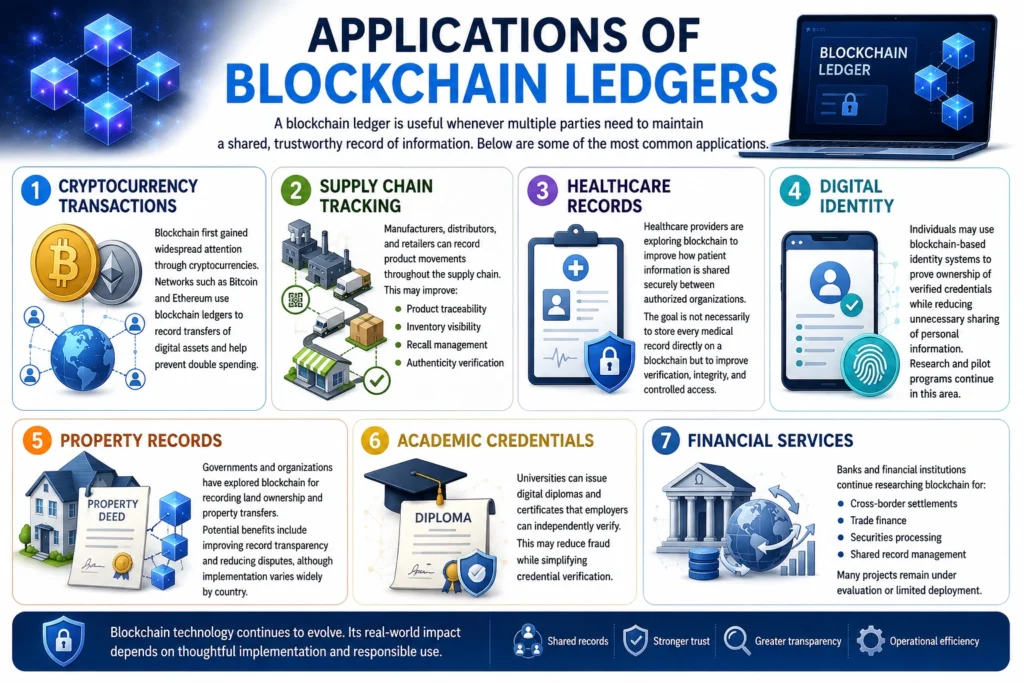
A blockchain ledger is useful whenever multiple parties need to maintain a shared, trustworthy record of information.
Below are some of the most common applications.
Cryptocurrency Transactions
Blockchain first gained widespread attention through cryptocurrencies.
Networks such as Bitcoin and Ethereum use blockchain ledgers to record transfers of digital assets and help prevent double spending.
Supply Chain Tracking
Manufacturers, distributors, and retailers can record product movements throughout the supply chain.
This may improve:
- Product traceability
- Inventory visibility
- Recall management
- Authenticity verification
Healthcare Records
Healthcare providers are exploring blockchain to improve how patient information is shared securely between authorized organizations.
The goal is not necessarily to store every medical record directly on a blockchain but to improve verification, integrity, and controlled access.
Digital Identity
Individuals may use blockchain-based identity systems to prove ownership of verified credentials while reducing unnecessary sharing of personal information.
Research and pilot programs continue in this area.
Property Records
Governments and organizations have explored blockchain for recording land ownership and property transfers.
Potential benefits include improving record transparency and reducing disputes, although implementation varies widely by country.
Academic Credentials
Universities can issue digital diplomas and certificates that employers can independently verify.
This may reduce fraud while simplifying credential verification.
Financial Services
Banks and financial institutions continue researching blockchain for:
- Cross-border settlements
- Trade finance
- Securities processing
- Shared record management
Many projects remain under evaluation or limited deployment.
Common Mistakes Beginners Make
Learning blockchain can be challenging, and many newcomers misunderstand how the technology works.
Avoiding these common mistakes can save time and reduce confusion.
Assuming Blockchain and Bitcoin Are the Same Thing
Bitcoin uses blockchain technology, but blockchain has many applications beyond cryptocurrency.
Believing All Blockchains Are Public
Some blockchains are open to everyone, while others restrict participation to approved users.
Understanding the difference between public and private networks is important.
Thinking Blockchain Is Completely Anonymous
Many public blockchains are better described as pseudonymous rather than anonymous.
Wallet addresses are visible on the blockchain even if they are not directly linked to real-world identities.
Assuming Transactions Are Instant
A transaction is usually considered complete only after sufficient network confirmation according to the blockchain’s rules.
Confirmation times differ between blockchain networks.
Ignoring Transaction Fees
Many blockchain networks charge fees to process transactions.
These fees can vary depending on network activity.
Believing Blockchain Is Impossible to Attack
Well-established blockchain networks are designed to be highly secure, but no technology is completely risk-free.
Applications, exchanges, wallets, and user behavior can still introduce vulnerabilities.
Practical Tips for Beginners
If you are new to blockchain technology, these practices can help you build a stronger understanding.
- Start by learning the basic concepts before exploring advanced topics.
- Understand the difference between blockchain, cryptocurrency, and distributed ledger technology.
- Learn how digital wallets work before sending digital assets.
- Verify wallet addresses carefully before confirming transactions.
- Read official documentation when researching blockchain projects.
- Stay informed about developments in your country’s regulations.
- Treat blockchain as a technology with multiple applications rather than focusing only on cryptocurrency prices.
Security Best Practices
Although blockchain networks can be highly secure, users still play a critical role in protecting their digital assets and information.
Protect Your Private Keys
Private keys control access to blockchain assets.
Never share them with anyone.
Store them securely using trusted methods.
Enable Two-Factor Authentication (2FA)
Whenever supported by wallets or exchanges, enable 2FA to add another layer of account protection.
Use Strong, Unique Passwords
Avoid reusing passwords across multiple services.
A password manager can help generate and store secure credentials.
Beware of Phishing Scams
Fraudsters often imitate trusted companies or wallet providers.
Always verify website addresses before entering sensitive information.
Keep Software Updated
Use the latest versions of:
- Wallet software
- Operating systems
- Security applications
Updates frequently include important security improvements.
Verify Transactions Carefully
Before confirming any blockchain transaction, double-check:
- Wallet address
- Amount
- Network
- Transaction fee
Taking a few extra seconds can help prevent costly mistakes.
Educational Reminder
Blockchain technology can improve data integrity and transparency, but safe usage also depends on informed user behavior. Good security habits remain essential regardless of which blockchain or wallet you use.
Frequently Asked Questions
1. What is a blockchain ledger in simple words?
A blockchain ledger is a digital record book shared across multiple computers. Instead of being controlled by one organization, every participating computer maintains a synchronized copy of the ledger. New information is verified before being permanently added, helping improve transparency and data integrity.
2. What is a distributed ledger in blockchain?
A distributed ledger is a database that is shared across multiple computers or organizations rather than stored on a single central server. Blockchain is one type of distributed ledger technology (DLT), but not all distributed ledgers use a blockchain structure.
3. How does a blockchain ledger work?
A blockchain ledger follows a series of steps:
A transaction is created.
The transaction is broadcast to the network.
Network nodes verify it.
Valid transactions are grouped into a block.
The network reaches consensus.
The new block is linked to the previous block.
Every participating node updates its copy of the ledger.
4. Why is a blockchain ledger considered immutable?
Blockchain ledgers are designed to resist unauthorized changes because each block is connected to the previous one using cryptographic hashes. Altering confirmed records would typically require changing multiple linked blocks and overcoming the network’s consensus process, making unauthorized modification extremely difficult.
5. What information is stored in a blockchain ledger?
Depending on the blockchain, a ledger may store:
1. Transaction records
2. Wallet addresses
3. Digital signatures
4. Smart contract data
5. Timestamps
6. Block hashes
References to previous blocks
Some applications store only verification data on the blockchain while keeping larger files elsewhere.
6. Is every blockchain ledger public?
No.
Blockchain ledgers can be:
Public
Private
Consortium
Hybrid
Each model is designed for different business and technical requirements.
7. What is the difference between a blockchain ledger and a traditional database?
A traditional database is usually controlled by one organization that can update records according to its policies.
A blockchain ledger distributes copies across multiple participants and validates new records using network consensus rules before they become part of the shared history.
8. Can blockchain records be deleted?
Generally, confirmed records on public blockchain networks are not designed to be deleted or modified.
If an error occurs, a new transaction is usually recorded to correct the history rather than removing the original entry.
The exact behavior depends on the blockchain’s design and governance.
9. Does blockchain only store cryptocurrency transactions?
No.
Blockchain can also record:
Supply chain events
Digital identities
Academic credentials
Property records
Smart contracts
Healthcare verification
Business agreements
Cryptocurrency is only one application of blockchain technology.
10. Is blockchain completely secure?
Blockchain uses advanced cryptographic techniques and distributed verification, making it highly resilient against many forms of tampering.
However, users must still protect their wallets, private keys, passwords, and accounts. Many security incidents result from phishing attacks, stolen credentials, or poor security practices rather than weaknesses in the blockchain itself.
What Is Blockchain Technology?
How Does a Blockchain Transaction Work?
What Is a Blockchain Ledger? Beginner’s Complete Guide
Best ChatGPT Prompts for Students
Written by StormNex Editorial Team
The StormNex Editorial Team publishes in-depth educational guides on blockchain, cryptocurrency, artificial intelligence, and emerging technologies. Every guide is carefully researched to make complex topics easier to understand for beginners and professionals alike.
1 thought on “What Is a Blockchain Ledger? Beginner’s Complete Guide”